

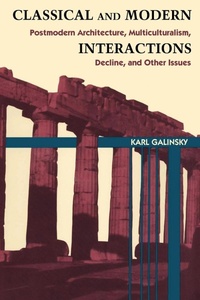
Classical and Modern Interactions
Postmodern Architecture, Multiculturalism, Decline, and Other Issues
Published on 27. February 2013
Book
Paperback/Softback
204 pages
978-0-292-75398-3 (ISBN)
Description
Postmodernism, multiculturalism, the alleged decline of the United States, deconstruction, leadership, and values-these topics have been at the forefront of contemporary intellectual and cultural debate and are likely to remain so for the near future. Participants in the debate can usefully enlarge the perspective to a comparison between the Greco-Roman world and contemporary society. In this thought-provoking work, a noted classics scholar tests the ancient-modern comparison, showing what it can add to the contemporary debates and what its limitations are.
Writing for intellectually adventurous readers, Galinsky explores Greece and Rome as multicultural societies, debates the merits of classicism in postmodern architecture, discusses the reign of Augustus in terms of modern leadership theories, and investigates the modern obsession with finding parallels between the supposed "decline and fall" of Rome and the "decay" of U.S. society.
Within these discussions, Galinsky shows the continuing vitality of the classical tradition in the contemporary world. The Greek and Roman civilizations have provided us not only with models for conscious adaptation but also points for radical departures. This ability to change and innovate from classical models is crucial, Galinsky maintains. It creates a reciprocal process whereby contemporary issues are projected into the past while aspects of the ancient world are redefined in terms of current approaches.
These essays result in a balanced assessment and stimulating restatement of some major issues in both contemporary U.S. society and the Greco-Roman world. The book, which speaks to a wide interdisciplinary audience, is based on a series of lectures that Galinsky gave as a national visiting scholar for Phi Beta Kappa. It concludes with a discussion of the role of classical studies in the United States today.
Writing for intellectually adventurous readers, Galinsky explores Greece and Rome as multicultural societies, debates the merits of classicism in postmodern architecture, discusses the reign of Augustus in terms of modern leadership theories, and investigates the modern obsession with finding parallels between the supposed "decline and fall" of Rome and the "decay" of U.S. society.
Within these discussions, Galinsky shows the continuing vitality of the classical tradition in the contemporary world. The Greek and Roman civilizations have provided us not only with models for conscious adaptation but also points for radical departures. This ability to change and innovate from classical models is crucial, Galinsky maintains. It creates a reciprocal process whereby contemporary issues are projected into the past while aspects of the ancient world are redefined in terms of current approaches.
These essays result in a balanced assessment and stimulating restatement of some major issues in both contemporary U.S. society and the Greco-Roman world. The book, which speaks to a wide interdisciplinary audience, is based on a series of lectures that Galinsky gave as a national visiting scholar for Phi Beta Kappa. It concludes with a discussion of the role of classical studies in the United States today.
Reviews / Votes
. . . a set of provocative and entertaining essays on the interplay of ancient and modern and the way in which postmodern architecture, multiculturalism, the Aeneid of Virgil, and the fall of the Roman Empire can illuminate one another and the state of the modern world and of contemporary America . . . . Galinsky's lively and provocative essays open up very interesting lines of thought, and their reasoned opposition to 'cultural tribalism ' is timely . . . (New York Review of Books)More details
Language
English
Place of publication
Austin, TX
United States
Target group
Professional and scholarly
Dimensions
Height: 229 mm
Width: 152 mm
Thickness: 12 mm
Weight
343 gr
ISBN-13
978-0-292-75398-3 (9780292753983)
Copyright in bibliographic data and cover images is held by Nielsen Book Services Limited or by the publishers or by their respective licensors: all rights reserved.
Schweitzer Classification
Person
Karl Galinsky is Floyd A. Cailloux Centennial Professor of Classics at the University of Texas at Austin.
Content
Preface
I. Classicism in Postmodern American Architecture
Classicism and Modernism
Three Pioneering Examples
The Conceptual Framework
Domestic Architecture
Commercial Buildings
Campus Architecture
Large Public Buildings
Some Implications
Short Bibliography and Suggestions for Further Reading
II. The Decline and Fall of the Roman Empire: Are There Modern Parallels?
Some General Definitions and Perspectives
"Decadence"
Single-Cause Explanations
The Explanations of the Intellectual Historians
"Immoderate Greatness" and "Imperial Overstretch"
America and Rome: Some Comparisons
Short Bibliography and Suggestions for Further Reading
Appendix: 210 Reasons for Rome's Fall
III. Reading Vergil's Aeneid in Modern Times
"Modern" and "Historical" Interpretation
Some Points of Convergence and Divergence
Aeneas and Modern Concepts of Masculinity
Social Responsibility: Vergil, Aeneas, and Vaclav Havel
Distrust of Rhetoric in the Aeneid and Today
Internal Heroism and Strong Emotions
Short Bibliography and Suggestions for Further Reading
IV. Leadership, Values, and the Question of Ideology: The Reign of Augustus
Some Views of Augustus
Leadership: The Moral Dimension
"Ideology" versus Pragmatism with an Ethos
Tradition and Innovation
The Moral Culture: Architecture and Art
Conclusion
Short Bibliography and Suggestions for Further Reading
V. Multiculturalism in Greece and Rome
Some Definitions
Greece before Alexander
Alexander the Great and the Hellenistic Period
Rome
Multiculturalism Then and Now
Selected Bibliography and Suggestions for Further Reading
VI. Rome, America, and the Classics in America Today
America and Rome
The Role of the Classics in America Today: Some Observations
Life beyond Academe
Classics in Its Academic Setting
Two Current Issues: Elitism and the Importance of Theory
Short Bibliography and Suggestions for Further Reading
Notes
Index
I. Classicism in Postmodern American Architecture
Classicism and Modernism
Three Pioneering Examples
The Conceptual Framework
Domestic Architecture
Commercial Buildings
Campus Architecture
Large Public Buildings
Some Implications
Short Bibliography and Suggestions for Further Reading
II. The Decline and Fall of the Roman Empire: Are There Modern Parallels?
Some General Definitions and Perspectives
"Decadence"
Single-Cause Explanations
The Explanations of the Intellectual Historians
"Immoderate Greatness" and "Imperial Overstretch"
America and Rome: Some Comparisons
Short Bibliography and Suggestions for Further Reading
Appendix: 210 Reasons for Rome's Fall
III. Reading Vergil's Aeneid in Modern Times
"Modern" and "Historical" Interpretation
Some Points of Convergence and Divergence
Aeneas and Modern Concepts of Masculinity
Social Responsibility: Vergil, Aeneas, and Vaclav Havel
Distrust of Rhetoric in the Aeneid and Today
Internal Heroism and Strong Emotions
Short Bibliography and Suggestions for Further Reading
IV. Leadership, Values, and the Question of Ideology: The Reign of Augustus
Some Views of Augustus
Leadership: The Moral Dimension
"Ideology" versus Pragmatism with an Ethos
Tradition and Innovation
The Moral Culture: Architecture and Art
Conclusion
Short Bibliography and Suggestions for Further Reading
V. Multiculturalism in Greece and Rome
Some Definitions
Greece before Alexander
Alexander the Great and the Hellenistic Period
Rome
Multiculturalism Then and Now
Selected Bibliography and Suggestions for Further Reading
VI. Rome, America, and the Classics in America Today
America and Rome
The Role of the Classics in America Today: Some Observations
Life beyond Academe
Classics in Its Academic Setting
Two Current Issues: Elitism and the Importance of Theory
Short Bibliography and Suggestions for Further Reading
Notes
Index