

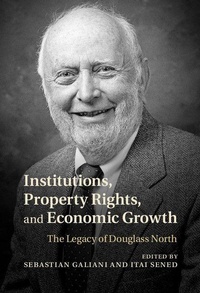
Institutions, Property Rights, and Economic Growth
The Legacy of Douglass North
Published on 17. April 2014
Book
Hardback
338 pages
978-1-107-04155-4 (ISBN)
Description
This volume showcases the impact of the work of Douglass North, winner of the Nobel Prize and father of the field of new institutional economics. Leading scholars contribute to a substantive discussion that best illustrates the broad reach and depth of Professor North's work. The volume speaks concisely about his legacy across multiple social sciences disciplines, specifically on scholarship pertaining to the understanding of property rights, the institutions that support the system of property rights, and economic growth.
More details
Language
English
Place of publication
Cambridge
United Kingdom
Target group
Professional and scholarly
Illustrations
13 Tables, unspecified; 1 Halftones, unspecified; 1 Halftones, black and white; 18 Line drawings, black and white
Dimensions
Height: 235 mm
Width: 157 mm
Thickness: 24 mm
Weight
700 gr
ISBN-13
978-1-107-04155-4 (9781107041554)
Copyright in bibliographic data and cover images is held by Nielsen Book Services Limited or by the publishers or by their respective licensors: all rights reserved.
Schweitzer Classification
Other editions
Additional editions
Sebastian Galiani | Itai Sened
Institutions, Property Rights, and Economic Growth
The Legacy of Douglass North
Book
05/2019
Cambridge University Press
€44.00
Shipment within 15-20 days
E-Book
04/2014
Cambridge University Press
€23.49
Available for download
Sebastian Galiani | Itai Sened
Institutions, Property Rights, and Economic Growth
The Legacy of Douglass North
E-Book
04/2014
1st Edition
Cambridge University Press
€27.99
Available for download
Persons
Sebastian Galiani is Professor of Economics at the University of Maryland. He is a Fellow of the National Bureau for Economic Research and the Bureau for Research and Economic Analysis of Development and a member of the executive committee of J-PAL at the Massachusetts Institute of Technology. He is also Associate Editor of the Journal of Development Economics. He has published numerous papers in leading academic journals, including the Journal of Political Economy, Quarterly Journal of Economics, American Economic Journal, Review of Economics and Statistics, Journal of Public Economics, Journal of Development Economics, Journal of Public Economic Theory, Economic Inquiry, and Labour Economics. Professor Galiani received his PhD from Oxford University. Itai Sened is Professor of Political Science at Washington University in St Louis. He has authored or co-authored several books, including The Political Institution of Private Property (Cambridge University Press, 1997), Political Bargaining: Theory, Practice and Process (with Gideon Doron, 2001), and Multiparty Democracy (with Norman Schofield, Cambridge University Press, 2006). He has also published numerous articles in leading journals, including The American Political Science Review, The American Journal of Political Science, The Journal of Politics, The British Journal of Political Science, the European Journal for Political Research, and the Journal of Theoretical Politics. He received his PhD from the University of Rochester.
Content
1. Introduction Itai Sened and Sebastian Galiani; 2. The contribution of Douglass North to new institutional economics Claude Menard and Mary M. Shirley; 3. Persistence and change in institutions: the evolution of Douglass North John Joseph Wallis; 4. The new institutionalism Robert Bates; 5. 'The rules of the game': what rules? Which game? Kenneth A. Shepsle; 6. Institutions and sustainability of ecological systems Elinor Ostrom; 7. Land property rights Sebastian Galiani and Ernesto Schargrodsky; 8. Endogenous institutions: law as a coordinating device Gillian K. Hadfield and Barry R. Weingast; 9. Culture, institutions, and modern growth Joel Mokyr; 10. What really happened during the Glorious Revolution? Steven C. A. Pincus and James A. Robinson; 11. The grand experiment that wasn't? New institutional economics and the postcommunist experience Scott Gehlbach and Edmund J. Malesky; 12. Using economic experiments to measure informal institutions Pamela Jakiela; 13. Experimental evidence on the workings of democratic institutions Pedro Dal Bo.