

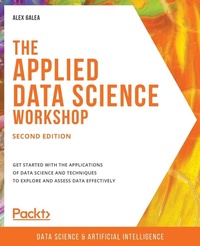
The Applied Data Science Workshop
Get started with the applications of data science and techniques to explore and assess data effectively
2nd Edition
Published on 22. July 2020
Book
Paperback/Softback
352 pages
978-1-80020-250-4 (ISBN)
Description
Designed with beginners in mind, this workshop helps you make the most of Python libraries and the Jupyter Notebook's functionality to understand how data science can be applied to solve real-world data problems.
Key Features
Gain useful insights into data science and machine learning
Explore the different functionalities and features of a Jupyter Notebook
Discover how Python libraries are used with Jupyter for data analysis
Book DescriptionFrom banking and manufacturing through to education and entertainment, using data science for business has revolutionized almost every sector in the modern world. It has an important role to play in everything from app development to network security.
Taking an interactive approach to learning the fundamentals, this book is ideal for beginners. You'll learn all the best practices and techniques for applying data science in the context of real-world scenarios and examples.
Starting with an introduction to data science and machine learning, you'll start by getting to grips with Jupyter functionality and features. You'll use Python libraries like sci-kit learn, pandas, Matplotlib, and Seaborn to perform data analysis and data preprocessing on real-world datasets from within your own Jupyter environment. Progressing through the chapters, you'll train classification models using sci-kit learn, and assess model performance using advanced validation techniques. Towards the end, you'll use Jupyter Notebooks to document your research, build stakeholder reports, and even analyze web performance data.
By the end of The Applied Data Science Workshop, you'll be prepared to progress from being a beginner to taking your skills to the next level by confidently applying data science techniques and tools to real-world projects.What you will learn
Understand the key opportunities and challenges in data science
Use Jupyter for data science tasks such as data analysis and modeling
Run exploratory data analysis within a Jupyter Notebook
Visualize data with pairwise scatter plots and segmented distribution
Assess model performance with advanced validation techniques
Parse HTML responses and analyze HTTP requests
Who this book is forIf you are an aspiring data scientist who wants to build a career in data science or a developer who wants to explore the applications of data science from scratch and analyze data in Jupyter using Python libraries, then this book is for you. Although a brief understanding of Python programming and machine learning is recommended to help you grasp the topics covered in the book more quickly, it is not mandatory.
Key Features
Gain useful insights into data science and machine learning
Explore the different functionalities and features of a Jupyter Notebook
Discover how Python libraries are used with Jupyter for data analysis
Book DescriptionFrom banking and manufacturing through to education and entertainment, using data science for business has revolutionized almost every sector in the modern world. It has an important role to play in everything from app development to network security.
Taking an interactive approach to learning the fundamentals, this book is ideal for beginners. You'll learn all the best practices and techniques for applying data science in the context of real-world scenarios and examples.
Starting with an introduction to data science and machine learning, you'll start by getting to grips with Jupyter functionality and features. You'll use Python libraries like sci-kit learn, pandas, Matplotlib, and Seaborn to perform data analysis and data preprocessing on real-world datasets from within your own Jupyter environment. Progressing through the chapters, you'll train classification models using sci-kit learn, and assess model performance using advanced validation techniques. Towards the end, you'll use Jupyter Notebooks to document your research, build stakeholder reports, and even analyze web performance data.
By the end of The Applied Data Science Workshop, you'll be prepared to progress from being a beginner to taking your skills to the next level by confidently applying data science techniques and tools to real-world projects.What you will learn
Understand the key opportunities and challenges in data science
Use Jupyter for data science tasks such as data analysis and modeling
Run exploratory data analysis within a Jupyter Notebook
Visualize data with pairwise scatter plots and segmented distribution
Assess model performance with advanced validation techniques
Parse HTML responses and analyze HTTP requests
Who this book is forIf you are an aspiring data scientist who wants to build a career in data science or a developer who wants to explore the applications of data science from scratch and analyze data in Jupyter using Python libraries, then this book is for you. Although a brief understanding of Python programming and machine learning is recommended to help you grasp the topics covered in the book more quickly, it is not mandatory.
More details
Edition
2nd Revised edition
Language
English
Place of publication
Birmingham
United Kingdom
Target group
Professional and scholarly
US School Grade: College Graduate Student
Edition type
Revised edition
Dimensions
Height: 235 mm
Width: 191 mm
Thickness: 19 mm
Weight
658 gr
ISBN-13
978-1-80020-250-4 (9781800202504)
Copyright in bibliographic data and cover images is held by Nielsen Book Services Limited or by the publishers or by their respective licensors: all rights reserved.
Schweitzer Classification
Other editions
Additional editions
Alex Galea | Paul Van Branteghem | Guillermina Bea j
The Applied Data Science Workshop
Get started with the applications of data science and techniques to explore and assess data effectively
E-Book
09/2024
2nd Edition
Packt Publishing
€23.49
Available for download
Persons
Alex Galea has been professionally practicing data analytics since graduating with a masters degree in physics from the University of Guelph, Canada. He developed a keen interest in Python while researching quantum gases as part of his graduate studies. Alex is currently doing web data analytics, where Python continues to play a key role in his work. He is a frequent blogger about data-centric projects that involve Python and Jupyter Notebooks. Contacted by Royluis on 30th Jan20 Shovon Sengupta is an experienced data scientist with over 10 years' experience in advanced predictive analytics, machine learning, deep learning, and reinforcement learning. He has worked extensively in designing award winning solutions for various organizations, for different business problems in the realm of Finance. Currently, he works as Senior Lead Data Scientist at one of the leading NBFCs in USA. Shovon holds an MS in Advanced Econometrics from one of the leading universities in India. You can follow him at his LinkedIn ID: https://www.linkedin.com/in/shovon-sengupta-272aa917/ Karen Yang has been a passionate self-learner in computer science for over 6 years. She has programming, big data processing, and engineering experience. Her recent interests include cloud computing. She previously taught for 5 years in a college evening adult program.
Content
Table of Contents
Introduction to Jupyter Notebooks
Data Exploration with Jupyter
Preparing Data for Predictive Modeling
Training Classification Models
Model Validation and Optimization
Web Scraping with Jupyter Notebooks
Introduction to Jupyter Notebooks
Data Exploration with Jupyter
Preparing Data for Predictive Modeling
Training Classification Models
Model Validation and Optimization
Web Scraping with Jupyter Notebooks