

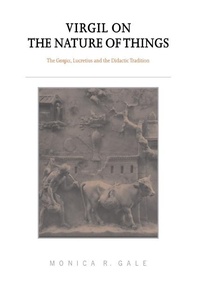
Virgil on the Nature of Things
The Georgics, Lucretius and the Didactic Tradition
Published on 9. November 2000
Book
Hardback
336 pages
978-0-521-78111-4 (ISBN)
Description
The Georgics has for many years been a source of fierce controversy among scholars of Latin literature. Is the work optimistic or pessimistic, pro- or anti-Augustan? Should we read it as a eulogy or a bitter critique of Rome and her imperial ambitions? This book suggests that the ambiguity of the poem is the product of a complex and thorough-going engagement with earlier writers in the didactic tradition: Hesiod, Aratus and - above all - Lucretius. Drawing on both traditional, philological approaches to allusion, and modern theories of intertextuality, it shows how the world-views of the earlier poets are subjected to scrutiny and brought into conflict with each other. Detailed consideration of verbal parallels and of Lucretian themes, imagery and structural patterns in the Georgics forms the basis for a reading of Virgil's poem as an extended meditation on the relations between the individual and society, the gods and the natural environment.
Reviews / Votes
'The book is characterized by thorough scholarship, discerning interpretation, and clear exposition. The success that she has achieved speaks both for her own energy and imagination, and for the abiding importance of the relationship between Virgil and his great predecessor.' Journal of Roman StudiesMore details
Language
English
Place of publication
Cambridge
United Kingdom
Target group
Professional and scholarly
College/higher education
Dimensions
Height: 235 mm
Width: 157 mm
Thickness: 24 mm
Weight
697 gr
ISBN-13
978-0-521-78111-4 (9780521781114)
Copyright in bibliographic data and cover images is held by Nielsen Book Services Limited or by the publishers or by their respective licensors: all rights reserved.
Schweitzer Classification
Other editions
Additional editions
E-Book
01/2005
1st Edition
Cambridge University Press
€38.49
Available for download
Person
Content
Preface; List of abbreviations; 1. Introduction: influence, allusion, intertextuality; 2. Beginnings and endings; 3. The gods, the farmer and the natural world; 4. Virgil's metamorphoses: mythological allusions; 5. Labor improbus; 6. The wonders of the natural world; 7. The cosmic battlefield: warfare and military imagery; 8. Epilogue: the philosopher and the farmer; Bibliography; Indexes.