


Inequality
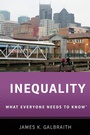
What Everyone Needs to Know (R)
Published on 31. March 2016
Book
Hardback
224 pages
978-0-19-025046-1 (ISBN)
Description
Over the past thirty years, the issue of economic inequality has emerged from the backwaters of economics to claim center stage in the political discourse of America and beyond a change prompted by a troubling fact: numerous measures of income inequality, especially in the United States in the last quarter of the twentieth century, have risen sharply in recent years. Even so, many people remain confused about what, exactly, politicians and media persons mean when they discuss inequality. What does "economic inequality " mean? How is it measured? Why should we care? Why did inequality rise in the United States? Is rising inequality an inevitable feature of capitalism? What should we do about it?
Inequality: What Everyone Needs to Know takes up these questions and more in plain and clear language, bringing to life one of the great economic and political debates of our age. Inequality expert James K. Galbraith has compiled the latest economic research on inequality and explains his findings in a way that everyone can understand. He offers a comprehensive introduction to the study of economic inequality, including its philosophical and theoretical origins, the variety of concepts in wide use, empirical measures and their advantages and disadvantages, competing modern theories of the causes and effects of rising inequality in the United States and worldwide, and a range of policy measures.
This latest addition to the popular What Everyone Needs to Know series from Oxford University Press will tell you everything you need to know to make informed opinions on this significant issue.
Inequality: What Everyone Needs to Know takes up these questions and more in plain and clear language, bringing to life one of the great economic and political debates of our age. Inequality expert James K. Galbraith has compiled the latest economic research on inequality and explains his findings in a way that everyone can understand. He offers a comprehensive introduction to the study of economic inequality, including its philosophical and theoretical origins, the variety of concepts in wide use, empirical measures and their advantages and disadvantages, competing modern theories of the causes and effects of rising inequality in the United States and worldwide, and a range of policy measures.
This latest addition to the popular What Everyone Needs to Know series from Oxford University Press will tell you everything you need to know to make informed opinions on this significant issue.
More details
Series
Language
English
Place of publication
New York
United States
Dimensions
Height: 222 mm
Width: 145 mm
Thickness: 16 mm
Weight
419 gr
ISBN-13
978-0-19-025046-1 (9780190250461)
Copyright in bibliographic data and cover images is held by Nielsen Book Services Limited or by the publishers or by their respective licensors: all rights reserved.
Schweitzer Classification
Other editions
Additional editions
Book
03/2016
Oxford University Press Inc
€16.00
Shipment within 15-20 days
E-Book
02/2016
1st Edition
OUP USA
€11.99
Available for download
E-Book
02/2016
1st Edition
OUP eBook
€11.99
Available for download
Person
James K. Galbraith teaches at The University of Texas at Austin. He holds degrees from Harvard and Yale, and was a Marshall Scholar at King's College, Cambridge. He served as Executive Director of the Joint Economic Committee, US Congress, in the early 1980s. In 2010 he was elected to the Accademia Nazionale dei Lincei. In 2012, he was President of the Association for Evolutionary Economics. He is the 2014 co-winner of the Leontief Prize for advancing the frontiers of economic thought.
Content
1. Inequality: Should We Care?
2. Inequality in the History of Economic Thought
3. Categorical Inequality
4. Major Concepts of Distribution
5. Measures of Inequality and Sources of Data
6. Causes and Consequences of Changing Inequalities
7. Norms and Policies
2. Inequality in the History of Economic Thought
3. Categorical Inequality
4. Major Concepts of Distribution
5. Measures of Inequality and Sources of Data
6. Causes and Consequences of Changing Inequalities
7. Norms and Policies