

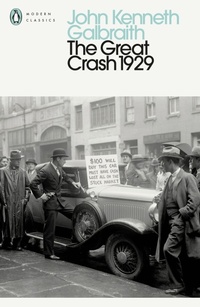
The Great Crash 1929
Published on 6. May 2021
Book
Paperback/Softback
208 pages
978-0-241-46808-1 (ISBN)
Description
'One of the most engrossing books I have ever read' Daily Telegraph
John Kenneth Galbraith's now-classic account of the 1929 stock market collapse remains the definitive book on the most disastrous cycle of boom and bust in modern times.
Vividly depicting the causes, effects, aftermath and long-term consequences of financial meltdown, Galbraith also describes the people and the corporations who were affected by the catastrophe. With its depiction of the 'gold-rush fantasy' ingrained in America's psychology, The Great Crash 1929 remains a penetrating study of human greed and folly.
John Kenneth Galbraith's now-classic account of the 1929 stock market collapse remains the definitive book on the most disastrous cycle of boom and bust in modern times.
Vividly depicting the causes, effects, aftermath and long-term consequences of financial meltdown, Galbraith also describes the people and the corporations who were affected by the catastrophe. With its depiction of the 'gold-rush fantasy' ingrained in America's psychology, The Great Crash 1929 remains a penetrating study of human greed and folly.
More details
Series
Language
English
Place of publication
London
United Kingdom
Publishing group
Penguin Books Ltd
Product notice
Paperback (UK-B)
Dimensions
Height: 198 mm
Width: 132 mm
Thickness: 15 mm
Weight
148 gr
ISBN-13
978-0-241-46808-1 (9780241468081)
Copyright in bibliographic data and cover images is held by Nielsen Book Services Limited or by the publishers or by their respective licensors: all rights reserved.
Schweitzer Classification
Persons
John Kenneth Galbraith, born in 1908, was one of the twentieth century's most influential economists. He produced dozens of books and hundreds of articles on economics, politics, foreign policy and the arts, his most famous including the popular trilogy on economics, American Capitalism (1952), The Affluent Society (1958), and The New Industrial State (1967). He taught at Harvard University for many years and was also active in politics, serving as an adviser to Franklin D. Roosevelt, Harry S. Truman, John F. Kennedy and Lyndon B. Johnson.