

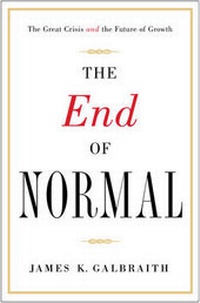
The End of Normal
The Great Crisis and the Future of Growth
Published on 9. September 2014
Book
Hardback
304 pages
978-1-4516-4492-0 (ISBN)
Description
Both sides and practically all analyses of the crisis so far take for granted that the economic growth from the early 1950s until 2000-interrupted only by the troubled 1970s-represented a normal performance. From this perspective the crisis was an interruption, caused by bad policy or bad people, and full recovery is to be expected if the cause is corrected.
The End of Normal challenges this view. Placing the crisis in perspective, Galbraith argues that the 1970s already ended the age of easy growth. The 1980s and 1990s saw only uneven growth, with rising inequality within and between countries. And the 2000s saw the end even of that-despite frantic efforts to keep growth going with tax cuts, war spending, and financial deregulation. When the crisis finally came, stimulus and automatic stabilization were able to place a floor under economic collapse. But they are not able to bring about a return to high growth and full employment.
Today, four factors impede a return to normal. They are the rising costs of real resources, the now-evident futility of military power, the labour-saving consequences of the digital revolution, and the breakdown of law and ethics in the financial sector. The Great Crisis should be seen as a turning point, a barometer of the rise of unstable economic conditions, which should be regarded as the new normal. Policies and institutions going forward should be designed, above all, modestly, to cope with this fact, maintaining conditions for a good life in difficult times.
The End of Normal challenges this view. Placing the crisis in perspective, Galbraith argues that the 1970s already ended the age of easy growth. The 1980s and 1990s saw only uneven growth, with rising inequality within and between countries. And the 2000s saw the end even of that-despite frantic efforts to keep growth going with tax cuts, war spending, and financial deregulation. When the crisis finally came, stimulus and automatic stabilization were able to place a floor under economic collapse. But they are not able to bring about a return to high growth and full employment.
Today, four factors impede a return to normal. They are the rising costs of real resources, the now-evident futility of military power, the labour-saving consequences of the digital revolution, and the breakdown of law and ethics in the financial sector. The Great Crisis should be seen as a turning point, a barometer of the rise of unstable economic conditions, which should be regarded as the new normal. Policies and institutions going forward should be designed, above all, modestly, to cope with this fact, maintaining conditions for a good life in difficult times.
Reviews / Votes
"Galbraith puts his pessimism into an engaging, plausible frame. His contentions deserve the attention of all economists and serious financial minds across the political spectrum." * Publishers Weekly (starred) * "Forceful prose and admittedly provocative suggestions.... Students of economics will enjoy the robust, fearless rebuke he delivers to some of the discipline's giants.... A cleareyed...analysis of the new normal...for the 21st century." * Kirkus * "Galbraith's study marks another sharp and suggestive installment in the ongoing effort to determine how and why our economic and political leaders have lost their once-confident grasp of sound strategies to promote macroeconomic growth. And to restore a measure of that lost confidence Galbraith lays out a bold intellectual agenda." * Book Forum * "We heartily recommend [The End of Normal]" * Monthly Review * "[M]agisterial" -- Jim Sleeper * Slate *More details
Language
English
Place of publication
New York
United States
Illustrations
index, notes
Dimensions
Height: 229 mm
Width: 152 mm
Thickness: 25 mm
Weight
454 gr
ISBN-13
978-1-4516-4492-0 (9781451644920)
Copyright in bibliographic data and cover images is held by Nielsen Book Services Limited or by the publishers or by their respective licensors: all rights reserved.
Schweitzer Classification
Other editions
Additional editions
E-Book
09/2014
1st Edition
Simon + Schuster LLC
€11.86
Available for download
Person
James K. Galbraith holds the Lloyd M. Bentsen Jr. Chair in Government/Business Relations at the Lyndon B. Johnson School of Public Affairs at the University of Texas at Austin. He lives in Austin, Texas. The End of Normal is his first book.