

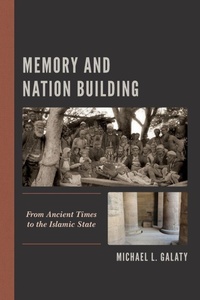
Memory and Nation Building
From Ancient Times to the Islamic State
Published on 6. May 2021
Book
Paperback/Softback
224 pages
978-1-5381-5838-8 (ISBN)
Description
Memory and Nation Building addresses the complex topic of collective memory, first described by sociologist Maurice Halbwachs in the first half of the 20th century. Author Michael Galaty argues that the first states appropriated traditional collective memory systems in order to form. With this in mind, he compares three Mediterranean societies - Egypt, Greece, and Albania - each of which experienced very different trajectories of state formation. Galaty attributes these differences to varying responses to collective memory in all three places through time, with climaxes in the Ottoman period, during which all three were under Ottoman control. Egypt was characterized by deeply meaningful memory tropes concerning national unity, which spanned all of Egyptian history, while Greece experienced memory fragmentation, a condition exacerbated by periods of imperial conquest. Albania adapted and assimilated when faced with foreign domination, such that an indigenous Albanian state did not form until 1912.
Galaty builds a diachronic model of state formation and its relationship to memory and political control. Memory and Nation Building culminates in an analysis of modern collective memory systems and resistance to those systems, which are often framed as conflicts over "heritage". The formation and eventual fall of the short-lived Islamic State serves as an example of extreme memory work, with lessons for other modern nations.
Galaty builds a diachronic model of state formation and its relationship to memory and political control. Memory and Nation Building culminates in an analysis of modern collective memory systems and resistance to those systems, which are often framed as conflicts over "heritage". The formation and eventual fall of the short-lived Islamic State serves as an example of extreme memory work, with lessons for other modern nations.
Reviews / Votes
In this lucid, sweeping monograph, Galaty (Univ. of Michigan) argues that collective memories are a necessary component of human cultural behavior, and, moreover, that they are the most crucial element of state formation and nation building. * Choice Reviews * What is most significant about Galaty's ambitious and highly readable book is that he takes a comparative and long-term diachronic approach to collective memory practices. . . . Memory and Nation Building is. . . a compelling book and an excellent example of how the archaeological study of memory has matured over time. It will be of interest to scholars involved in the study of memory, the relationship between memory practices and the longue duree, and comparative approaches to history. * American Journal of Archaeology * Galaty (2018), moves the study of collective memory beyond a simplistic association between monuments and legitimacy, following Jonker (1995) and J. Assman (2011) to develop a model that explains how would-be leaders transformed individual memory (particularly from funerary contexts) into collective memory. * Annual Review Of Anthropology * Galaty's aims are laudable, and I respect the breadth of the scholarship on display here. . . . Galaty is sincere about deploying the craft of archaeology to make sense of the violence and upheaval in our times. Colleagues of a processual bent who value large-scale comparative studies and who study the rise of states, nationalism and memory may well find much to interest them here. * Cambridge Archaeological Journal * Galaty closes his compelling volume with a defence of the importance of archaeology and its relevance to the modern political climate by reminding the reader that archaeology "is not a peripheral academic pursuit; rather, it is absolutely necessary if we are to make sense of world history, which is largely viewed, by most people, through the prism of memory" (p. 157). * Antiquity * Memory and Nation Building is a hugely ambitious and ultimately convincing narrative of the tight bonds between memory, social formation, and ultimately of state building. Few authors have attempted to connect deep prehistory to the present in a single region of the world, much less three. Beautifully written, deeply researched, and often surprising, scholars in many fields will find Galaty's new theorization of memory convincing and useful. -- Wayne Lee, Dowd Distinguished Professor of History, University of North Carolina In Memory and Nation Building, Michael Galaty reveals the pervasiveness of memory work in society through a series of well researched diachronic case studies. His prose is both erudite and accessible, making this book essential reading for scholars and students in all walks of the Social Sciences and Humanities. -- Robert Schon, Associate Professor of Anthropology, School of Anthrpology Associate Director (Academic Affairs), Director of Graduate Studies, The University of Arizona This ambitious book focuses on the collective memories and so-called counter-memories of three eastern Mediterranean societies-Egypt, Greece, and Albania. * American Antiquity *More details
Language
English
Place of publication
United States
Publishing group
Bloomsbury Publishing Plc
Target group
Professional and scholarly
Illustrations
27 b/w photos; 3 tables;
Dimensions
Height: 229 mm
Width: 152 mm
Thickness: 13 mm
Weight
374 gr
ISBN-13
978-1-5381-5838-8 (9781538158388)
Copyright in bibliographic data and cover images is held by Nielsen Book Services Limited or by the publishers or by their respective licensors: all rights reserved.
Schweitzer Classification
Other editions
Additional editions
E-Book
08/2018
1st Edition
Bloomsbury eBooks US
€33.49
Available for download
Person
Michael L. Galaty is Professor of Anthropology in the Department of Anthropology at the University of Michigan and directs the University of Michigan's Museum of Anthropological Archaeology. He received his PhD from the University of Wisconsin-Madison. He directs collaborative field research projects in Albania and Greece, and, beginning in 2018, in Kosovo. From 1998-2003 he co-directed the Mallakastra Regional Archaeological Project (MRAP) in central Albania, a program of survey and excavation in the hinterland of the Greek colonial city of Apollonia. From 2004-2008, he co-directed the Shala Valley Project (SVP), an interdisciplinary regional research project focused on the Shala Valley of northern highland Albania. The SVP final report, titled Light and Shadow: Isolation and Interaction in the Shala Valley of Northern Albania, won the Society for American Archaeology's 2013 Scholarly Book Award. From 2010-2014, he co-directed the Projekti Arkeologjik i Shkodres (PASH), focused on the northern Albanian region of Shkodra, and The Diros Project, focused on Alepotrypa Cave in the Mani, Greece.
Galaty has primary interests in the archaeology of complex societies and the formation of social inequalities. His work is strongly interdisciplinary and focused on regional landscapes. A trained archaeometrist, he often employs scientific methods, including petrography, mass spectroscopy, and portable x-ray fluorescence spectroscopy to study interactions between archaeological populations. He has published numerous edited volumes, including Rethinking Mycenaean Palaces, Archaeology Under Dictatorship, and Archaic State Interaction. The latter was the result of an Advanced Seminar at the School for Advanced Research in Santa Fe, New Mexico. He has published nearly 100 articles on topics ranging from Albanian bunkers to Greek-Egyptian trade.
Galaty has primary interests in the archaeology of complex societies and the formation of social inequalities. His work is strongly interdisciplinary and focused on regional landscapes. A trained archaeometrist, he often employs scientific methods, including petrography, mass spectroscopy, and portable x-ray fluorescence spectroscopy to study interactions between archaeological populations. He has published numerous edited volumes, including Rethinking Mycenaean Palaces, Archaeology Under Dictatorship, and Archaic State Interaction. The latter was the result of an Advanced Seminar at the School for Advanced Research in Santa Fe, New Mexico. He has published nearly 100 articles on topics ranging from Albanian bunkers to Greek-Egyptian trade.