

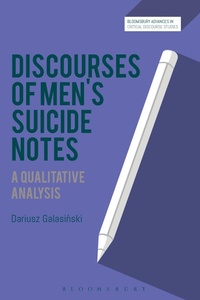
Discourses of Men's Suicide Notes
A Qualitative Analysis
Published on 18. April 2019
Book
Paperback/Softback
216 pages
978-1-350-10902-5 (ISBN)
Description
Deaths by suicide are high: every 40 seconds, someone in the world chooses to end their life. Despite acknowledgement that suicide notes are social texts, there has been no book which analyzes suicide notes as discursive texts and no attempt at a qualitative discourse analysis of them. Discourses of Men's Suicide Notes redresses this gap in the literature.
Focussing on men and masculinity and anchored in qualitative discourse analysis, Dariusz Galasinski responds to the need for a more thorough understanding of suicidal behaviour. Culturally, men have been posited to be 'masters of the universe' and yet some choose to end their lives. This book takes a qualitative approach to data gathered from the Polish Corpus of Suicide Notes, a unique repository of over 600 suicide notes, to explore discourse from and about men at the most traumatic juncture of their lives. Discussing how men construct suicide notes and the ways in which they position their relationships and identities within them, Discourses of Men's Suicide Notes seeks to understand what these notes mean and what significance and power they are invested with.
Focussing on men and masculinity and anchored in qualitative discourse analysis, Dariusz Galasinski responds to the need for a more thorough understanding of suicidal behaviour. Culturally, men have been posited to be 'masters of the universe' and yet some choose to end their lives. This book takes a qualitative approach to data gathered from the Polish Corpus of Suicide Notes, a unique repository of over 600 suicide notes, to explore discourse from and about men at the most traumatic juncture of their lives. Discussing how men construct suicide notes and the ways in which they position their relationships and identities within them, Discourses of Men's Suicide Notes seeks to understand what these notes mean and what significance and power they are invested with.
Reviews / Votes
[An] important publication that lays the foundation for the future study of suicide notes. It clearly delineates linguistic and discursive features of the corpus that are characteristic of the genre. More importantly, as this work presents a comprehensive cataloguing of suicide note features, it is able to challenge long-held assumptions on the nature and purpose of the suicide note. * LINGUIST List * The strength of this book is its interdisciplinarity: it is useful to a wide range of researchers, and Galasinski's arguments for adopting discourse analysis in clinical research is convincing, well-argued and maintained through the book ... An important publication that enriches our understanding of the key themes of suicide notes and uses these observations to challenge previous research ... A valuable book for anyone interested in suicide research and health communication studies more generally. * CADAAD Journal *More details
Series
Language
English
Place of publication
London
United Kingdom
Publishing group
Bloomsbury Publishing PLC
Target group
College/higher education
Professional and scholarly
Dimensions
Height: 234 mm
Width: 156 mm
Thickness: 12 mm
Weight
330 gr
ISBN-13
978-1-350-10902-5 (9781350109025)
Copyright in bibliographic data and cover images is held by Nielsen Book Services Limited or by the publishers or by their respective licensors: all rights reserved.
Schweitzer Classification
Other editions
Additional editions
E-Book
10/2017
1st Edition
Bloomsbury Academic
€38.99
Available for download
E-Book
10/2017
1st Edition
Bloomsbury Academic
€38.99
Available for download
Person
Dariusz Galasinski is Professor of Discourse and Cultural Studies at the University of Wolverhampton, UK, and Visiting Professor at the University of Social Sciences and Humanities (SWPS) in Warsaw, Poland.
Content
Introduction
Part I: The Past
1. Broken lives and agency in a relationship
2. External and internal sources of suicide
Part II: The Present
3. Suicide: the act outside discourse
4. Identities and speaking positions
5. The note - Exercise in timing
Part III: The Future
6. 'See you later' - Non-finality of suicide
7. Narratives of continuous control
Bibliography
Index
Part I: The Past
1. Broken lives and agency in a relationship
2. External and internal sources of suicide
Part II: The Present
3. Suicide: the act outside discourse
4. Identities and speaking positions
5. The note - Exercise in timing
Part III: The Future
6. 'See you later' - Non-finality of suicide
7. Narratives of continuous control
Bibliography
Index