

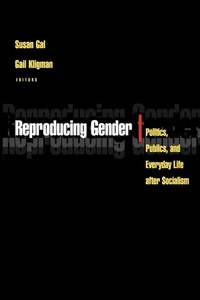
Reproducing Gender
Politics, Publics, and Everyday Life after Socialism
Published on 28. May 2000
Book
Paperback/Softback
448 pages
978-0-691-04868-0 (ISBN)
Description
The striking fact that abortion was among the first issues raised, after 1989, by almost all of the newly formed governments of East Central Europe points to the significance of gender and reproduction in the postsocialist transformations. The fourteen studies in this volume result from a comparative, collaborative research project on the complex relationship between ideas and practices of gender, and political economic change. The book presents detailed evidence about women's and men's new circumstances in eight of the former communist countries, exploring the intersection of politics and the life cycle, the differential effects of economic restructuring, and women's public and political participation. Individual contributions on the former German Democratic Republic, Poland, the Czech Republic, Slovakia, Hungary, Serbia, Romania, and Bulgaria provide rich empirical data and interpretive insights on postsocialist transformation analyzed from a gendered perspective. Drawing on multiple methods and disciplines, these original papers advance scholarship in several fields, including anthropology, sociology, women's studies, law, comparative political science, and regional studies.
The analyses make clear that practices of gender, and ideas about the differences between men and women, have been crucial in shaping the broad social changes that have followed the collapse of communism. In addition to the editors, the contributors are Eleonora Zieliaska, Eva Maleck-Lewy, Myra Marx Ferree, Sharon Wolchik, Irene Dolling, Daphne Hahn, Sylka Scholz, Mira Marody, Anna Giza-Poleszczuk, Katalin Kovacs, Monika Varadi, Julia Szalai, Adriana Baban, MaIgorzata Fuszara, Laura Grunberg, Zorica Mrsevia, Krassimira Daskalova, Joanna Goven, and Jasmina Lukia.
The analyses make clear that practices of gender, and ideas about the differences between men and women, have been crucial in shaping the broad social changes that have followed the collapse of communism. In addition to the editors, the contributors are Eleonora Zieliaska, Eva Maleck-Lewy, Myra Marx Ferree, Sharon Wolchik, Irene Dolling, Daphne Hahn, Sylka Scholz, Mira Marody, Anna Giza-Poleszczuk, Katalin Kovacs, Monika Varadi, Julia Szalai, Adriana Baban, MaIgorzata Fuszara, Laura Grunberg, Zorica Mrsevia, Krassimira Daskalova, Joanna Goven, and Jasmina Lukia.
Reviews / Votes
"... unusually sophisticated and subtle."--Foreign Affairs "The particular strength of the volume is that it includes many essays by scholars who are living what they analyze; eastern Europe is not viewed from within universities across the Atlantic, rather it is assessed by a number of scholars who are working in the countries they describe."--Robert G. Moeller, Journal of Social HistoryMore details
Language
English
Place of publication
New Jersey
United States
Target group
Professional and scholarly
College/higher education
Product notice
Paperback (trade)
Illustrations
37 tables
Dimensions
Height: 234 mm
Width: 156 mm
Thickness: 24 mm
Weight
685 gr
ISBN-13
978-0-691-04868-0 (9780691048680)
Copyright in bibliographic data and cover images is held by Nielsen Book Services Limited or by the publishers or by their respective licensors: all rights reserved.
Schweitzer Classification
Other editions
Additional editions
E-Book
07/2021
1st Edition
Princeton University Press
€66.49
Available for download
Persons
Susan Gal is Professor of Anthropology at the University of Chicago, and has written widely on questions of language, politics, and gender in East Central Europe. Gail Kligman is Professor of Sociology at the University of California, Los Angeles, and has written widely on culture, politics, and gender in East Central Europe. She is most recently the author of The Politics of Duplicity: Controlling Reproduction in Ceausescu's Romania.
Content
ACKNOWLEDGMENTS ix INTRODUCTION Susan Gal and Gail Kligman 3 PART ONE: REPRODUCTION AS POLITICS 21 CHAPTER 1 Between Ideology, Politics, and Common Sense: The Discourse of Reproductive Rights in Poland - Eleonora Zielinska 23 CHAPTER 2 Reproductive Policies in the Czech and Slovak Republics - Sharon L. Wolchik 58 CHAPTER 3 Talking about Women and Wombs: The Discourse of Abortion and Reproductive Rights in the G.D.R. during and after the Wende - Eva Maleck-Lewy and Myra Marx Ferree 92 CHAPTER 4 Birth Strike in the New Federal States: Is Sterilization an Act of Resistance? - Irene Dolling, Daphne Hahn, and Sylka Scholz 118 PART TWO: GENDER RELATIONS IN EVERYDAY LIFE 149 CHAPTER 5 Changing Images of Identity in Poland: From the Self-Sacrificing to the Self-Investing Woman? - Mira Marody andAnna Giza-Poleszczuk 151 CHAPTER 6 Women's Life Trajectories and Class Formation in Hungary - Katalin Kovacs and Monika Varadi 176 CHAPTER 7 From Informal Labor to Paid Occupations: Marketization from below in Hungarian Women's Work - Julia Szalai 200 CHAPTER 8 Women's Sexuality and Reproductive Behavior in Post-Ceausescu Romania: A Psychological Approach - Adriana Baban 225 PART THREE: ARENAS OF POLITICAL ACTION: STRUGGLES FOR REPRESENTATION 257 CHAPTER 9 New Gender Relations in Poland in the 1990s - Malgorzata Fuszara 259 CHAPTER 10 New Parliament, Old Discourse? The Parental Leave Debate in Hungary - Joanna Goven 286 CHAPTER 11 Women's NGOs in Romania - Laura Grunberg 307 CHAPTER 12 Women's Problems, Women's Discourses in Bulgaria - Krassimira Daskalova 370 CHAPTER 13 Belgrade's SOS Hotline for Women and Children Victims of Violence: A Report - Zorica Mrsevic 370 CHAPTER 14 Media Representations of Men and Women in Times of War and Crisis: The Case of Serbia - Jasmina Lukic 393 CONCLUSION Susan Gal and Gail Kligman 424 CONTRIBUTORS 427 INDEX 429