

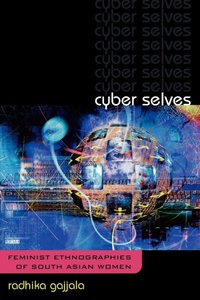
Cyber Selves
Feminist Ethnographies of South Asian Women
Published on 21. October 2004
Book
Paperback/Softback
170 pages
978-0-7591-0692-5 (ISBN)
Description
In her new book Gajjala examines online community formations and subjectivities that are produced at the intersection of technologies and globalization. She describes the process of designing and building cyberfeminist webs for South Asian women's communities, the generation of feminist cyber(auto)ethnographies, and offers a third-world critique of cyberfeminism. She ultimately views virtual communities as imbedded in real life communities and contexts, with human costs. The online discussions are visible, textual records of the discourses that circulate within real life communities. Her methodology involves a form of 'cyberethnography,' which explores the dialogic and disruptive possibilities of the virtual medium and of hypertext. Gajjala's work addresses the political, economic, and cultural ramifications of the Internet communication explosion. This book will be a valuable reference for those with an interest in cultural studies, feminist studies, and new technologies.
Reviews / Votes
Radhika Gajjala's Cyberselves asks all the essential questions about technology, diaspora, nationality, and gender in the age of the Internet. Her lyrical interventions into the form of the academic book disrupt expectations about what ethnography ought to look like, and her unusual perspective as a member and leader of early online community gives the book a welcome grounding in lived experience. Her earnest, passionate, and deeply felt intervention into cyberculture studies is grounded in an excellent knowledge of the most relevant theoretical debates regarding postcolonialism, gender, and technology. This book also includes an exciting dialogue with a South Asian women's labor activist, and is committed throughout to collaborative thinking and knowledge-creation. This is a very personal and intimate book, and a welcome addition to the existing body of literature on online ethnography. -- Lisa Nakamura, University of Wisconsin, Madison This probing and thoughtful work begins by addressing the politics of enunciation within diasporic cyberspaces, illustrating the kinds of complicities and resistances that get articulated through the struggle for control over meaning-making in such spaces. The book concludes by challenging us to think about how internet technologies could be redesigned to enable a truly dialogic exchange across gender, race, class and geographic location. -- Jyotsna Vaid, founding member of Committee on South Asian Wo, Texas A&M University Using cyber-ethnographic methodology and feminist theoretical framwork, [Gajjala] has studies the structure and content of exchanges among paricipants (netizens) in these virtual communities to answer fundamental questions about virtual communities...Theauthor's critical and reflective analysis challenges students of feminist studies and of online communication studies to reconsider the assumption that internet communication in the globalized world is a power equalizerrrr * Electronic Magazine Of Multicultural Education * ...an intriguing study... * H-Net: Humanities and Social Science Reviews Online * ...insightful. It highlights several important issues, not only online practices that lead to an 'insider' becoming an 'outsider', but more importantly women only spaces on the Web. -- 2008 * Indian Journal Of Gender Studies * Gajjala's book is uniquely personal, uniquely insightful, and uniquely provocative. It adds new and important dimensions to the study of identity, race, and communication, on the internet as well as in the world offline. -- Steve Jones, University of Illinois Chicago Using cyber-ethnographic methodology and feminist theoretical framwork, [Gajjala] has studies the structure and content of exchanges among paricipants (netizens) in these virtual communities to answer fundamental questions about virtual communities...The author's critical and reflective analysis challenges students of feminist studies and of online communication studies to reconsider the assumption that internet communication in the globalized world is a power equalizer * Electronic Magazine Of Multicultural Education *More details
Language
English
Place of publication
California
United States
Dimensions
Height: 229 mm
Width: 152 mm
Thickness: 10 mm
Weight
259 gr
ISBN-13
978-0-7591-0692-5 (9780759106925)
Copyright in bibliographic data and cover images is held by Nielsen Book Services Limited or by the publishers or by their respective licensors: all rights reserved.
Schweitzer Classification
Other editions
Additional editions
E-Book
11/2004
1st Edition
AltaMira Press
€42.99
Available for download
Persons
Radhika Gajjala is associate professor of Communication Studies at Bowling Green State University.
Content
Part 1 ACKNOWLEDGMENTS
Part 2 PROLOGUE: I REFUSE TO BE READ
Part 3 INTRODUCTION
Part 4 PART I: Cyborg-Diaspora to the SAWnet Refusal
Chapter 5 Chapter One: Imagining Virtual Community and Dialogic Encounters
Chapter 6 Chapter Two: The SAWnet Refusal
Chapter 7 Chapter Three: Feminist Ethnography, Feminist Media Studies, and Internet Research
Part 8 PART II: Building (South Asian) Cyberfeminist Webs?
Chapter 9 Chapter Four: Interrogating Identities: Composing Other Cyberspaces
Chapter 10 Chapter Five: Building Cyberfeminist Webs
Part 11 PART III: Cyberfeminism and the "third-world"-Dialogues
Chapter 12 Chapter Six: Cyberfeminism, technology, and international "development"
Chapter 13 Chapter Seven: Carving dis-appearing analogue/digital "selves"
Part 14 EPILOGUE: I WANT TO CURL UP AND DENY YOU
Part 15 REFERENCES
Part 16 ABOUT THE AUTHOR
Part 2 PROLOGUE: I REFUSE TO BE READ
Part 3 INTRODUCTION
Part 4 PART I: Cyborg-Diaspora to the SAWnet Refusal
Chapter 5 Chapter One: Imagining Virtual Community and Dialogic Encounters
Chapter 6 Chapter Two: The SAWnet Refusal
Chapter 7 Chapter Three: Feminist Ethnography, Feminist Media Studies, and Internet Research
Part 8 PART II: Building (South Asian) Cyberfeminist Webs?
Chapter 9 Chapter Four: Interrogating Identities: Composing Other Cyberspaces
Chapter 10 Chapter Five: Building Cyberfeminist Webs
Part 11 PART III: Cyberfeminism and the "third-world"-Dialogues
Chapter 12 Chapter Six: Cyberfeminism, technology, and international "development"
Chapter 13 Chapter Seven: Carving dis-appearing analogue/digital "selves"
Part 14 EPILOGUE: I WANT TO CURL UP AND DENY YOU
Part 15 REFERENCES
Part 16 ABOUT THE AUTHOR