

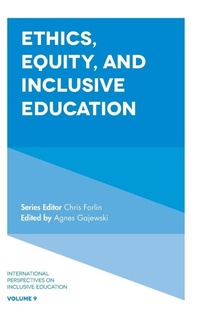
Ethics, Equity, and Inclusive Education
Published on 11. May 2017
Book
Hardback
296 pages
978-1-78714-153-7 (ISBN)
Description
This volume focuses on professional ethics and the moral dimensions of inclusive education. The significance of ethics in inclusive education has been noted by numerous scholars, however, to date, a comprehensive review does not exist in the field. Grounded in an examination of international conceptualizations of ethics and inclusion, this book provides a comprehensive analysis of current understandings of professional ethics in the context of inclusive education and the many issues associated with its practice. The first chapters provide an overview of ethics and inclusive education, including; discussions on inclusion as ethical in nature based on an argument of inclusion as a human right; an examination of ethics and epistemology as it relates to inclusion; and the role of administrators in ethical practice. The second section focuses on practical issues related to ethical challenges, issues, and dilemmas in inclusive classrooms and teaching practice. The roles of the teacher, the co-teacher, and colleagues, which include administrators, specialists, and staff, are examined. Moreover, practice related problems are discussed including assessment, emergent curriculum, and meeting the needs of gifted learners in inclusive settings.
Reviews / Votes
Characterizing inclusion as inherently ethical and arguably a human right, education scholars present theoretical and empirical perspectives on ethics and equity within inclusive education. They examine international conceptualizations of professional ethics in inclusive education, drawing on different interpretations and understandings of ethics in teaching and learning with students who have different learning needs. Among their topics are ethics of inclusion for secondary students with intellectual and developmental disabilities in the US, ethical considerations for inclusive practices for students with extensive support needs, uncovering moral aspects in inclusive co-teaching, and the case of gifted students. -- Annotation (c)2017 Ringgold Inc. * (protoview.com) *More details
Series
Language
English
Place of publication
Bingley
United Kingdom
Target group
Professional and scholarly
Dimensions
Height: 235 mm
Width: 157 mm
Thickness: 21 mm
Weight
582 gr
ISBN-13
978-1-78714-153-7 (9781787141537)
Copyright in bibliographic data and cover images is held by Nielsen Book Services Limited or by the publishers or by their respective licensors: all rights reserved.
Schweitzer Classification
Other editions
Additional editions
Agnes Gajewski
Ethics, Equity, and Inclusive Education
E-Book
05/2017
Emerald Publishing Limited
€113.99
Available for download
Persons
Content
Chapter 1: Conceptualizing professional ethics in inclusive education - Agnes Gajewski
Chapter 2: Reclaiming disability through Pimatisiwin: Indigenous ethics, spatial justice, and gentle teaching - Margaret M. Kress
Chapter 3: Ethics, epistemologies and inclusive pedagogy - Kieron Sheehy
Chapter 4: Ethics of inclusion for secondary students with intellectual and developmental disabilities in the United States - Nancy Molfenter & Cheryl Hanley-Maxwell
Chapter 5: Ethical considerations for inclusive practices for students with extensive support needs - Debbie Taub, Megan H. Foster, Ann-Marie Orlando, & Diane L. Ryndak
Chapter 6: The ethics of inclusion: Digital approaches to literacy among struggling readers in two Jamaican high schools - Thursica Kovinthan & Kisha McPherson
Chapter 7: Uncovering moral aspects in inclusive co-teaching - Juhani Lohtonen, Auli Toom, & Jukka Husu
Chapter 8: Ethical curricula through responsive, multimodal literacy & pedagogy: Illustrations from a kindergarten classroom curriculum - Rachel Heydon, Beatrix Bocazar, & Zheng Zhang
Chapter 9: Untangling optical illusions: The moral dilemmas and ethics in assessment practices for inclusive education - Roseanna Bourke
Chapter 10: Ethical challenges in inclusive education: The case of gifted students - Kirsi Tirri & Sonja Laine
Chapter 2: Reclaiming disability through Pimatisiwin: Indigenous ethics, spatial justice, and gentle teaching - Margaret M. Kress
Chapter 3: Ethics, epistemologies and inclusive pedagogy - Kieron Sheehy
Chapter 4: Ethics of inclusion for secondary students with intellectual and developmental disabilities in the United States - Nancy Molfenter & Cheryl Hanley-Maxwell
Chapter 5: Ethical considerations for inclusive practices for students with extensive support needs - Debbie Taub, Megan H. Foster, Ann-Marie Orlando, & Diane L. Ryndak
Chapter 6: The ethics of inclusion: Digital approaches to literacy among struggling readers in two Jamaican high schools - Thursica Kovinthan & Kisha McPherson
Chapter 7: Uncovering moral aspects in inclusive co-teaching - Juhani Lohtonen, Auli Toom, & Jukka Husu
Chapter 8: Ethical curricula through responsive, multimodal literacy & pedagogy: Illustrations from a kindergarten classroom curriculum - Rachel Heydon, Beatrix Bocazar, & Zheng Zhang
Chapter 9: Untangling optical illusions: The moral dilemmas and ethics in assessment practices for inclusive education - Roseanna Bourke
Chapter 10: Ethical challenges in inclusive education: The case of gifted students - Kirsi Tirri & Sonja Laine