

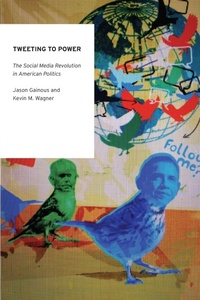
Tweeting to Power
The Social Media Revolution in American Politics
Published on 16. January 2014
Book
Paperback/Softback
208 pages
978-0-19-996509-0 (ISBN)
Description
Online social media are changing the face of politics in the United States. Beginning with a strong theoretical foundation grounded in political, communications and psychology literature, Tweeting to Power examines the effect of online social media on how people come to learn, understand and engage in politics. Gainous and Wagner propose that platforms such as Facebook and Twitter offer the opportunity for a new information flow that is no longer being structured and limited by the popular media. Television and newspapers, which were traditionally the sole or primary gatekeeper, can no longer limit or govern what information is exchanged. By lowering the cost of both supplying the information and obtaining it, social networking applications have recreated how, when and where people are informed.
To establish this premise, Gainous and Wagner analyze multiple datasets, quantitative and qualitative, exploring and measuring the use of social media by voters and citizens as well as the strategies and approaches adopted by politicians and elected officials. They illustrate how these new and growing online communities are new forums for the exchange of information that is governed by relationships formed and maintained outside traditional media. Using empirical measures, they prove both how candidates utilize Twitter to shape the information voters rely upon and how effective this effort was at garnering votes in the 2010 congressional elections. With both theory and data, Gainous and Wagner show how the social media revolution is creating a new paradigm for political communication and shifting the very foundation of the political process.
To establish this premise, Gainous and Wagner analyze multiple datasets, quantitative and qualitative, exploring and measuring the use of social media by voters and citizens as well as the strategies and approaches adopted by politicians and elected officials. They illustrate how these new and growing online communities are new forums for the exchange of information that is governed by relationships formed and maintained outside traditional media. Using empirical measures, they prove both how candidates utilize Twitter to shape the information voters rely upon and how effective this effort was at garnering votes in the 2010 congressional elections. With both theory and data, Gainous and Wagner show how the social media revolution is creating a new paradigm for political communication and shifting the very foundation of the political process.
Reviews / Votes
Tweeting to Power is the most ambitious and well-researched study of social media's political consequences to date. Using an impressive array of qualitative and quantitative data, Gainous and Wagner systematically track how Twitter and Facebook are influencing Congress, political parties and the American public. This book is much more than a narrow study of social media, however. By situating their evidence in long-standing theoretical debates, Gainous and Wagner tackle more fundamental questions about the functioning of American democracy in the age of the internet. Tweeting to Power is essential reading for anyone interested in technology's impact on election campaigns, political communication and public opinion. * Kevin Wallsten, California State University, Long Beach * Social media have already become a fundamental part of politics in the digital age. In Tweeting to Power, Jason Gainous and Kevin M. Wagner use an impressive array of quantitative and qualitative data to explore a wide variety of questions about the impacts of social media on American politics. In doing so, they make an important new contribution to ongoing debates about the political implications of the internet. * Michael Xenos, Center for Communication Research, University of Wisconsin-Madison *More details
Series
Language
English
Place of publication
New York
United States
Target group
College/higher education
Professional and scholarly
Illustrations
12 illustrations
Dimensions
Height: 234 mm
Width: 156 mm
Thickness: 12 mm
Weight
363 gr
ISBN-13
978-0-19-996509-0 (9780199965090)
Copyright in bibliographic data and cover images is held by Nielsen Book Services Limited or by the publishers or by their respective licensors: all rights reserved.
Schweitzer Classification
Other editions
Additional editions

E-Book
11/2013
1st Edition
OUP eBook
€24.99
Available for download

E-Book
11/2013
1st Edition
OUP eBook
€24.99
Available for download
Persons
Jason Gainous is Associate Professor of Political Science at the University of Louisville. Kevin M. Wagner is Assistant Professor of Political Science at Florida Atlantic University.
Content
Chapter 1: Social Media - The New Dinner Table? ; Chapter 2: Evolution or Revolution - Why Facebook and Twitter Matter? ; Chapter 3: Congress 2.0 - Internet-Style Politics ; Chapter 4: Congress 2.0 - Who's Tweeting? ; Chapter 5: Public Opinion 2.0 - Read My Feed ; Chapter 6: Public Opinion 2.0 - The New Social Capital ; Chapter 7: Congress 2.0 - Controlling the Flow of Information ; Chapter 8: Public Opinion 2.0 - The Direct Conduit ; Chapter 9: Congress 2.0 - Tweeting for Support ; Chapter 10: Social Media Tomorrow - Tweeting the Future? ; Appendix ; Notes ; References ; Index