

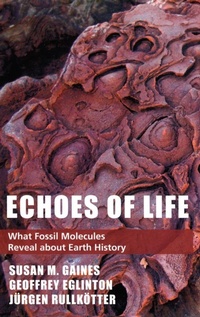
Echoes of Life
What Fossil Molecules Reveal about Earth History
Published on 6. November 2008
Book
Hardback
376 pages
978-0-19-517619-3 (ISBN)
Description
In 1936 a German chemist identified certain organic molecules in ancient rocks and oils as the fossil remains of chlorophyll, presumably from plants that had lived millions of years in the past. Many years later this insight was revisited and the term biomarker coined to describe fossil molecules whose molecular structures could reveal the presence of otherwise elusive organisms and processesand then, the hunt was on. Echoes of Life is the story of those molecules and how they illuminate the history of the earth and its life. It is also the story of how a few maverick organic chemists and geologists defied the dictates of their disciplines and, at a time when the natural sciences were fragmenting into ever-more-specialized sub-disciplines, reunited chemistry, biology and geology in a common endeavor.
Reviews / Votes
Distilling the complex biochemistry and biogeology and presenting the history in a readable form is a daunting task, and Susan Gaines has done a remarkable job. [A] book that simply must be read by all interdisciplinary science enthusiasts...it is quite simply 'everything you wanted to know about organic chemistry but were afraid to ask'. * Chemistry World * Distilling the complex biochemistry and biogeology and presenting the history in a readable form is a daunting task, and Susan Gaines has done a remarkable job. With a background in chemical oceanography and a passion for writing, she has found a welcoming venue in this genre. * Astrobiology * ...the delightful writing of lead author Susan Gaines is infused with the enthusiasm and extensive knowledge of her collaborators , Geoffrey Eglington and Juergen Rullkoetter...This book will be enjoyed by anyone who is curious about the molecular remnants of life and the tales they tell about ancient Earth...offers a festive celebration of why science is fun and of the "rampant human curiosity" that fules science, scientists, and young elephants alike. * Katherine H. Freeman SCIENCE * Perhaps too late scientists begin to realise how much the living and the material Earth are one. Through the authors pioneering research we gain glimpses of the character of our planet from childhood to its present seniority. Although a first-rate biogeochemical text, the book features some of the qualities of a family photograph, and is all the more interesting. Life and Earth scientists both should have it on their shelves. * James Lovelock, Honorary Visiting Fellow, Green College, Oxford, originator of Gaia theory * As scientists descriptions of earth history grow more detailed and more relevant to public policy and economics, laymen are bound to be both curious and suspicious. How do they know what the climate was like 200 million years ago, or why petroleum formed in some places and not in others, or what happened to marine life during the last great mass extinction? Echoes of Life gives us marvelously up-to-date, precise explanations of the molecular tools scientists are using to answer such questions. * John Hayes, Scientist Emeritus, Woods Hole Oceanographic Institution * Echoes of Life provides answers to all the questions that any chemist, or indeed any scientist, could possibly ask about the history of life on Earth. Its authors conduct a forensic analysis of bodies discovered over a period of nearly 80 years to make it read more like a detective story than a text book. * Colin Pillinger, Head Scientist on Beagle 2, the UK-led project to land on Mars * A compelling, readable chronicle of scientific research, that blends the basics of organic chemistry with the needs of other scientific pursuits including geology, paleoclimatology, ocean sciences, petroleum geochemistry, environmental sciences, archeology, and the origin of life. The description of the research is understandable for the layperson and retains sufficient scientific details for scientists. * John W. Farrington, Scientist Emeritus, and former Vice President for Academic Programs and Dean, Woods Hole Oceanographic Institution *More details
Language
English
Place of publication
New York
United States
Target group
Professional and scholarly
Illustrations
17 black and white halftones, 87 line illustrations
Dimensions
Height: 240 mm
Width: 161 mm
Thickness: 25 mm
Weight
728 gr
ISBN-13
978-0-19-517619-3 (9780195176193)
Copyright in bibliographic data and cover images is held by Nielsen Book Services Limited or by the publishers or by their respective licensors: all rights reserved.
Schweitzer Classification
Other editions
Additional editions
Susan M. Gaines | Geoffrey Eglinton | Jurgen Rullkotter
Echoes of Life
What Fossil Molecules Reveal about Earth History
E-Book
11/2008
1st Edition
OUP eBook
€44.99
Available for download
Susan M. Gaines | Geoffrey Eglinton | Jurgen Rullkotter
Echoes of Life
What Fossil Molecules Reveal about Earth History
E-Book
11/2008
1st Edition
OUP eBook
€44.99
Available for download
Persons
Susan Gaines was trained as a chemist and oceanographer. Her short fiction has appeared in numerous literary anthologies and been nominated for the Pushcart Prize, and she is the author of the novel Carbon Dreams.
Geoffrey Eglinton is Professor Emeritus at Bristol University, Adjunct Scientist at Woods Hole Oceanographic Institution and at Dartmouth College. He is the recipient of the NASA Gold Medal, the Royal Society Queens Medal, and the 2008 Dan David Prize.
Juergen Rullkoetter is a professor of organic geochemistry and Director of the Institute of Chemistry and Biology of the Marine Environment, University of Oldenburg, Germany.
Geoffrey Eglinton is Professor Emeritus at Bristol University, Adjunct Scientist at Woods Hole Oceanographic Institution and at Dartmouth College. He is the recipient of the NASA Gold Medal, the Royal Society Queens Medal, and the 2008 Dan David Prize.
Juergen Rullkoetter is a professor of organic geochemistry and Director of the Institute of Chemistry and Biology of the Marine Environment, University of Oldenburg, Germany.
Author
Professor EmeritusProfessor Emeritus, Bristol University, Woods Hole Oceanographic Institution, and Dartmouth College
Professor of Organic Geochemistry and Director of the Institute of Chemis tryProfessor of Organic Geochemistry and Director of the Institute of Chemis try, University of Oldenburg
Content
1. Molecular Informants: A Changing Perspective of Organic Chemistry ; 2. Looking to the Rocks: Molecular Clues to the Origin of Life ; 3. From the Moon to Mars: The Search for Extraterrestrial Life ; 4. Black Gold: An Alchemist's Guide to Petroleum ; 5. Deep Sea Mud: Biomarker Clues to Ancient Climates ; 6. More Molecules, More Mud and the Isotopic Dimension: Ancient Environments Revealed ; 7. Microbiologists (Finally) Climb on Board ; 8. Weird Molecules, Inconceivable Microbes, and Unlikely Proxies: Marine Ecology Revised ; 9. Molecular Paleontology and Biochemical Evolution ; 10. Early Life Revisited ; 11. Thinking Molecularly, Anything Goes: from Mummies to Oil Spills, Doubts to New Directions