

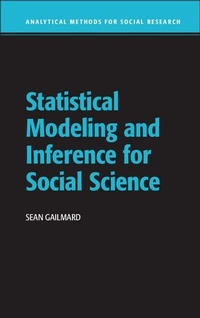
Statistical Modeling and Inference for Social Science
Published on 9. June 2014
Book
Hardback
388 pages
978-1-107-00314-9 (ISBN)
Description
Written specifically for graduate students and practitioners beginning social science research, Statistical Modeling and Inference for Social Science covers the essential statistical tools, models and theories that make up the social scientist's toolkit. Assuming no prior knowledge of statistics, this textbook introduces students to probability theory, statistical inference and statistical modeling, and emphasizes the connection between statistical procedures and social science theory. Sean Gailmard develops core statistical theory as a set of tools to model and assess relationships between variables - the primary aim of social scientists - and demonstrates the ways in which social scientists express and test substantive theoretical arguments in various models. Chapter exercises guide students in applying concepts to data, extending their grasp of core theoretical concepts. Students will also gain the ability to create, read and critique statistical applications in their fields of interest.
Reviews / Votes
'With careful consideration for both rigor and intuition, Gailmard fills a large void in the social science literature. Those seeking clear mathematical exposition will not be disappointed. Those hoping for substantive applications to illuminate the data analysis will also be pleased. This book strikes a nearly perfect balance.' Wendy K. Tam Cho, National Center for Supercomputing Applications and University of Illinois, Urbana-Champaign 'This is the single best book on modeling in social science - it goes beyond any extant book and will without a doubt become the standard text in methods courses throughout the social sciences.' James N. Druckman, Payson S. Wild Professor of Political Science, Northwestern University, Illinois 'In Statistical Modeling and Inference for Social Science, Gailmard provides a complete and well-written review of statistical modeling from the modern perspective of causal inference. It provides all the material necessary for an introduction to quantitative methods for social science students.' Jonathan N. Katz, Kay Sugahara Professor of Social Sciences and Statistics, and Chair, Division of the Humanities and Social Sciences, California Institute of TechnologyMore details
Series
Language
English
Place of publication
Cambridge
United Kingdom
Target group
Professional and scholarly
College/higher education
Illustrations
18 Tables, unspecified; 18 Line drawings, black and white
Dimensions
Height: 235 mm
Width: 157 mm
Thickness: 28 mm
Weight
785 gr
ISBN-13
978-1-107-00314-9 (9781107003149)
Copyright in bibliographic data and cover images is held by Nielsen Book Services Limited or by the publishers or by their respective licensors: all rights reserved.
Schweitzer Classification
Other editions
Additional editions
Sean Gailmard
Statistical Modeling and Inference for Social Science
Book
04/2017
Cambridge University Press
€46.90
Shipment within 15-20 days
Sean Gailmard
Statistical Modeling and Inference for Social Science
E-Book
06/2014
1st Edition
Cambridge University Press
€26.49
Available for download
Sean Gailmard
Statistical Modeling and Inference for Social Science
E-Book
06/2014
Cambridge University Press
€21.99
Available for download
Person
Sean Gailmard is Associate Professor of Political Science at the University of California, Berkeley. Formerly an Assistant Professor at Northwestern University and at the University of Chicago, Gailmard earned his PhD in Social Science (economics and political science) from the California Institute of Technology. He is the author of Learning While Governing: Institutions and Accountability in the Executive Branch (2013), winner of the 2013 American Political Science Association's William H. Riker Prize for best book on political economy. His articles have been published in a variety of journals, including American Political Science Review, American Journal of Political Science and Journal of Politics. He currently serves as an associate editor for the Journal of Experimental Political Science and on the editorial boards for Political Science Research and Methods and Journal of Public Policy.
Content
1. Introduction; 2. Descriptive statistics: data and information; 3. Observable data and data-generating processes; 4. Probability theory: basic properties of data-generating processes; 5. Expectation and moments: summaries of data-generating processes; 6. Probability and models: linking positive theories and data-generating processes; 7. Sampling distributions: linking data-generating processes and observable data; 8. Hypothesis testing: assessing claims about the data-generating process; 9. Estimation: recovering properties of the data-generating process; 10. Causal inference: inferring causation from correlation; Afterword: statistical methods and empirical research.