

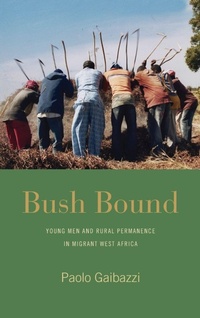
Bush Bound
Young Men and Rural Permanence in Migrant West Africa
1st Edition
Published on 1. August 2015
Book
Hardback
232 pages
978-1-78238-779-4 (ISBN)
Description
Whereas most studies of migration focus on movement, this book examines the experience of staying put. It looks at young men living in a Soninke-speaking village in Gambia who, although eager to travel abroad for money and experience, settle as farmers, heads of families, businessmen, civic activists, or, alternatively, as unemployed, demoted youth. Those who stay do so not only because of financial and legal limitations, but also because of pressures to maintain family and social bases in the Gambia valley. 'Stayers' thus enable migrants to migrate, while ensuring the activities and values attached to rural life are passed on to the future generations.
Reviews / Votes
"The book is an important piece of scholar- ship that demonstrates the continuing actuality and relevance of 'bush ethnography,'... In the tradition of the best anthropological work, it complicates our understanding of migration, highlighting the concept of permanence to counter both the Gambian state's rhetoric on youths' dreams of migration and the discourses of invasion by European populists. Thanks to its balanced mixture of historical documentation, quantitative data, and qualitative ethnography, this book will appeal equally to readers in migration studies and specialists of the Mande area." * African Studies Review"At a macro-micro level, this timely book exposes global transformations found in current globalist market economy and sheds light on the influences on these transformations as actualized at local level." * Anthropology Book Forum
"The book's strength lies in its innovative approach to analysing mobility and permanence as mutually constituting parts, with a keen concern with interpersonal relationships...Overall, Gaibazzi's analysis of the symbiotic relationship between permanence and migration advances our understanding of migration beyond the Marxist insights. In particular, his explanation of young men embrace of rural permanence in Sabi calls for a reconsideration of current discourses and representations of West Africa as a region constantly on the move." * Anthropological Forum
"... a readable, nuanced, and timely monograph, complemented by a glossary and by original photographs and maps. It responds to the under-theorization of emplacement in migration and transnationalism studies. It does so as a rich ethnography of rural permanence and global mobility, thus resisting, for the most part, over-theorizing on the subject." * Journal of the Royal Anthropological Institute
"[Gaibazzi's] research achieves a level of analytic clarity that should excite scholars of the contemporary realities of West Africa. With displaced peoples globally reaching numbers not seen since World War II, this contribution is both timely and critical." * American Ethnologist
"Bush Bound is a timely and important, but in ways counterintuitive, contribution to the scholarship on African migration to Europe and elsewhere... a compelling book that should be read by multiple audiences and not just those with an interest in Senegambia. Indeed, its greatest contribution is arguably the way it shifts the focus of the migration debate away from humanitarian platitudes to elucidating the complex, socially embedded (and historically deep) practices and ideas that fuel migration." * Journal of Modern African Studies
"A very interesting and significant study of young men in The Gambia illustrates the mutual dependence of those who migrate and those who 'sit' in the village and farm, arguing that both are valid forms of 'looking for money' in the modern world and that the village helps maintain social solidarity while inculcating values and skills that are as appropriate for migration as for village life." * Anthropology Review Database
"Bush Bound is, to my knowledge, the only scholarly monograph to examine so extensively the effects of mobility (and restricted mobility) on a migrant-sending community. As such, it offers a crucial complement and counter-weight to the many case studies of migrant communities in the social science literature." * Bruce Whitehouse, Lehigh University
"This is a very welcome, interesting, and original study ... Rather than concentrating on the economic circuits of work and consumption or on the cultures of consumption - a frequent preoccupation in the research on young migrants - the emphasis is on young men's selfhood, identity, subjectivity, and active social imaginaries." * Ann Whitehead, University of Sussex
"The chapters ... convince the reader that sitting, or immobility, is part of the migration stories from Africa. The theoretical discussions in between the ethnography are interesting, as is his way of weaving in older ideas of anthropological thinkers." * Mirjam de Bruijn, Leiden University
More details
Language
English
Place of publication
Oxford
United Kingdom
Target group
College/higher education
Product notice
Library binding
Illustrations
Bibliography; Index; 16 Illustrations
Dimensions
Height: 235 mm
Width: 157 mm
Thickness: 17 mm
Weight
496 gr
ISBN-13
978-1-78238-779-4 (9781782387794)
DOI
10.3167/9781782387794
Copyright in bibliographic data and cover images is held by Nielsen Book Services Limited or by the publishers or by their respective licensors: all rights reserved.
Schweitzer Classification
Other editions
Additional editions
E-Book
08/2015
Berghahn Books
€82.99
Available for download
Person
Paolo Gaibazzi is a Social Anthropologist and a Research Fellow at the Leibniz-Zentrum Moderner Orient (ZMO), Berlin. In addition to (im)mobility in the Gambia, he has published on West African post-slavery, Euro-African borders and West African Muslim traders in Angola.
Content
List of Illustrations
Acknowledgements
Notes on Transliteration
Abbreviations
Introduction
From Ploughing the Sea to Navigating the Bush
Soninke Migration and the Young Men Who Stay Put
'Sitting': Creating and Inhabiting Immobility
The Onus of Rural Permanence
On Bush-bound Ethnography
Overview of the Book
A Brief Note on The Gambia
Chapter 1. Peasants by Other Means:(Im)mobility and the Making of a Village Mooring
'Sitting' Sabi, Creating Movement, 1902 - ca.1945
The Farmer-trader
New Routes and Roots in the Post-war Period
Parting Sedentary and Migrant Livelihoods: 1970s - Present
Bush Troubles: the Decline of the Rural Economy
The Rise of International Labour Migration
Barriers to International Migration
Diasporization, Transnationality and Urban Homes
The Traveller, the 'Sitter' and the Urban 'Sitter'
Chapter 2. Being-on-the-land: The Agri-culture of Migration
Of Bushmen and Moneymen
Earning Calloused Hands: The Embodiment of Rural Suffering
Cultivating an Agrarian Ethos
From Bush to Travel-bush
The Alienation of the Farmer?
Chapter 3. Looking for Money: Livelihood Trajectories in and out of Mobility
The Social Currency of Money
Locating the Bounty: Routes and Destinations
Two Hustlers
Navigating the Political Economy
Stranded in Circulation: From Spurious Travel to 'Sitting'
Wind in the Sails: the Economy of Support
Chapter 4. Just Sitting: The Spectre of Bare Immobility
Ghetto Youth: (Em)placing Male Sociability
Stilled Bodies and Burdened Heads
The Nerves Syndrome
Waiting: The Stilled Time of Sitting
The Virtue of Patience: Temporal Fixes to Spatial Problems
Chapter 5. Hesitant Patriarchs: Becoming a Household Head
The Ka
Becoming a Kagume: Ascent to Power or Buck Passing?
In a Meal Bowl: Ensuring Subsistence in an Extraverted Domestic Economy
Around a Meal Bowl: Creating Conviviality and Male Authority
Governing Change: Cooperation, Conflict and Translocality in Household Formation
Chapter 6. Civic Leaders? Reviving the Age Groups, Recapturing Permanence
The Sappanu
Youth, in the Active Voice
The Sabi Youth Committee
Quiet Ceremonies: Legal Innovation and Socio-moral Reforms
Conclusion: Possibilities
If...
Placing Immobility in Migration
Trailing on
Glossary
Bibliography
Acknowledgements
Notes on Transliteration
Abbreviations
Introduction
From Ploughing the Sea to Navigating the Bush
Soninke Migration and the Young Men Who Stay Put
'Sitting': Creating and Inhabiting Immobility
The Onus of Rural Permanence
On Bush-bound Ethnography
Overview of the Book
A Brief Note on The Gambia
Chapter 1. Peasants by Other Means:(Im)mobility and the Making of a Village Mooring
'Sitting' Sabi, Creating Movement, 1902 - ca.1945
The Farmer-trader
New Routes and Roots in the Post-war Period
Parting Sedentary and Migrant Livelihoods: 1970s - Present
Bush Troubles: the Decline of the Rural Economy
The Rise of International Labour Migration
Barriers to International Migration
Diasporization, Transnationality and Urban Homes
The Traveller, the 'Sitter' and the Urban 'Sitter'
Chapter 2. Being-on-the-land: The Agri-culture of Migration
Of Bushmen and Moneymen
Earning Calloused Hands: The Embodiment of Rural Suffering
Cultivating an Agrarian Ethos
From Bush to Travel-bush
The Alienation of the Farmer?
Chapter 3. Looking for Money: Livelihood Trajectories in and out of Mobility
The Social Currency of Money
Locating the Bounty: Routes and Destinations
Two Hustlers
Navigating the Political Economy
Stranded in Circulation: From Spurious Travel to 'Sitting'
Wind in the Sails: the Economy of Support
Chapter 4. Just Sitting: The Spectre of Bare Immobility
Ghetto Youth: (Em)placing Male Sociability
Stilled Bodies and Burdened Heads
The Nerves Syndrome
Waiting: The Stilled Time of Sitting
The Virtue of Patience: Temporal Fixes to Spatial Problems
Chapter 5. Hesitant Patriarchs: Becoming a Household Head
The Ka
Becoming a Kagume: Ascent to Power or Buck Passing?
In a Meal Bowl: Ensuring Subsistence in an Extraverted Domestic Economy
Around a Meal Bowl: Creating Conviviality and Male Authority
Governing Change: Cooperation, Conflict and Translocality in Household Formation
Chapter 6. Civic Leaders? Reviving the Age Groups, Recapturing Permanence
The Sappanu
Youth, in the Active Voice
The Sabi Youth Committee
Quiet Ceremonies: Legal Innovation and Socio-moral Reforms
Conclusion: Possibilities
If...
Placing Immobility in Migration
Trailing on
Glossary
Bibliography