

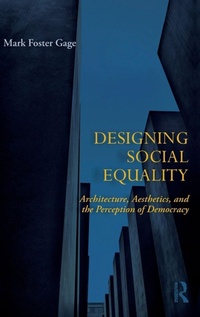
Designing Social Equality
Architecture, Aesthetics, and the Perception of Democracy
1st Edition
Published on 13. December 2018
Book
Hardback
132 pages
978-0-8153-6974-5 (ISBN)
Description
In Designing Social Equality, Mark Foster Gage proposes a dramatic realignment between aesthetic thought, politics, social equality, and the design of our physical world. By reconsidering historic concepts from aesthetic philosophy and weaving them with emerging intellectual positions from a variety of disciplines, he sets out to design a more encompassing social theory for how humanity perceives its very reality, and how it might begin to more justly define that reality through new ways of reconsidering the built environment.
More details
Language
English
Place of publication
New York
United States
Publishing group
Taylor & Francis Inc
Target group
College/higher education
Dimensions
Height: 240 mm
Width: 161 mm
Thickness: 13 mm
Weight
388 gr
ISBN-13
978-0-8153-6974-5 (9780815369745)
Copyright in bibliographic data and cover images is held by Nielsen Book Services Limited or by the publishers or by their respective licensors: all rights reserved.
Schweitzer Classification
Other editions
Additional editions
Book
12/2018
1st Edition
Routledge
€62.60
Shipment within 15-20 days
E-Book
12/2018
1st Edition
Routledge
€55.49
Available for download
E-Book
12/2018
1st Edition
Routledge
€55.49
Available for download
Person
Mark Foster Gage is an internationally recognized architect and theorist. He has written extensively on the relationship between aesthetic philosophy and design in both academic and popular publications and edited defining books on the subject, including: Essential Texts: Aesthetic Theory for Architecture and Design (2008) and Aesthetics Equals Politics: New Discourses Across Art, Architecture and Philosophy (2019). Gage is the Principal of Mark Foster Gage Architects in New York City and Assistant Dean of the Yale School of Architecture, USA.
Content
Introduction 1. The Aesthetic Turn 2. The Politics of the Unknown 3. Aesthetic Distances Defined 4. From the Critical to the Speculative 5. Axiomatic Equality 6. Hierarchy and the Problem of the Privleged Observer 7. Race, Gender and the Politics of Omission 8. Philosophy and the Aesthetics of Social Engagement 9. The Equity of Equidistance 10. Strangely Equal 11. The Invitation of Curiosity 12. From Sustainability to Dark Ecology 13. Revising Practice and Pedagogy 14. The Death of Disciplinarity 15. Beyond Prattle Acknowledgements