

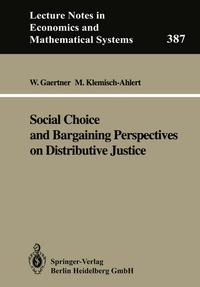
Social Choice and Bargaining Perspectives on Distributive Justice
Published on 12. October 1992
Book
Paperback/Softback
VIII, 136 pages
978-3-540-55815-6 (ISBN)
Description
It is probably fair to say that there does not exist a unique and generally accepted not ion of justice. Even if one confines oneself to economic justice one can still get many answers to the question of how justice - henceforth we shall use the term "distributive justice" should be defined and characterized. This may be disappointing for the outside observer but one can also view this as achallenge, at least as long as one thinks that distributive justice is an issue economics should be concerned with. Many problems of distributive justice can be described as follows: There is a fixed collection of well-defined objects (usually commodi ties) which are quantitatively measurable and perfectly divisible. This collection is to be divided up among a certain number of individuals, the members of society, let 's say. According to which principles or rules should this distribution be carried out? Should people be rewarded according to their ability or according to their needs? Should the distribution be such that nobody envies the bundle of any other member of society? Should the collection of entities be distributed in a way that yields the greatest benefi.
More details
Series
Language
English
Place of publication
Berlin
Germany
Publishing group
Springer Berlin
Target group
Professional and scholarly
Research
Illustrations
VIII, 136 p.
Dimensions
Height: 244 mm
Width: 170 mm
Thickness: 9 mm
Weight
269 gr
ISBN-13
978-3-540-55815-6 (9783540558156)
DOI
10.1007/978-3-662-02811-7
Schweitzer Classification
Content
1: Introduction.- 2: Distributive Judgments.- 3: Models of Bargaining and Distributive Justice.- 4: Axiomatic Characterizations of Gauthier's Bargaining Solution.- 5: Distributive Results in Bargaining Experiments.- Author Index.