

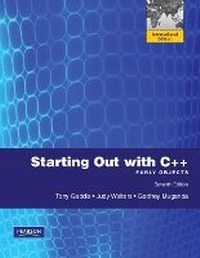
Starting Out with C++
Early Objects: International Edition
7th Edition
Published on 6. May 2010
Book
Mixed media product
1200 pages
978-0-13-137714-1 (ISBN)
Description
Tony Gaddis's accessible, step-by-step presentation helps beginning students understand the important details necessary to become skilled programmers at an introductory level. Gaddis motivates the study of both programming skills and the C++ programming language by presenting all the details needed to understand the "how" and the "why"-but never losing sight of the fact that most beginners struggle with this material. His approach is both gradual and highly accessible, ensuring that students understand the logic behind developing high-quality programs.
In Starting Out with C++: Early Objects, Gaddis covers objects and classes early after functions and before arrays and pointers. As with all Gaddis texts, clear and easy-to-read code listings, concise and practical real-world examples, and an abundance of exercises appear in every chapter. This text is intended for either a one-semester accelerated introductory course or a traditional two-semester sequence covering C++ programming.
In Starting Out with C++: Early Objects, Gaddis covers objects and classes early after functions and before arrays and pointers. As with all Gaddis texts, clear and easy-to-read code listings, concise and practical real-world examples, and an abundance of exercises appear in every chapter. This text is intended for either a one-semester accelerated introductory course or a traditional two-semester sequence covering C++ programming.
More details
Edition
7th edition
Language
English
Place of publication
United States
Publishing group
Pearson Education (US)
Target group
College/higher education
Dimensions
Height: 205 mm
Width: 253 mm
Thickness: 40 mm
Weight
1838 gr
ISBN-13
978-0-13-137714-1 (9780131377141)
Copyright in bibliographic data is held by Nielsen Book Services Limited or its licensors: all rights reserved.
Schweitzer Classification
Other editions
New editions
Tony Gaddis | Judy Walters | Godfrey Muganda
Starting Out with C++: Early Objects, International Edition
Book
06/2013
8th Edition
Pearson Education Limited
€73.03
Article exhausted; check for reprint
Previous edition
Book
08/2007
6th Edition
Pearson
€70.73
Article exhausted; check for reprint
Persons
Judy Walters is an Associate Professor of Computer Science at North Central College in Naperville, Illinois. In addition to her many computer science courses, she enjoys teaching a freshman course on film and literature. She also enjoys studying foreign languages and cultures, and recently developed a new course in technology and society, which she taught in Costa Rica Fall 2005, as part of the college's international studies program.
Godfrey Muganda is an Associate Professor of Computer Science at North Central College in Naperville, Illinois, where he chairs the Computer Science Department. He teaches a wide variety of courses at both the undergraduate and graduate levels including courses in Object-Oriented Programming, Comparative Programming Languages, and Complier Design. His primary research interests are in the Fuzzy Sets and Systems. He won the North Central College faculty award for outstanding scholarship in 1993.
Tony Gaddis is the principal author of the Starting Out with series of textbooks. Tony teaches computer science courses at Haywood Community College in North Carolina. He is a highly acclaimed instructor who was previously selected as the North Carolina Community College "Teacher of the Year," and has received the Teaching Excellence award from the National Institute for Staff and Organizational Development. Besides C++ books, the Starting Out with series includes introductory books using the Java (TM) programming language, Microsoft (R) Visual Basic (R) .NET, and Microsoft (R) C# (R), all published by Addison-Wesley.
Godfrey Muganda is an Associate Professor of Computer Science at North Central College in Naperville, Illinois, where he chairs the Computer Science Department. He teaches a wide variety of courses at both the undergraduate and graduate levels including courses in Object-Oriented Programming, Comparative Programming Languages, and Complier Design. His primary research interests are in the Fuzzy Sets and Systems. He won the North Central College faculty award for outstanding scholarship in 1993.
Tony Gaddis is the principal author of the Starting Out with series of textbooks. Tony teaches computer science courses at Haywood Community College in North Carolina. He is a highly acclaimed instructor who was previously selected as the North Carolina Community College "Teacher of the Year," and has received the Teaching Excellence award from the National Institute for Staff and Organizational Development. Besides C++ books, the Starting Out with series includes introductory books using the Java (TM) programming language, Microsoft (R) Visual Basic (R) .NET, and Microsoft (R) C# (R), all published by Addison-Wesley.
Content
CHAPTER 1 Introduction to Computers and Programming
CHAPTER 2 Introduction to C++
CHAPTER 3 Expressions and Interactivity
CHAPTER 4 Making Decisions
CHAPTER 5 Looping
CHAPTER 6 Functions
CHAPTER 7 Introduction to Classes and Objects
CHAPTER 8 Arrays
CHAPTER 9 Searching, Sorting, and Algorithm Analysis
CHAPTER 10 Pointers
CHAPTER 11 More About Classes and Object-Oriented Programming
CHAPTER 12 More About Characters, Strings, and the string Class
CHAPTER 13 Advanced File and I/O Operations
CHAPTER 14 Recursion
CHAPTER 15 Polymorphism and Virtual Functions
CHAPTER 16 Exceptions, Templates, and the Standard Template Library (STL)
CHAPTER 17 Linked Lists
CHAPTER 18 Stacks and Queues
CHAPTER 19 Binary Trees
Appendix A: The ASCII Character Set
Appendix B: Operator Precedence and Associativity
Index
Student CD
The following appendices are on the accompanying Student CD.
Appendix C: A Brief Introduction to Object-Oriented Programming (revised)
Appendix D: Using UML in Class Design
Appendix E: Namespaces
Appendix F: Passing Command Line Arguments
Appendix G: Header File and Library Function Reference
Appendix H: Binary Numbers and Bitwise Operations
Appendix I: C++ Casts and Run-Time Type Identification
Appendix J: Multi-Source File Programs
Appendix K: Multiple and Virtual Inheritance (new)
Appendix L: Introduction to the MinGW C++ Compiler and the wxDev-C++ IDE (new)
Appendix M: Introduction to Microsoft Visual C++ 2008 Express Edition (new)
Appendix N: .NET and Managed C++
Appendix O: Introduction to Flowcharting
Appendix P: Answers to Checkpoints
Appendix Q: Answers to Odd-Numbered Review Questions
CHAPTER 2 Introduction to C++
CHAPTER 3 Expressions and Interactivity
CHAPTER 4 Making Decisions
CHAPTER 5 Looping
CHAPTER 6 Functions
CHAPTER 7 Introduction to Classes and Objects
CHAPTER 8 Arrays
CHAPTER 9 Searching, Sorting, and Algorithm Analysis
CHAPTER 10 Pointers
CHAPTER 11 More About Classes and Object-Oriented Programming
CHAPTER 12 More About Characters, Strings, and the string Class
CHAPTER 13 Advanced File and I/O Operations
CHAPTER 14 Recursion
CHAPTER 15 Polymorphism and Virtual Functions
CHAPTER 16 Exceptions, Templates, and the Standard Template Library (STL)
CHAPTER 17 Linked Lists
CHAPTER 18 Stacks and Queues
CHAPTER 19 Binary Trees
Appendix A: The ASCII Character Set
Appendix B: Operator Precedence and Associativity
Index
Student CD
The following appendices are on the accompanying Student CD.
Appendix C: A Brief Introduction to Object-Oriented Programming (revised)
Appendix D: Using UML in Class Design
Appendix E: Namespaces
Appendix F: Passing Command Line Arguments
Appendix G: Header File and Library Function Reference
Appendix H: Binary Numbers and Bitwise Operations
Appendix I: C++ Casts and Run-Time Type Identification
Appendix J: Multi-Source File Programs
Appendix K: Multiple and Virtual Inheritance (new)
Appendix L: Introduction to the MinGW C++ Compiler and the wxDev-C++ IDE (new)
Appendix M: Introduction to Microsoft Visual C++ 2008 Express Edition (new)
Appendix N: .NET and Managed C++
Appendix O: Introduction to Flowcharting
Appendix P: Answers to Checkpoints
Appendix Q: Answers to Odd-Numbered Review Questions