

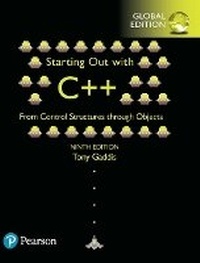
Starting Out with C++ from Control Structures through Objects, Global Edition
9th Edition
Published on 21. November 2018
Book
Paperback/Softback
1344 pages
978-1-292-22233-2 (ISBN)
Description
A clear and student-friendly way to teach the fundamentals of C++
Starting Out with C++: From Control Structures through Objects covers control structures, functions, arrays, and pointers before objects and classes in Tony Gaddis's hallmark accessible, step-by-step presentation.
His books help beginning students understand the important details necessary to become skilled programmers at an introductory level. Gaddis motivates the study of both programming skills and the C++ programming language by presenting all the details needed to understand the "how" and the "why"-but never losing sight of the fact that most beginners struggle with this material. His approach is gradual and highly accessible, ensuring that students understand the logic behind developing high-quality programs. As with all Gaddis texts, clear and easy-to-read code listings, concise and practical real-world examples, and an abundance of exercises appear in every chapter. Updates to the 9th Edition include revised, improved problems throughout and a new chapter featuring completely rewritten and expanded material on the Standard Template Library (STL).
Starting Out with C++: From Control Structures through Objects covers control structures, functions, arrays, and pointers before objects and classes in Tony Gaddis's hallmark accessible, step-by-step presentation.
His books help beginning students understand the important details necessary to become skilled programmers at an introductory level. Gaddis motivates the study of both programming skills and the C++ programming language by presenting all the details needed to understand the "how" and the "why"-but never losing sight of the fact that most beginners struggle with this material. His approach is gradual and highly accessible, ensuring that students understand the logic behind developing high-quality programs. As with all Gaddis texts, clear and easy-to-read code listings, concise and practical real-world examples, and an abundance of exercises appear in every chapter. Updates to the 9th Edition include revised, improved problems throughout and a new chapter featuring completely rewritten and expanded material on the Standard Template Library (STL).
More details
Edition
9th edition
Language
English
Place of publication
Harlow
United Kingdom
Target group
College/higher education
Dimensions
Height: 254 mm
Width: 202 mm
Thickness: 42 mm
Weight
2220 gr
ISBN-13
978-1-292-22233-2 (9781292222332)
Copyright in bibliographic data and cover images is held by Nielsen Book Services Limited or by the publishers or by their respective licensors: all rights reserved.
Schweitzer Classification
Other editions
Additional editions
E-Book
08/2018
9th Edition
Pearson Education Limited
from
€58.19
Available for download
Previous edition
Book
08/2014
8th Edition
Pearson Education Limited
€94.27
Article exhausted; check for reprint
Content
1. Introduction to Computers and Programming
2. Introduction to C++
3. Expressions and Interactivity
4. Making Decisions
5. Loops and Files
6. Functions
7. Arrays and Vectors
8. Searching and Sorting Arrays
9. Pointers
10. Characters, C-Strings, and More about the string Class
11. Structured Data
12. Advanced File Operations
13. Introduction to Classes
14. More about Classes
15. Inheritance, Polymorphism, and Virtual Functions
16. Exceptions and Templates
17. The Standard Template Library
18. Linked Lists
19. Stacks and Queues
20. Recursion
21. Binary Trees
Appendix A: The ASCII Character Set
Appendix B: Operator Precedence and Associativity
Quick References
2. Introduction to C++
3. Expressions and Interactivity
4. Making Decisions
5. Loops and Files
6. Functions
7. Arrays and Vectors
8. Searching and Sorting Arrays
9. Pointers
10. Characters, C-Strings, and More about the string Class
11. Structured Data
12. Advanced File Operations
13. Introduction to Classes
14. More about Classes
15. Inheritance, Polymorphism, and Virtual Functions
16. Exceptions and Templates
17. The Standard Template Library
18. Linked Lists
19. Stacks and Queues
20. Recursion
21. Binary Trees
Appendix A: The ASCII Character Set
Appendix B: Operator Precedence and Associativity
Quick References