

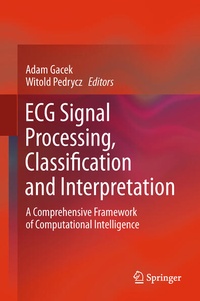
ECG Signal Processing, Classification and Interpretation
A Comprehensive Framework of Computational Intelligence
Published on 2. December 2014
Book
Paperback/Softback
X, 278 pages
978-1-4471-5920-9 (ISBN)
Description
The book shows how the various paradigms of computational intelligence, employed either singly or in combination, can produce an effective structure for obtaining often vital information from ECG signals. The text is self-contained, addressing concepts, methodology, algorithms, and case studies and applications, providing the reader with the necessary background augmented with step-by-step explanation of the more advanced concepts. It is structured in three parts: Part I covers the fundamental ideas of computational intelligence together with the relevant principles of data acquisition, morphology and use in diagnosis; Part II deals with techniques and models of computational intelligence that are suitable for signal processing; and Part III details ECG system-diagnostic interpretation and knowledge acquisition architectures. Illustrative material includes: brief numerical experiments; detailed schemes, exercises and more advanced problems.
More details
Product info
Previously published in hardcover
Edition
2012 ed.
Language
English
Place of publication
London
United Kingdom
Target group
Professional and scholarly
Research
Illustrations
X, 278 p.
Dimensions
Height: 235 mm
Width: 155 mm
Thickness: 16 mm
Weight
441 gr
ISBN-13
978-1-4471-5920-9 (9781447159209)
DOI
10.1007/978-0-85729-868-3
Schweitzer Classification
Other editions
Additional editions
Adam Gacek | Witold Pedrycz
ECG Signal Processing, Classification and Interpretation
A Comprehensive Framework of Computational Intelligence
Book
09/2011
Springer
€106.99
Shipment within 15-20 days
Adam Gacek | Witold Pedrycz
ECG Signal Processing, Classification and Interpretation
A Comprehensive Framework of Computational Intelligence
E-Book
09/2011
1st Edition
Springer
€96.29
Available for download
Persons
PhD and DSci degrees. Doctor Gacek's research interests are in biomedical instrumentation and signal processing, especially a detection and analysis of ECG signals, based on fuzzy set theory and information granulation methods. He has been involved in research based on application of Computational Intelligence in biomedical signal processing. Doctor Gacek has published numerous papers concerning biomedical instrumentation and signal processing.He is a member of the Institute of Electrical Electronics and Engineering (IEEE) and the Association for Computing Machinery (ACM). He is also a member of the Polish Society of Biomedical Engineering, the Committee of Biocybernetics and Biomedical Engineering of Polish Academy of Science and the Polish Society of Theoretical and Applied Electrotechnics. Witold Pedrycz is a Professor and Canada Research Chair (CRC) in the Department of Electrical and Computer Engineering, University of Alberta, Edmonton, Canada. He is also with the Systems Research Institute of the Polish Academy of Sciences. Professor Pedrycz is a Foreign Member of the Polish Academy of Sciences. He is actively pursuing research in Computational Intelligence, fuzzy modeling, knowledge discovery and data mining, fuzzy control including fuzzy controllers, pattern recognition, knowledge-based neural networks, relational computation, bioinformatics, and Software Engineering. He has published numerous papers in this area. He is also an author of 14 research monographs covering various aspects of Computational Intelligence and Software Engineering.Witold Pedrycz has been a member of numerous program committees of conferences in the area of fuzzy sets and neurocomputing. He currently serves as Editor in Chief of IEEE Trans. on Systems, Man and Cybernetics, Part A and Information Sciences. He is also an Associate Editor of IEEE Transactions on Fuzzy Systems. Doctor Pedrycz is an Editor-in-Chief of Information Sciences. He isa Past President of IFSA and Past President of NAFIPS.
Content
Part I: Introduction.- Introduction to ECG Signal Processing.- Fuzzy Sets: A Primer.- Neural Networks and Neurocomputing.- Evolutionary and Population-based Optimization.- Part II: Techniques and Models of Computational Intelligence for ECG Signal Analysis and Classification.- Neurocomputing in ECG Signal Classification.- Knowledge-based Representation and Processing of ECG Signals: A Fuzzy Set Approach.- Evolutionary Optimization of ECG Signal Analysis and Classification.- Granular Models of ECG Signal Analysis and Their Refinements and Abstractions.- Hybrid Architectures of ECG Analyzers and Classifiers. Part III: Computational-intelligence-based ECG System Diagnostic, Interpretation and Knowledge Acquisition Architectures.- Diagnostic ECG Systems and Computational Intelligence: Development Issues.- Interpretation of ECG Signals: A Systems Approach.- Knowledge Representation and ECG Diagnostic and Interpretation Systems.