

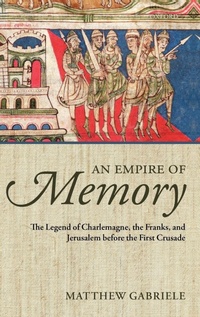
An Empire of Memory
The Legend of Charlemagne, the Franks, and Jerusalem before the First Crusade
1st Edition
Published on 24. March 2011
Book
Hardback
216 pages
978-0-19-959144-2 (ISBN)
Description
Beginning shortly after Charlemagne's death in 814, the inhabitants of his historical empire looked back upon his reign and saw in it an exemplar of Christian universality - Christendom. They mapped contemporary Christendom onto the past and so, during the ninth, tenth, and eleventh centuries, the borders of his empire grew with each retelling, almost always including the Christian East. Although the pull of Jerusalem on the West seems to have been strong during the eleventh century, it had a more limited effect on the Charlemagne legend. Instead, the legend grew during this period because of a peculiar fusion of ideas, carried forward from the ninth century but filtered through the social, cultural, and intellectual developments of the intervening years.
Paradoxically, Charlemagne became less important to the Charlemagne legend. The legend became a story about the Frankish people, who believed they had held God's favour under Charlemagne and held out hope that they could one day reclaim their special place in sacred history. Indeed, popular versions of the Last Emperor legend, which spoke of a great ruler who would reunite Christendom in preparation for the last battle between good and evil, promised just this to the Franks. Ideas of empire, identity, and Christian religious violence were potent reagents. The mixture of these ideas could remind men of their Frankishness and move them, for example, to take up arms, march to the East, and reclaim their place as defenders of the faith during the First Crusade.
An Empire of Memory uses the legend of Charlemagne, an often-overlooked current in early medieval thought, to look at how the contours of the relationship between East and West moved across centuries, particularly in the period leading up to the First Crusade.
Paradoxically, Charlemagne became less important to the Charlemagne legend. The legend became a story about the Frankish people, who believed they had held God's favour under Charlemagne and held out hope that they could one day reclaim their special place in sacred history. Indeed, popular versions of the Last Emperor legend, which spoke of a great ruler who would reunite Christendom in preparation for the last battle between good and evil, promised just this to the Franks. Ideas of empire, identity, and Christian religious violence were potent reagents. The mixture of these ideas could remind men of their Frankishness and move them, for example, to take up arms, march to the East, and reclaim their place as defenders of the faith during the First Crusade.
An Empire of Memory uses the legend of Charlemagne, an often-overlooked current in early medieval thought, to look at how the contours of the relationship between East and West moved across centuries, particularly in the period leading up to the First Crusade.
Reviews / Votes
Matthew Gabriele has made a powerful and convincing attempt to show that the evolution of Charlemagne myths can reveal a Frankish sense of manifest Christian destiny * Times Literary Supplement * As with all the best exercises in intellectual archaeology, Gabrieles book raises as many questions as it claims to answer. It is a monograph in the very best sense of the term, showing how a field that some might presume mined to exhaustion can still yield up a rich, albeit highly speculative seam of ore. * Nicholas Vincent, History * I really like this book and learned a lot from it... The argument and research are critical, thorough, and sound. * Thomas F.X. Noble, The Medieval Review * the depth of analysis on offer here and its relevance to debates about memory makes this a hugely welcome addition to a growing body of research. * Christian Harding, Journal of Ecclesiastical History * This efficiently argued and interesting book is an informed and thoughtful discussion of the ideas and associations that attached themselves to the memory of Charlemagne between the reign of his successor Louis the Pious and the First Crusade. * Marcus Bull, Crusades * a bold and interesting argument * David Rollason, English Historical Review *More details
Language
English
Place of publication
Oxford
United Kingdom
Target group
College/higher education
Academics, graduate, and undergraduate students of medieval history.
Illustrations
8 black and white images
Dimensions
Height: 240 mm
Width: 161 mm
Thickness: 16 mm
Weight
493 gr
ISBN-13
978-0-19-959144-2 (9780199591442)
Copyright in bibliographic data and cover images is held by Nielsen Book Services Limited or by the publishers or by their respective licensors: all rights reserved.
Schweitzer Classification
Other editions
Additional editions
Matthew Gabriele
An Empire of Memory
The Legend of Charlemagne, the Franks, and Jerusalem before the First Crusade
Book
09/2013
Oxford University Press
€72.00
Shipment within 15-20 days
Person
Matthew Gabriele received his Ph.D. in History from the University of California, Berkeley. He has published widely on topics related to Charlemagne, kingship, and religiosity in the eleventh century. He has also co-edited, with Jace Stuckey, an interdisciplinary volume of essays on the medieval legend of Charlemagne entitled The Legend of Charlemagne in the Middle Ages: Power, Faith, and Crusade. His next project investigates how a shift in language signalled a change in how the West understood the relationship between past, present, and future.
Content
PART I: THE FRANKS REMEMBER EMPIRE; PART II: JERUSALEM; PART III: THE FRANKS RECREATE EMPIRE