

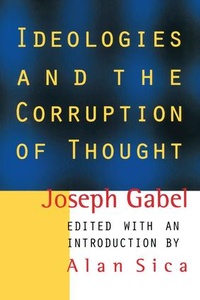
Ideologies and the Corruption of Thought
1st Edition
Will be published approx. on 28. February 1997
Book
Hardback
238 pages
978-1-56000-287-1 (ISBN)
Description
Edited and with an introduction by Alan Sica.
In 1975 Joseph Gabel published a modern masterpiece which appeared in English as False Consciousness: An Essay on Reification. Combining his special knowledge of existential psychiatry, axiology, Marxism, and political history, Gabel proposed the utterly novel idea that victims of serious mental disturbances (especially paranoia and schizophrenia) reproduce those distorted thought patterns commonly associated with ideological beliefs at the collective level. Such beliefs initially had been laid bare in the 1920s by Gabel's intellectual progenitors, Karl Mannheim and George Lukacs. Gabel's remarkable innovation was to transfer the private crisis of mental collapse into the analytic framework previously reserved for ideological critique, making him an expert on what was later called "the micro-macro problem."
Ideologies and the Corruption of Thought
includes Gabel's essays over the last 40 years, characteristically treating micro and macro theoretical matters simultaneously. Originally written in French and German, they have been recast in idiomatic English and bibliographically updated. Using a unique mode and vocabulary of analysis, Gabel offers theoretical investigations of McCarthyism and Stalinism (original and more recent types), as well as Althusser, Orwell, and Jonathan Swift in his capacity as a psychiatric theorist. He also explores anti-Zionism, anti-Semitism, and a fascinating case study of a paranoid who regarded himself as the pope. In addition this volume includes a range of general commentaries on ideological "thought," utopianism, and false consciousness.This rich feast of social and political analysis and theory illuminates a range of contemporary concerns: racism, utopian fantasy, ethnocentrism, anti-Semitism, the interplay of social structure and mental illness, and ideological transformations of social life, which only Gabel's unique mixture of the clinical and the political could achieve. It will be studied with interest by all theorists and politically alert readers in the social sciences, philosophy, and related fields of study.
In 1975 Joseph Gabel published a modern masterpiece which appeared in English as False Consciousness: An Essay on Reification. Combining his special knowledge of existential psychiatry, axiology, Marxism, and political history, Gabel proposed the utterly novel idea that victims of serious mental disturbances (especially paranoia and schizophrenia) reproduce those distorted thought patterns commonly associated with ideological beliefs at the collective level. Such beliefs initially had been laid bare in the 1920s by Gabel's intellectual progenitors, Karl Mannheim and George Lukacs. Gabel's remarkable innovation was to transfer the private crisis of mental collapse into the analytic framework previously reserved for ideological critique, making him an expert on what was later called "the micro-macro problem."
Ideologies and the Corruption of Thought
includes Gabel's essays over the last 40 years, characteristically treating micro and macro theoretical matters simultaneously. Originally written in French and German, they have been recast in idiomatic English and bibliographically updated. Using a unique mode and vocabulary of analysis, Gabel offers theoretical investigations of McCarthyism and Stalinism (original and more recent types), as well as Althusser, Orwell, and Jonathan Swift in his capacity as a psychiatric theorist. He also explores anti-Zionism, anti-Semitism, and a fascinating case study of a paranoid who regarded himself as the pope. In addition this volume includes a range of general commentaries on ideological "thought," utopianism, and false consciousness.This rich feast of social and political analysis and theory illuminates a range of contemporary concerns: racism, utopian fantasy, ethnocentrism, anti-Semitism, the interplay of social structure and mental illness, and ideological transformations of social life, which only Gabel's unique mixture of the clinical and the political could achieve. It will be studied with interest by all theorists and politically alert readers in the social sciences, philosophy, and related fields of study.
More details
Language
English
Place of publication
New York
United States
Publishing group
Taylor & Francis Inc
Target group
College/higher education
Professional and scholarly
Dimensions
Height: 229 mm
Width: 152 mm
Weight
180 gr
ISBN-13
978-1-56000-287-1 (9781560002871)
Copyright in bibliographic data and cover images is held by Nielsen Book Services Limited or by the publishers or by their respective licensors: all rights reserved.
Schweitzer Classification
Other editions
Additional editions
Joseph Gabel | Alan Sica
Ideologies and the Corruption of Thought
Book
02/2018
1st Edition
Routledge
€64.00
Shipment within 10-20 days
Joseph Gabel | Alan Sica
Ideologies and the Corruption of Thought
E-Book
01/2018
1st Edition
Routledge
€64.49
Available for download
Persons
Joseph Gabel was born in Hungary, and educated in French universities. He is the author of False Consciousness (1962); Sociology of Alienation (1970); Ideologies, Vol. I (1974); Ideologies II (1978), all in French. His book on The Forms of Estrangement (1964) was published in German. His shorter articles have appeared in Kolner Zeitschrift for Soziologie und Sozial-psychologie, and the Newsletter of the International Society for the Sociology of Knowledge.
Content
Introduction: Bridging Pathologies of the Individual and the Collective: Gabel's Contribution to Contemporary Analysis; 1: Utopian Consciousness and False Consciousness; 2: Political Delusion of a Paranoid Patient; 3: Axiology and Dialectics; 4: Durkheimianism and Political Allenation: Durkheim and Marx; 5: Jonathan Swift as Forerunner of the Theory of "Morbid Geometrism"; 6: Althusser and Orwell; 7: Political Ideologies; 8: Stalinism as Ideology: An Ideal-Type of Ideological Distortion; 9: McCarthyism: An American Form of Political False Consciousness; 10: Eugene Minkowski and the Problem of Allenation; 11: Effet Pervers and False Consciousness; 12: Racist Consciousness as a Form of False Consciousness; 13: Anti-Zionism as Ideology; 14: The Psychology of De-Stalinization and the Problem of Political Allenation; Epilogue: From Schizophrenia to False Consciousness: Joseph Gabel and Theories of Psychopathology