

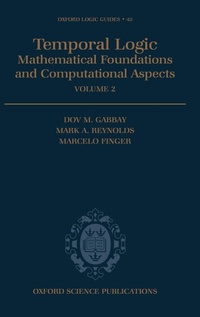
Temporal Logic: Volume 2
Mathematical Foundations and Computational Aspects Volume 2
Published on 30. March 2000
Book
Hardback
612 pages
978-0-19-853768-7 (ISBN)
Description
This is the second volume of this respected work in temporal logic. Whereas volume 1 dealt primarily with basic concepts and methods, volume 2 discusses the more applicable aspects of temporal logics. The first four chapters continue the more theoretical presentations in volume 1, covering automata, branching time and labelled deduction. The rest of the book discusses temporal databases, temporal execution and programming, actions and planning.
More details
Series
Language
English
Place of publication
Oxford
United Kingdom
Target group
Professional and scholarly
Illustrations
line figures
Dimensions
Height: 240 mm
Width: 161 mm
Thickness: 37 mm
Weight
1074 gr
ISBN-13
978-0-19-853768-7 (9780198537687)
Copyright in bibliographic data and cover images is held by Nielsen Book Services Limited or by the publishers or by their respective licensors: all rights reserved.
Schweitzer Classification
Persons
Content
1. Introduction and overview ; 2. Temporal logic and automata ; 3. Branching time ; 4. Labelled deduction presentation of temporal logics ; 5. Temporal logic programming ; 6. Combining temporal logic systems ; 7. Extensional semantics ; 8. Intervals and planning ; 9. Many-dimensional systems and generalized quantifiers ; 10. The declarative past and imperative future ; 11. The METATEM programming language ; 12. METATEM in intensive care ; 13. Nonmonotonic coding of the declarative past ; 14. A logical view of temporal databases ; 15. A logical view of temporal database dynamics ; 16. Temporal conceptual-level databases ; 17. Temporal active databases: a background for creating and detecting time paradoxes ; 18. Calendar logic