

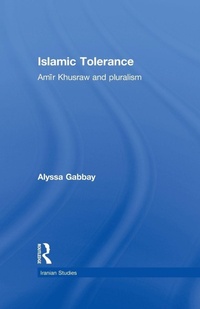
Islamic Tolerance
Amir Khusraw and Pluralism
1st Edition
Published on 15. August 2014
Book
Paperback/Softback
160 pages
978-1-138-78927-2 (ISBN)
Description
Although pluralism and religious tolerance are most often associated today with Western Enlightenment thinkers, the roots of these ideologies stretch back to non-Western and premodern societies, including many under Muslim rule. This book explores the development of pluralism in Islam in South Asia through the work of the poet, historian and musician Amir Khusraw and sheds new light on how Islam developed its own culture of tolerance.
Countering stereotypes of Islam as intrinsically intolerant, the book provides a better understanding of how rhetorics of pluralism develop, which may aid in identifying and encouraging such discourses in the present. Khusraw, a practicing Muslim who showed great affection toward Hindus and used much indigenous imagery in his poetry, is an ideal figure through whom to explore these issues. Addressing issues of ethnicity, religion and gender in the early medieval period, Alyssa Gabbay demonstrates the pre-modern precedents for pluralism, conveying the broad sweep of Perso-Islamicate culture and the profound transformations it underwent in medieval South Asia.
Accurately depicting the paradoxicality and jaggedness involved in the development of its composite culture, this book will have great relevance to scholars and students of Islam in South Asia, gender, religious pluralism, and Persian literature.
Countering stereotypes of Islam as intrinsically intolerant, the book provides a better understanding of how rhetorics of pluralism develop, which may aid in identifying and encouraging such discourses in the present. Khusraw, a practicing Muslim who showed great affection toward Hindus and used much indigenous imagery in his poetry, is an ideal figure through whom to explore these issues. Addressing issues of ethnicity, religion and gender in the early medieval period, Alyssa Gabbay demonstrates the pre-modern precedents for pluralism, conveying the broad sweep of Perso-Islamicate culture and the profound transformations it underwent in medieval South Asia.
Accurately depicting the paradoxicality and jaggedness involved in the development of its composite culture, this book will have great relevance to scholars and students of Islam in South Asia, gender, religious pluralism, and Persian literature.
Reviews / Votes
"This book marks an important landmark in scholarship on classical Persian literature and medieval South Asian history... This excellent book, meticulously researched and lucidly written, has much to offer scholars of religion, literature, and history, both from the view of comparative studies in Islamic societies and of the culture of medieval South Asia. It succeeds in demonstrating the complexity of Amir Khusraw's position in history and that it is possible to study his writings outside the usual paradigm of his relationship with his spiritual master, Nizamuddin Awliya."- Sunil Sharma, Department of Modem Languages and Comparative Literature, Boston University; International Journal of Middle East Studies 44 (2012)More details
Series
Language
English
Place of publication
London
United Kingdom
Publishing group
Taylor & Francis Ltd
Target group
College/higher education
Dimensions
Height: 216 mm
Width: 140 mm
Thickness: 9 mm
Weight
211 gr
ISBN-13
978-1-138-78927-2 (9781138789272)
Copyright in bibliographic data and cover images is held by Nielsen Book Services Limited or by the publishers or by their respective licensors: all rights reserved.
Schweitzer Classification
Other editions
Additional editions
E-Book
05/2010
Routledge
€77.99
Available for download
E-Book
05/2010
Routledge
€77.99
Available for download
Book
05/2010
1st Edition
Routledge
€241.00
Shipment within 15-20 days
Person
Alyssa Gabbay is a cultural historian whose work on medieval and early modern Persianate societies sits at the intersections of literature, gender, and history. A graduate of the University of Chicago, she is currently a visiting scholar at the University of Washington.
Content
1. Introduction: "O Wind, Tell the Demons and Fairies" A Call for Reconciliation in Northern India 2. The Framework of Frontier Studies: When Two Cultures Meet 3. Setting New Standards of Islamic Legitimacy in the Dibachah, 1293-94 4. Balancing Gender Roles: Male/Female Dynamics in the Hasht Bihisht, 1301-2 5. "They see My Hindu Kill in the Style of Turks": The Dismantling of a Dichotomy in the Nuh Sipihr, 1318-19 6. Conclusion: "Glorious the Radiance of that Exalted Sun": Pluralistic Ideals on the Subcontinent and Beyond