

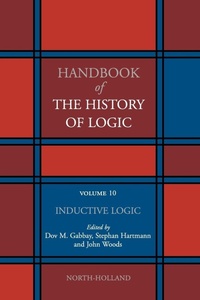
Inductive Logic: Volume 10
Published on 5. May 2011
Book
Hardback
800 pages
978-0-444-52936-7 (ISBN)
Description
Inductive Logic is number ten in the 11-volume Handbook of the History of Logic. While there are many examples were a science split from philosophy and became autonomous (such as physics with Newton and biology with Darwin), and while there are, perhaps, topics that are of exclusively philosophical interest, inductive logic - as this handbook attests - is a research field where philosophers and scientists fruitfully and constructively interact. This handbook covers the rich history of scientific turning points in Inductive Logic, including probability theory and decision theory. Written by leading researchers in the field, both this volume and the Handbook as a whole are definitive reference tools for senior undergraduates, graduate students and researchers in the history of logic, the history of philosophy, and any discipline, such as mathematics, computer science, cognitive psychology, and artificial intelligence, for whom the historical background of his or her work is a salient consideration.
More details
Series
Language
English
Place of publication
United States
Publishing group
Elsevier Science & Technology
Target group
Professional and scholarly
Researchers and graduate students in all areas of logic: Historians of logic, cognitive psychologists, computer scientists, AI theorists, theorists of legal reasoning.
Product notice
Laminated cover
Dimensions
Height: 259 mm
Width: 185 mm
Thickness: 41 mm
Weight
1793 gr
ISBN-13
978-0-444-52936-7 (9780444529367)
Copyright in bibliographic data and cover images is held by Nielsen Book Services Limited or by the publishers or by their respective licensors: all rights reserved.
Schweitzer Classification
Other editions
Additional editions
Persons
Dov M. Gabbay is Augustus De Morgan Professor Emeritus of Logic at the Group of Logic, Language and Computation, Department of Computer Science, King's College London. He has authored over four hundred and fifty research papers and over thirty research monographs. He is editor of several international Journals, and many reference works and Handbooks of Logic.
Content
Introduction (Dov Gabbay, Stephan Hartman and John Woods)
Induction before Hume (J. R. Milton)
Hume and the Problem of Induction (Marc Lange)
The Debate between Whewell and Mill on the Nature of Scientific Induction (Malcolm Forster)
An Explorer upon Untrodden Ground: Peirce on Abduction (Stathis Psillos)
The Modern Epistemic Interpretations of Probability: Logicism and Subjectivism (Maria Carla Galavotti)
Popper and Hypothetico-deductivism (Alan Musgrave)
Hempel and the Paradoxes of Confirmation (Jan Sprenger)
Carnap and the Logic of Induction (Sandy Zabell)
The Development of the Hintikka Program (Ilkka Niiniluoto)
Hans Reichenbach's Probability Logic (Frederick Eberhardt and Clark Glymour)
Goodman and the Demise of Syntactic and Semantics Models (Robert Schwartz)
Development of Subjective Bayesianism (James Joyce)
Varieties of Bayesianism (Jonathan Weisberg)
Inductive Logic and Empirical Psychology (Nick Chater, Mike Oaksford, Ulrike Hahn and Evan Heit)
Inductive Logic and Statistics (Jan-Willem Romeijn)
Statistical Learning Theory (Ulrike von Luxburg and Bernhard Schoelkopf)
Formal Learning Theory in Context (Daniel Osherson and Scott Weinstein)
Mechanizing Induction (Ronald Ortner and Hannes Leitgeb)
Index
Induction before Hume (J. R. Milton)
Hume and the Problem of Induction (Marc Lange)
The Debate between Whewell and Mill on the Nature of Scientific Induction (Malcolm Forster)
An Explorer upon Untrodden Ground: Peirce on Abduction (Stathis Psillos)
The Modern Epistemic Interpretations of Probability: Logicism and Subjectivism (Maria Carla Galavotti)
Popper and Hypothetico-deductivism (Alan Musgrave)
Hempel and the Paradoxes of Confirmation (Jan Sprenger)
Carnap and the Logic of Induction (Sandy Zabell)
The Development of the Hintikka Program (Ilkka Niiniluoto)
Hans Reichenbach's Probability Logic (Frederick Eberhardt and Clark Glymour)
Goodman and the Demise of Syntactic and Semantics Models (Robert Schwartz)
Development of Subjective Bayesianism (James Joyce)
Varieties of Bayesianism (Jonathan Weisberg)
Inductive Logic and Empirical Psychology (Nick Chater, Mike Oaksford, Ulrike Hahn and Evan Heit)
Inductive Logic and Statistics (Jan-Willem Romeijn)
Statistical Learning Theory (Ulrike von Luxburg and Bernhard Schoelkopf)
Formal Learning Theory in Context (Daniel Osherson and Scott Weinstein)
Mechanizing Induction (Ronald Ortner and Hannes Leitgeb)
Index