

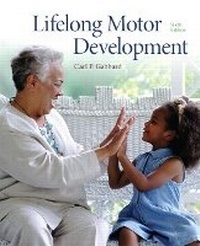
Lifelong Motor Development
6th Edition
Published on 23. June 2011
Book
Hardback
482 pages
978-0-321-73494-5 (ISBN)
Description
Lifelong Motor Development,Sixth Edition, is a comprehensive, science-based text covering background, theory, and research in the field of physical growth and motor behavior across the life span, as well as the practical application of these concepts. The Sixth edition focuses on the notion that the study of motor development is the study of change. In order to truly understand the multicausal and complex nature of motor development, this book was created and continues with the goal of introducing students to not a single theoretical explanation, but the most prominent theories and views that underscore our understanding of change in motor development-establishing the Sixth edition as still the most scientific, contemporary, and applicable text of its kind.
More details
Edition
6th edition
Language
English
Place of publication
United States
Publishing group
Pearson Education (US)
Target group
Professional and scholarly
Dimensions
Height: 232 mm
Width: 187 mm
Weight
780 gr
ISBN-13
978-0-321-73494-5 (9780321734945)
Copyright in bibliographic data and cover images is held by Nielsen Book Services Limited or by the publishers or by their respective licensors: all rights reserved.
Schweitzer Classification
Other editions
New editions
Carl P. Gabbard
Lifelong Motor Development
Book
10/2016
7th Edition
Lippincott Williams and Wilkins
€127.76
Article exhausted; check for reprint
Previous edition
Carl P. Gabbard
Lifelong Motor Development
Book
03/2007
5th Edition
Pearson Education (US)
€110.36
Article exhausted; check for reprint
Person
Carl Gabbard is Professor and Director of Motor Development Studies at Texas A&M University in College Station, Texas, and a Fellow of The American Academy of Kinesiology and Physical Education. He teaches both graduate and undergraduate courses in motor development. He has published numerous articles related to motor development and physical activity for infants and children. Gabbard has co-authored and reviewed several major curricular documents for National Association for Sport and Physical Education (NASPE) and the American Heart Association (AHA).
In addition to being honored as the Southern District AAHPERD Scholar in 2003, Gabbard has received the Karpovich Lecturer recognition from Springfield College and the Margie R. Hanson Distinguished Service Award from AAHPERD. Gabbard is a former president of the NASPE (membership of 18,000) and served as Chair of the Motor Development section for the North American Society for the Psychology of Sport and Physical Activity. He continues to be a contributing member of the Motor Development Academy.
In addition to being honored as the Southern District AAHPERD Scholar in 2003, Gabbard has received the Karpovich Lecturer recognition from Springfield College and the Margie R. Hanson Distinguished Service Award from AAHPERD. Gabbard is a former president of the NASPE (membership of 18,000) and served as Chair of the Motor Development section for the North American Society for the Psychology of Sport and Physical Activity. He continues to be a contributing member of the Motor Development Academy.
Content
I. AN OVERVIEW OF LIFELONG HUMAN DEVELOPMENT
1. Introduction to the Developmental Perspective
II. BIOLOGICAL GROWTH AND DEVELOPMENT
2. Heredity and Neurological Changes
3. Physical Growth Changes
4. Physiological Changes
5. Factors Affecting Growth and Development
III. PERCEPTION AND INFORMATION PROCESSING
6. Perceptual Development
7. Information Processing and Motor Control
IV. MOTOR BEHAVIOR ACROSS THE LIFE SPAN
8. Early Movement Behavior
9. Motor Behavior During Early Childhood
10. Motor Behavior During Later Childhood and Adolescence
11. Motor Behavior in the Adult Years
V. ASSESSING CHANGE
13. Sociocultural Influences on Motor Development
VI. SOCIOCULTURAL INFLUENCES ON MOTOR DEVELOPMENT
12. Assessment
1. Introduction to the Developmental Perspective
II. BIOLOGICAL GROWTH AND DEVELOPMENT
2. Heredity and Neurological Changes
3. Physical Growth Changes
4. Physiological Changes
5. Factors Affecting Growth and Development
III. PERCEPTION AND INFORMATION PROCESSING
6. Perceptual Development
7. Information Processing and Motor Control
IV. MOTOR BEHAVIOR ACROSS THE LIFE SPAN
8. Early Movement Behavior
9. Motor Behavior During Early Childhood
10. Motor Behavior During Later Childhood and Adolescence
11. Motor Behavior in the Adult Years
V. ASSESSING CHANGE
13. Sociocultural Influences on Motor Development
VI. SOCIOCULTURAL INFLUENCES ON MOTOR DEVELOPMENT
12. Assessment