

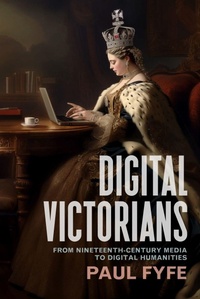
Digital Victorians
From Nineteenth-Century Media to Digital Humanities
Published on 29. October 2024
Book
Paperback/Softback
294 pages
978-1-5036-4094-8 (ISBN)
Description
Perhaps no period better clarifies our current crisis of digital information than the nineteenth century. Self-aware about its own epochal telecommunications changes and awash in a flood of print, the nineteenth century confronted the consequences of its media shifts in ways that still define contemporary responses. In this authoritative new work, Paul Fyfe argues that writing about Victorian new media continues to shape reactions to digital change. Among its unexpected legacies are what we call digital humanities, characterized by the self-reflexiveness, disciplinary reconfigurations, and debates that have made us digital Victorians, so to speak, struggling again to resituate humanities practices amid another technological revolution.
Engaging with writers such as Thomas De Quincey, George Eliot, George du Maurier, Henry James, and Robert Louis Stevenson who confronted the new media of their day, Fyfe shows how we have inherited Victorian anxieties about quantitative and machine-driven reading, professional obsolescence in the face of new technology, and more-telling a longer history of how writers, readers, and scholars adapt to dramatically changing media ecologies, then and now. The result is a predigital history for the digital humanities through nineteenth-century encounters with telecommunication networks, privacy intrusions, quantitative reading methods, remediation, and their effects on literary professionals. As Fyfe demonstrates, well before computers, the Victorians were already digital.
Engaging with writers such as Thomas De Quincey, George Eliot, George du Maurier, Henry James, and Robert Louis Stevenson who confronted the new media of their day, Fyfe shows how we have inherited Victorian anxieties about quantitative and machine-driven reading, professional obsolescence in the face of new technology, and more-telling a longer history of how writers, readers, and scholars adapt to dramatically changing media ecologies, then and now. The result is a predigital history for the digital humanities through nineteenth-century encounters with telecommunication networks, privacy intrusions, quantitative reading methods, remediation, and their effects on literary professionals. As Fyfe demonstrates, well before computers, the Victorians were already digital.
Reviews / Votes
"Fyfe makes a powerful case for tracing the origins of digital humanities to Victorians' debates about information overload. Digital Victorians offers an important and innovative contribution to digital humanities as a field, to media history, and to Victorian literary studies."-Jon Lawrence, University of Exeter "This work offers an exciting new lens for understanding the Victorian era. Fyfe ranks among the leaders in bringing together Victorian studies and the digital humanities, and this work shows him at the top of his game."
-Adrian Wisnicki, University of Nebraska-Lincoln "Full of elegant, surprising readings, Fyfe's book is required reading for anyone who is concerned about the material and epistemological stakes of how we know what we know about the past (and that should be all of us)."
-Meredith Martin, Princeton University "Fyfe's book offers much food for thought as well as fresh insight into both the Victorian period and today. With notes and illustrations, this volume is lucidly written and well organized. Highly recommended."-M. Anderson, CHOICE "Digital Victorians looks backward not only to freshen our view of the nineteenth century but also to sharpen our view of twenty-first-century debates and dilemmas that-in many ways, it contends-we have had before."-Richard Menke, Technology and Culture
More details
Series
Edition
New edition
Language
English
Place of publication
Palo Alto
United States
Target group
Professional and scholarly
Edition type
New edition
Product notice
Paperback (trade)
Illustrations
12 halftones
Dimensions
Height: 224 mm
Width: 152 mm
Thickness: 20 mm
Weight
424 gr
ISBN-13
978-1-5036-4094-8 (9781503640948)
Copyright in bibliographic data and cover images is held by Nielsen Book Services Limited or by the publishers or by their respective licensors: all rights reserved.
Schweitzer Classification
Other editions
Additional editions
E-Book
10/2024
Stanford University Press
€57.99
Available for download
Person
Paul Fyfe is Associate Professor in the Department of English, North Carolina State University. He is the author of By Accident or Design: Writing the Victorian Metropolis (2015).
Content
Acknowledgments
Introduction
1. How the Internet Lost (and Found) Its Body: The Dream of Disintermediation from the Mail Coach to Transoceanic Cables
2. Data Ethics from Realism to the Right to Be Forgotten
3. Henry James, Counting Words, and Machine Reading
4. Jekyll, Hyde, and the Dark Side of Digital Humanities
5. The Archaeology of Victorian New Media
Afterword: The Digital Victorian Frame of Mind, 1957-2020
Notes
Index
Introduction
1. How the Internet Lost (and Found) Its Body: The Dream of Disintermediation from the Mail Coach to Transoceanic Cables
2. Data Ethics from Realism to the Right to Be Forgotten
3. Henry James, Counting Words, and Machine Reading
4. Jekyll, Hyde, and the Dark Side of Digital Humanities
5. The Archaeology of Victorian New Media
Afterword: The Digital Victorian Frame of Mind, 1957-2020
Notes
Index