

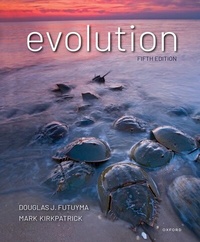
Evolution
5th Edition
Published on 20. October 2022
Book
Hardback
592 pages
978-0-19-761961-2 (ISBN)
Description
Because all organisms, and all their characteristics, are products of a history of evolutionary change, the scope of an evolutionary biology course can be an overwhelming challenge for students; organismal biology, including paleobiology, ecology, animal behavior, physiology and systematics are all central to evolutionary biology. Instructors want students to gain a big picture view in which they understand the general principles of evolution and the process of evolutionary change.
In Evolution, 5e the authors provide learning objectives for each major section that are supported by signposts at key points in the manuscript to highlight and summarize key takeaways. A broader view of the subject is presented by using abstract concepts, such as natural selection, and providing a range of applications and implications so that students can recognize evolutionary patterns of change.
Students in this course also struggle with thinking like scientists-they need to understand theoretical hypotheses and ideas, and how and why the empirical study provides evidence for them.
Evolution guides the student through hypothesis testing by posing informed hypotheses, making predictions based on what we do know, and judging the validity of each hypothesis vis-a-vis observations.
Part of any discussion of hypothesis testing is acknowledging that evolution, like other branches of science, is evolving. In this edition, the authors include What We Don't Know boxes that convey that scientific ideas are constantly being tested and revised.
Students struggle with quantitative skills and need practice manipulating data in this course. End of chapter Data Analysis questions gives students practice in performing calculations, experimental design, and interpreting and analyzing data. As additional support, the authors have included a Statistics Primer that introduces the concept of a probability distribution, reviews how statistics are used to describe populations, looks at how to estimate quantities, and discusses how hypotheses are tested.
Evolution can be a required course for biology majors with health career aspirations and they don't see the relevance of evolutionary biology to their professional goals.
In Evolution, 5e the authors focus on deepening and highlighting the coverage of human biology to engage students, both through in text examples and a stronger focus on human evolution in Chapter 21, The Evolutionary Story of Homo sapiens.
The 5e will also feature an enhanced eBook which will include embedded self-assessment questions, interactive figures, data exercises with white board videos that use real data sets from the literature, and simulation exercises. BoClip videos, if available, will round out this robust enhanced ebook.
In Evolution, 5e the authors provide learning objectives for each major section that are supported by signposts at key points in the manuscript to highlight and summarize key takeaways. A broader view of the subject is presented by using abstract concepts, such as natural selection, and providing a range of applications and implications so that students can recognize evolutionary patterns of change.
Students in this course also struggle with thinking like scientists-they need to understand theoretical hypotheses and ideas, and how and why the empirical study provides evidence for them.
Evolution guides the student through hypothesis testing by posing informed hypotheses, making predictions based on what we do know, and judging the validity of each hypothesis vis-a-vis observations.
Part of any discussion of hypothesis testing is acknowledging that evolution, like other branches of science, is evolving. In this edition, the authors include What We Don't Know boxes that convey that scientific ideas are constantly being tested and revised.
Students struggle with quantitative skills and need practice manipulating data in this course. End of chapter Data Analysis questions gives students practice in performing calculations, experimental design, and interpreting and analyzing data. As additional support, the authors have included a Statistics Primer that introduces the concept of a probability distribution, reviews how statistics are used to describe populations, looks at how to estimate quantities, and discusses how hypotheses are tested.
Evolution can be a required course for biology majors with health career aspirations and they don't see the relevance of evolutionary biology to their professional goals.
In Evolution, 5e the authors focus on deepening and highlighting the coverage of human biology to engage students, both through in text examples and a stronger focus on human evolution in Chapter 21, The Evolutionary Story of Homo sapiens.
The 5e will also feature an enhanced eBook which will include embedded self-assessment questions, interactive figures, data exercises with white board videos that use real data sets from the literature, and simulation exercises. BoClip videos, if available, will round out this robust enhanced ebook.
Reviews / Votes
Evolution is good at providing a lot of empirical examples for each major concept, and I generally like the organization, particularly in the early units, where chapters build on each other in a good natural progression." - Jeremy Yoder, CSU Northridge Very good combination of large-scale evolutionary trends and overview of our understanding of evolution of Homo sapiens." - Alyssa Bell, Cal Poly Pomona Generally quite well-organized and clearly written. Important topics are generally covered to a level that I would feel is appropriate for students in my class. The examples are generally interesting and well-illustrated." - Rene Malenfant, University of New Brunswick Very well written and is probably the best textbook on evolution on the market right now. Full of data, including recent findings." - Mark Sturtevant, Oakland UniversityMore details
Edition
5th Revised edition
Language
English
Place of publication
New York
United States
Target group
College/higher education
Edition type
Revised edition
Dimensions
Height: 229 mm
Width: 276 mm
ISBN-13
978-0-19-761961-2 (9780197619612)
Copyright in bibliographic data and cover images is held by Nielsen Book Services Limited or by the publishers or by their respective licensors: all rights reserved.
Schweitzer Classification
Other editions
Additional editions
Douglas Futuyma | Mark Kirkpatrick
Evolution
Book
09/2023
5th Edition
Oxford University Press Inc
€240.50
Available immediately
Content
- Chapter 1: An Idea that Changed the World
- Chapter 2: The Tree of Life
- Chapter 3: Natural Selection and Adaptation
- Chapter 4: Mutation and Variation
- Chapter 5: The Genetical Theory of Natural Selection
- Chapter 6: Genetic Drift: Evolution at Random
- Chapter 7: Quantitative Traits
- Chapter 8: Evolution in Space
- Chapter 9: Species and Speciation
- Chapter 10: The Evolution of Genes and Genomes
- Chapter 11: Evolution and Development
- Chapter 12: All about Sex
- Chapter 13: Cooperation and Conflict
- Chapter 14: Evolutionary Ecology: How to be Fit
- Chapter 15: Interactions among Species
- Chapter 16: Phylogeny: The Unity and Diversity of Life
- Chapter 17: The History of Life
- Chapter 18: The Geography of Evolution
- Chapter 19: Macroevolution: Evolution above the Species Level
- Chapter 20: The Evolutionary Story of Homo sapiens
- Chapter 21: Evolution and Society
- Chapter 22: A Statistics Primer
- Chapter 2: The Tree of Life
- Chapter 3: Natural Selection and Adaptation
- Chapter 4: Mutation and Variation
- Chapter 5: The Genetical Theory of Natural Selection
- Chapter 6: Genetic Drift: Evolution at Random
- Chapter 7: Quantitative Traits
- Chapter 8: Evolution in Space
- Chapter 9: Species and Speciation
- Chapter 10: The Evolution of Genes and Genomes
- Chapter 11: Evolution and Development
- Chapter 12: All about Sex
- Chapter 13: Cooperation and Conflict
- Chapter 14: Evolutionary Ecology: How to be Fit
- Chapter 15: Interactions among Species
- Chapter 16: Phylogeny: The Unity and Diversity of Life
- Chapter 17: The History of Life
- Chapter 18: The Geography of Evolution
- Chapter 19: Macroevolution: Evolution above the Species Level
- Chapter 20: The Evolutionary Story of Homo sapiens
- Chapter 21: Evolution and Society
- Chapter 22: A Statistics Primer