

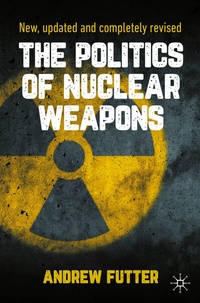
The Politics of Nuclear Weapons
New, updated and completely revised
2nd Edition
Published on 24. November 2020
Book
Paperback/Softback
352 pages
978-3-030-48736-2 (ISBN)
Description
This comprehensively updated second edition provides an introduction to the political, normative, technological and strategic aspects of nuclear weaponry. It offers an accessible overview of the concept of nuclear weapons, outlines how thinking about these weapons has developed and considers how nuclear threats can continue to be managed in the future. This book will help you to understand what nuclear weapons are, the science behind their creation and operation, why states build them in the first place, and whether it will be possible for the world to banish these weapons entirely. Essential reading for all students of International Relations, Security Studies and Military History.
More details
Product info
Paperback
Edition
2nd ed. 2021
Language
English
Place of publication
Cham
Switzerland
Publishing group
Springer International Publishing
Target group
Professional and scholarly
Edition type
Revised edition
Illustrations
XVIII, 333 p.; XVIII, 333 p.
Dimensions
Height: 235 mm
Width: 155 mm
Thickness: 20 mm
Weight
534 gr
ISBN-13
978-3-030-48736-2 (9783030487362)
DOI
10.1007/978-3-030-48737-9
Schweitzer Classification
Other editions
Additional editions
E-Book
11/2020
2nd Edition
Palgrave Macmillan
€53.49
Available for download
Person
Andrew Futter is Professor of International Politics at the University of Leicester, UK.
Content
¿1. Introduction: The Politics of Nuclear Weapons.
2. What are Nuclear Weapons and Why Are They So Powerful?.
3. Testing, Authorising and Delivering Nuclear Weapons.
4. Nuclear Proliferation and Nuclear Ages.
5. The Nuclear Revolution, Nuclear Strategy and Nuclear War.
6. Vertical proliferation challenges.
7. Horizontal Proliferation Challenges: The Nuclear Outliers.
8. Managing Nuclear Threats: Structures of Global Nuclear Governance.
9. Nuclear Weapons and Non-State Actors.
10. Nuclear Disarmament.
11. Future Nuclear Challenges.
12. Conclusion: Surviving our Nuclear Future.