

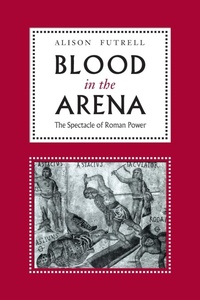
Blood in the Arena
The Spectacle of Roman Power
Published on 1. March 2001
Book
Paperback/Softback
352 pages
978-0-292-72523-2 (ISBN)
Description
From the center of Imperial Rome to the farthest reaches of ancient Britain, Gaul, and Spain, amphitheaters marked the landscape of the Western Roman Empire. Built to bring Roman institutions and the spectacle of Roman power to conquered peoples, many still remain as witnesses to the extent and control of the empire.
In this book, Alison Futrell explores the arena as a key social and political institution for binding Rome and its provinces. She begins with the origins of the gladiatorial contest and shows how it came to play an important role in restructuring Roman authority in the later Republic. She then traces the spread of amphitheaters across the Western Empire as a means of transmitting and maintaining Roman culture and control in the provinces.
Futrell also examines the larger implications of the arena as a venue for the ritualized mass slaughter of human beings, showing how the gladiatorial contest took on both religious and political overtones. This wide-ranging study, which draws insights from archaeology and anthropology, as well as Classics, broadens our understanding of the gladiatorial contest and its place within the highly politicized cult practice of the Roman Empire.
In this book, Alison Futrell explores the arena as a key social and political institution for binding Rome and its provinces. She begins with the origins of the gladiatorial contest and shows how it came to play an important role in restructuring Roman authority in the later Republic. She then traces the spread of amphitheaters across the Western Empire as a means of transmitting and maintaining Roman culture and control in the provinces.
Futrell also examines the larger implications of the arena as a venue for the ritualized mass slaughter of human beings, showing how the gladiatorial contest took on both religious and political overtones. This wide-ranging study, which draws insights from archaeology and anthropology, as well as Classics, broadens our understanding of the gladiatorial contest and its place within the highly politicized cult practice of the Roman Empire.
Reviews / Votes
. . . bring[s] fresh perspectives to the study of the Roman amphitheater, situating the Roman arena within a larger cross-cultural framework of human sacrifice and providing important insights into the psychological dimensions of these public spectacles for the Roman viewer. (Classical World)More details
Language
English
Place of publication
Austin, TX
United States
Target group
Professional and scholarly
Product notice
Paperback (trade)
Dimensions
Height: 229 mm
Width: 152 mm
Thickness: 21 mm
Weight
575 gr
ISBN-13
978-0-292-72523-2 (9780292725232)
Copyright in bibliographic data and cover images is held by Nielsen Book Services Limited or by the publishers or by their respective licensors: all rights reserved.
Schweitzer Classification
Person
Alison Futrell is an associate professor of history at the University of Arizona.
Content
Abbreviations
Acknowledgments
Introduction
I. Beginnings
Campanian Gladiators
Etruscan Gladiators
Origines Gladiatorum
Early Spectacle in Rome
The Late Republic: Spectacle and Political Manipulation
The Imperial Games
II. A Scatter of Circles
The Iberian Peninsula
Britannia
The Northeastern Frontier
The Galliae
III. Order and Struggle: Cult in the Amphitheater
Imperial Cult
Celtic Cult
Nemesis
IV. The System of Construction
The Early Builders
Builders during the Empire
Management
Labor
Military Amphitheaters
Technology
Tickets and Seating
V. The Magic Ring: Human Sacrifice in the Arena
Patterns of Human Sacrifice
Human Sacrifice in Rome
The Ideology of Human Sacrifice
Conclusion
Appendix I. Amphitheaters and Central Place Theory
Appendix II. Pliny in Bithynia
Notes
Bibliography
Index
Acknowledgments
Introduction
I. Beginnings
Campanian Gladiators
Etruscan Gladiators
Origines Gladiatorum
Early Spectacle in Rome
The Late Republic: Spectacle and Political Manipulation
The Imperial Games
II. A Scatter of Circles
The Iberian Peninsula
Britannia
The Northeastern Frontier
The Galliae
III. Order and Struggle: Cult in the Amphitheater
Imperial Cult
Celtic Cult
Nemesis
IV. The System of Construction
The Early Builders
Builders during the Empire
Management
Labor
Military Amphitheaters
Technology
Tickets and Seating
V. The Magic Ring: Human Sacrifice in the Arena
Patterns of Human Sacrifice
Human Sacrifice in Rome
The Ideology of Human Sacrifice
Conclusion
Appendix I. Amphitheaters and Central Place Theory
Appendix II. Pliny in Bithynia
Notes
Bibliography
Index