

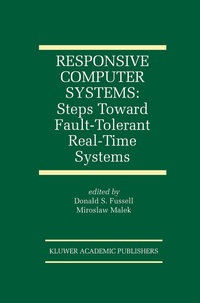
Responsive Computer Systems: Steps Toward Fault-Tolerant Real-Time Systems
Published on 31. August 1995
Book
Paperback/Softback
XX, 268 pages
978-0-7923-9563-8 (ISBN)
Description
Responsive Computer Systems: Steps Towards Fault-Tolerant Real-Time
Systems
provides an extensive treatment of the most important issues in the design of modern Responsive Computer Systems. It lays the groundwork for a more comprehensive model that allows critical design issues to be treated in ways that more traditional disciplines of computer research have inhibited. It breaks important ground in the development of a fruitful, modern perspective on computer systems as they are currently developing and as they may be expected to develop over the next decade.
Audience: An interesting and important road map to some of the most important emerging issues in computing, suitable as a secondary text for graduate level courses on responsive computer systems and as a reference for industrial practitioners.
Audience: An interesting and important road map to some of the most important emerging issues in computing, suitable as a secondary text for graduate level courses on responsive computer systems and as a reference for industrial practitioners.
More details
Series
Edition
Softcover reprint of the original 1st ed. 1995
Language
English
Place of publication
New York
United States
Target group
Professional and scholarly
Research
Illustrations
19 s/w Abbildungen
XX, 268 p. 19 illus.
Dimensions
Height: 235 mm
Width: 155 mm
Thickness: 16 mm
Weight
446 gr
ISBN-13
978-0-7923-9563-8 (9780792395638)
DOI
10.1007/978-1-4615-2271-3
Schweitzer Classification
Other editions
Additional editions
Donald Fussell | Miroslaw Malek
Responsive Computer Systems: Steps Toward Fault-Tolerant Real-Time Systems
E-Book
12/2012
Springer
€213.99
Available for download
Content
1 A Tight Lower Bound for Processor Coordination.- 1 Introduction.- 2 Overview.- 3 The Problem.- 4 The Bermuda Triangle.- 5 The Lower Bound.- 6 Generalizing to the Partially Synchronous Model.- References.- 2 Self-Stabilizing Real-Time Decision Systems.- 1 Introduction.- 2 Related Work.- 3 A Model of Computation.- 4 Definitions and Notation.- 5 Terminating Self-Stabilizing Programs.- 6 Boolean (Finite State) Programs.- 7 Non-Terminating Self-Stabilizing Programs.- 8 Self-Stabilization and Informed Decisions.- 9 Acknowledgements.- References.- 3 Management and Scheduling of Tests for Locating Failures Dependent Upon Operation-Time in Responsive Systems.- 1 Introduction.- 2 Definitions and Notation.- 3 Assignment and Scheduling of Multiple Test Sets.- 4 The Analysis of Fault Location.- 5 A priori information analysis.- 6 Conclusion.- References.- 4 Adding Robustness in Dynamic Preemptive Scheduling.- 1 Introduction.- 2 Terminology and Assumptions.- 3 Schedulability analysis.- 4 The RED scheduling strategy.- 5 Performance Evaluation.- 6 Related Work.- 7 Conclusions.- References.- 5 Static Deadlock Analysis for CSP-Type Communications.- 1 Introduction.- 2 The Sequence Condition.- References.- 6 Comparing How Well Asynchronous Atomic Broadcast Protocols Perform.- 1 Introduction.- 2 Assumptions.- 3 Overview of Broadcast Protocols.- 4 Simulation Results.- 5 Relative Performance.- 6 Conclusion.- References.- 7 Hard Real-Time Reliable Multicast in the Dedos System.- 1 Introduction.- 2 System architecture and failure assumptions.- 3 Protocol description.- 4 Protocol analysis.- 5 Conclusion.- References.- 8 Speculative Algorithms for Concurrency Control in Responsive Databases.- 1 Introduction.- 2 RTDBMS Concurrency Control.- 3 A Generic SCC-nS Algorithm.- 4 SCC-NS Family Members.- 5 Conclusion.- References.- 9 Autonomous Transaction Managers in Responsive Computing.- 1 Introduction.- 2 System Structure and Notation.- 3 Synchronization of the Local Schedules.- 4 Effects of Transaction Aborts.- 5 Synchronization of CSR Schedules.- 6 A Pragmatic Restriction.- 7 Further Observations.- 8 Conclusions.- 9 Appendix.- References.- 10 Adaptable Fault Tolerance for Real-Time Systems.- 1 Introduction.- 2 The Three-level Framework.- 3 FERT Specification Language.- 4 Support for Scheduling.- 5 Conclusions and Discussion.- References.- 11 Fault-Tolerant Automatic Control.- 1 Introduction to the Software Fault-Tolerance Problem.- 2 The Simplex Architecture.- 3 Laboratory Experiments.- 4 Conclusion.- References.- 12 Design and Performance Evaluation of A Fault-Tolerant, Hard-Real-Time, Parallel Processor.- 1 Introduction.- 2 FTPP Overview.- 3 Overview of FTPP Scheduling.- 4 OS Performance Measurements.- 5 NE Contention Model.- 6 Conclusions.- References.