

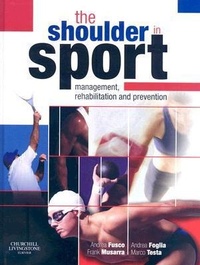
The Shoulder in Sport
Management, Rehabilitation and Prevention
Published on 28. December 2007
Book
Hardback
348 pages
978-0-443-06874-4 (ISBN)
Description
The book is divided into 5 sections: the first and second sections provide introductory topics, such as anatomical variances of the articulations and soft tissues, the biomechanics of the shoulder, diagnostic imaging, specialist and functional examinations. The third section is dedicated to the description of surgical solutions in acute articular, muscle and tendinous pathologies. Rehabilitation and prevention are described in the fourth section, where the authors present exercises of post-surgical rehabilitation, techniques of mobilizing in manual therapy and load multidimensional model. The last two chapters in this section are dedicated to prevention, especially of chronic pathologies, using intervention influencing programmes, methodology of training and how to rectify incorrectly performed movements. The last section is dedicated to the use of electromyography of the surface. This method is used to register muscular activity during training; the description contains practical information and a great number of references of clinical interest.
Highly topical subject, considering the increase in the practice of amateur sports and the demand of high level performances in professional sports activitiesMultidisciplinary approach by opinion leaders and specialists in the pathology of the shoulder at different levels (diagnostic, medical, surgical and rehabilitative therapy of articular, muscle and tendinous pathologies).
Highly topical subject, considering the increase in the practice of amateur sports and the demand of high level performances in professional sports activitiesMultidisciplinary approach by opinion leaders and specialists in the pathology of the shoulder at different levels (diagnostic, medical, surgical and rehabilitative therapy of articular, muscle and tendinous pathologies).
More details
Language
English
Place of publication
London
United Kingdom
Publishing group
Elsevier Health Sciences
Target group
Professional and scholarly
Product notice
sewn/stitched
Paper over boards
Illustrations
Approx. 300 illustrations
Dimensions
Height: 248 mm
Width: 197 mm
Thickness: 23 mm
Weight
943 gr
ISBN-13
978-0-443-06874-4 (9780443068744)
Copyright in bibliographic data and cover images is held by Nielsen Book Services Limited or by the publishers or by their respective licensors: all rights reserved.
Schweitzer Classification
Content
Section 1 Functional anatomy and recent biomechanical discoveries
1. Anatomical variants of the shoulder P. Van Roy, E. Barbaix, J.P. Baeyens, M. De Maeseneer, J.P.ClarijsGlenohumeral joint Bone structures of the glenohumeral jointSoft tissues of the glenohumeral jointCoracoacromial archBone Structures of the coracoacromial archSoft tissues associated with the coracoacromial arch
Acromioclavicular jointBone structure of the acromioclavicular jointSoft tissues of the acromioclavicular joint
Sternoclavicular joint Bone structures of the Sternoclavicular joint Soft tissues of the Sternoclavicular joint Neurovascular bundle and adjacent structuresConclusionsBibliography
2. Biomechanics of the shoulder J.P. Baeyens, P. Van Roy
Stability of the glenohumeral jointCongruency of the joint heads
Joint OrientationNegative intra-articular pressureLabrumActive stabilizationConclusions Elevation of the armOsteokinematicsGlenohymeral osteokinematicsScapulothoracic osteokinematicsOsteokinematics of the clavicle ArthrokinematicsGlenohumeral arthrokinematicsThrowing movementsKinematics of throwingKinetics of throwingBibliography
Section II Pathology, clinical aspects and diagnostic imaging
3A. Premise A.Fusco
Examination of the painful shoulder interdisciplinarity and clinical rationale Bibliography
3. Shoulder instability A. Fusco, R. ZuccarinoAethiopathogenesisStructural factors and principles of classificationFunctional factors and athletic actionsAthletic actions below 90 of abductionAthletic actions above 90 of abduction (overhead)Ballistic sports and conditions prejudicial to stabilty Conclusions AcknowledgementsBibliography
1. Anatomical variants of the shoulder P. Van Roy, E. Barbaix, J.P. Baeyens, M. De Maeseneer, J.P.ClarijsGlenohumeral joint Bone structures of the glenohumeral jointSoft tissues of the glenohumeral jointCoracoacromial archBone Structures of the coracoacromial archSoft tissues associated with the coracoacromial arch
Acromioclavicular jointBone structure of the acromioclavicular jointSoft tissues of the acromioclavicular joint
Sternoclavicular joint Bone structures of the Sternoclavicular joint Soft tissues of the Sternoclavicular joint Neurovascular bundle and adjacent structuresConclusionsBibliography
2. Biomechanics of the shoulder J.P. Baeyens, P. Van Roy
Stability of the glenohumeral jointCongruency of the joint heads
Joint OrientationNegative intra-articular pressureLabrumActive stabilizationConclusions Elevation of the armOsteokinematicsGlenohymeral osteokinematicsScapulothoracic osteokinematicsOsteokinematics of the clavicle ArthrokinematicsGlenohumeral arthrokinematicsThrowing movementsKinematics of throwingKinetics of throwingBibliography
Section II Pathology, clinical aspects and diagnostic imaging
3A. Premise A.Fusco
Examination of the painful shoulder interdisciplinarity and clinical rationale Bibliography
3. Shoulder instability A. Fusco, R. ZuccarinoAethiopathogenesisStructural factors and principles of classificationFunctional factors and athletic actionsAthletic actions below 90 of abductionAthletic actions above 90 of abduction (overhead)Ballistic sports and conditions prejudicial to stabilty Conclusions AcknowledgementsBibliography