

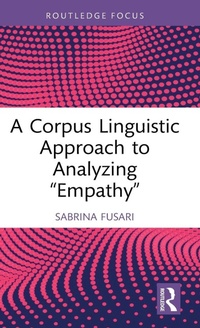
A Corpus Linguistic Approach to Analyzing "Empathy"
1st Edition
Published on 26. June 2025
Book
Hardback
136 pages
978-1-041-05343-9 (ISBN)
Description
This volume offers an in-depth corpus linguistic analysis of the word "empathy" aiming to foster unique insights into a word widely found across contemporary discourses and into methodological innovations for analyzing large corpora. Given the understanding of empathy's importance for individual and social development, A Corpus Linguistic Approach to Analyzing "Empathy" demonstrates the potential of a corpus approach to shed new light on a significant yet difficult-to-define concept. Fusari systematically applies the use of concordances and other corpus output to derive patterns and recurrent phraseologies in the 36+ billion-word electronic corpus, English Web 2020, to help readers grapple with key ideas around empathy. Such questions include what we really mean by empathy, whether it is always positive, whether it is learned or innate, and whether empathy is truly what "makes us human". The book contends with these questions across disciplines, from the clinical to the psychological and philosophical to the linguistic and discursive. Opening new areas of research into inclusive language and the use of corpus tools to analyze individual terms, this book will be of interest to students and scholars in corpus linguistics and applied linguistics, as well as such fields as cognitive science, psychology, philosophy, and allied health.
The Open Access version of this book, available at http://www.taylorfrancis.com, has been made available under a CC-BY-NC-ND 4.0 license.
The Open Access version of this book, available at http://www.taylorfrancis.com, has been made available under a CC-BY-NC-ND 4.0 license.
More details
Series
Language
English
Place of publication
London
United Kingdom
Publishing group
Taylor & Francis Ltd
Target group
College/higher education
Professional and scholarly
Postgraduate
Illustrations
6 s/w Abbildungen, 1 s/w Photographie bzw. Rasterbild, 5 s/w Zeichnungen, 17 s/w Tabellen
17 Tables, black and white; 5 Line drawings, black and white; 1 Halftones, black and white; 6 Illustrations, black and white
Dimensions
Height: 222 mm
Width: 145 mm
Thickness: 12 mm
Weight
326 gr
ISBN-13
978-1-041-05343-9 (9781041053439)
Copyright in bibliographic data and cover images is held by Nielsen Book Services Limited or by the publishers or by their respective licensors: all rights reserved.
Schweitzer Classification
Other editions
Additional editions
Sabrina Fusari
A Corpus Linguistic Approach to Analyzing "Empathy"
E-Book
06/2025
Routledge
€28.99
Available for download
Sabrina Fusari
A Corpus Linguistic Approach to Analyzing "Empathy"
E-Book
06/2025
Routledge
€28.99
Available for download
Person
Sabrina Fusari is Associate Professor of English Language and Linguistics in the Department of Modern Languages, Literatures and Cultures (LILEC) at the University of Bologna, Italy.
Content
List of figures
List of tables
Introduction
1. Empathy: some definitions
1.1. Debunking myths about empathy
1.2. Talking about empathy
2. Empathy: an experiential and logical overview
2.1. Experiential meaning: Transitivity
2.2. Logical meanings: the noun group
2.3. Grammatical metaphor
3. Empathy: an interpersonal overview
3.1. Interpersonal meaning: Attitude
3.2. Quantitative analysis of Attitude types related to empathy
3.3. Empathy in the dialogic space: Engagement and Graduation
4. Empathy: a textual overview
4.1. Non-structural cohesive devices realizing textual meanings
Conclusion
References
Index
List of tables
Introduction
1. Empathy: some definitions
1.1. Debunking myths about empathy
1.2. Talking about empathy
2. Empathy: an experiential and logical overview
2.1. Experiential meaning: Transitivity
2.2. Logical meanings: the noun group
2.3. Grammatical metaphor
3. Empathy: an interpersonal overview
3.1. Interpersonal meaning: Attitude
3.2. Quantitative analysis of Attitude types related to empathy
3.3. Empathy in the dialogic space: Engagement and Graduation
4. Empathy: a textual overview
4.1. Non-structural cohesive devices realizing textual meanings
Conclusion
References
Index