

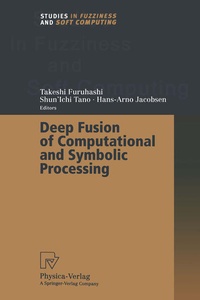
Deep Fusion of Computational and Symbolic Processing
Published on 28. July 2012
Book
Paperback/Softback
XIV, 256 pages
978-3-662-00373-2 (ISBN)
Description
Symbolic processing has limitations highlighted by the symbol grounding problem. Computational processing methods, like fuzzy logic, neural networks, and statistical methods have appeared to overcome these problems. However, they also suffer from drawbacks in that, for example, multi-stage inference is difficult to implement. Deep fusion of symbolic and computational processing is expected to open a new paradigm for intelligent systems. Symbolic processing and computational processing should interact at all abstract or computational levels. For this undertaking, attempts to combine, hybridize, and fuse these processing methods should be thoroughly investigated and the direction of novel fusion approaches should be clarified. This book contains the current status of this attempt and also discusses future directions.
More details
Series
Edition
Softcover reprint of the original 1st ed. 2001
Language
English
Place of publication
Heidelberg
Germany
Target group
Professional and scholarly
Research
Illustrations
173 s/w Abbildungen
XIV, 256 p. 173 illus.
Dimensions
Height: 235 mm
Width: 155 mm
Thickness: 15 mm
Weight
417 gr
ISBN-13
978-3-662-00373-2 (9783662003732)
DOI
10.1007/978-3-7908-1837-6
Schweitzer Classification
Other editions
Additional editions
Takeshi Furuhashi | Shun'Ichi Tano | Hans-Arno Jacobsen
Deep Fusion of Computational and Symbolic Processing
Book
12/2000
Physica
€85.59
Article exhausted; check different version
Content
I. Integration of Computational and Symbolic Processing.- A Subsymbolic and Symbolic Model for Learning Sequential Decision Tasks.- Integration of Different Information Processing Methods.- Symbol Pattern Integration Using Multilinear Functions.- II. Toward Deep Fusion of Computational and Symbolic Processing.- Design of Autonomously Learning Controllers Using FYNESSE.- Modeling for Dynamical Systems with Fuzzy Sequential Knowledge.- Hybrid Machine Learning Tools: INSS - A Neuro-Symbolic System for Constructive Machine Learning.- A Generic Architecture for Hybrid Intelligent Systems.- New Paradigm toward Deep Fusion of Computational and Symbolic Processing.- III. Knowledge Representation.- Fusion of Symbolic and Quantitative Processing by Conceptual Fuzzy Sets.- Novel Knowledge Representation (Area Representation) and the Implementation by Neural Network.- A Symbol Grounding Problem of Gesture Motion through a Self-organizing Network of Time-varying Motion Images.