

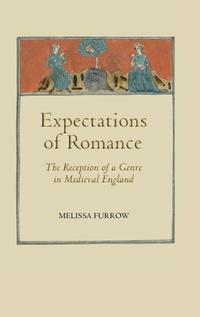
Expectations of Romance
The Reception of a Genre in Medieval England
Published on 19. November 2009
Book
Hardback
274 pages
978-1-84384-207-1 (ISBN)
Description
What did medieval readers think of romance? Their attitudes to it, and the implications for the genre, are explored in this provocative study.
An important and powerful meditation on romance genre, reception and ethical/moral purpose -- amongst many other aspects of romance. Professor ROBERT ROUSE, University of British Columbia.
Medieval readers, like modern ones, differed in whether they saw "noble storie, and worthie for to drawen to memorie" in romance, or "drasty rymyng, nat worth a toord". This book tackles the task of discerning what were the medieval expectations of the genrein England: the evidence, and the implications. Safe for monastic, trained readers, romances provided moral examples. But not all readers saw that role as valid, desirable, or to the point, and not all readers were monks.
Working from what was central to medieval readers' concept of the genre from the twelfth century onward, the book sees the changing linguistic, literary, religious and political contexts through such heterogeneous lenses as Denis Piramus, Robert Manning, and Walter Map; Guy of Warwick and Guenevere; chansons de geste and fabliaux; Tristram and Isolde and John Gower's uses of the pair as exemplary; Geoffrey Chaucer as reader and writer ofromance; and the Lollards, clergy, and didacts of the fifteenth century.
MELISSA FURROW is Professor of English at Dalhousie University.
An important and powerful meditation on romance genre, reception and ethical/moral purpose -- amongst many other aspects of romance. Professor ROBERT ROUSE, University of British Columbia.
Medieval readers, like modern ones, differed in whether they saw "noble storie, and worthie for to drawen to memorie" in romance, or "drasty rymyng, nat worth a toord". This book tackles the task of discerning what were the medieval expectations of the genrein England: the evidence, and the implications. Safe for monastic, trained readers, romances provided moral examples. But not all readers saw that role as valid, desirable, or to the point, and not all readers were monks.
Working from what was central to medieval readers' concept of the genre from the twelfth century onward, the book sees the changing linguistic, literary, religious and political contexts through such heterogeneous lenses as Denis Piramus, Robert Manning, and Walter Map; Guy of Warwick and Guenevere; chansons de geste and fabliaux; Tristram and Isolde and John Gower's uses of the pair as exemplary; Geoffrey Chaucer as reader and writer ofromance; and the Lollards, clergy, and didacts of the fifteenth century.
MELISSA FURROW is Professor of English at Dalhousie University.
Reviews / Votes
A well-structured, in-depth study of how the first readers of medieval romances responded to these texts. * ANGLIA * Will surely be welcomed by many scholars of Middle English romance both for contributing a number of new insights and for affirming a number of currently popular theories. * ARTHURIANA * Furrow marshals her material well, interspersing her critical arguments with textual exemplars that allow the discussion to move forward as well as providing her reader with a functional model through which to think about this problematic genre and its reception. * ENGLISH * Offers extensive and fascinating evidence of the lives romance lived throughout medieval England. [...] It offers a significant redirection of our reception of English romance. * SPECULUM * A rich and suggestive book, it gives us a new model for considering not only how romances were read in different contexts, but also, perhaps more acutely, how they were written to be read. * MEDIUM AEVUM * A detailed and intriguing study of the ways in which medieval readers may have approached and understood these texts. [...] In its sophisticated consideration of genre in social, political and even material, as well as literary, contexts, Expectations of Romance makes a significant contribution to the study of genre theory as it applies to insular medieval writing. * REVIEW OF ENGLISH STUDIES * This a scholarly work, drawing on a wide range of data. It contains excellent readings. * MODERN LANGUAGE REVIEW *More details
Series
Language
English
Place of publication
Cambridge
United Kingdom
Publishing group
Boydell & Brewer Ltd
Target group
College/higher education
Product notice
Cloth over boards
Illustrations
2 s/w Abbildungen
2 b/w illus.
Dimensions
Height: 240 mm
Width: 161 mm
Thickness: 19 mm
Weight
578 gr
ISBN-13
978-1-84384-207-1 (9781843842071)
Copyright in bibliographic data and cover images is held by Nielsen Book Services Limited or by the publishers or by their respective licensors: all rights reserved.
Schweitzer Classification
Other editions
Additional editions
E-Book
11/2009
1st Edition
De Gruyter
€48.99
Available for download
Person
Content
The Problem with Romance
The Name and the Genre
Genres, Language, and Literary History
The Example of Tristram and Isolde
Making Free with the Truth
Coda: The Reception of a Genre
Appendix: Romances and the Male Regular Clergy by Order
Bibliography
The Name and the Genre
Genres, Language, and Literary History
The Example of Tristram and Isolde
Making Free with the Truth
Coda: The Reception of a Genre
Appendix: Romances and the Male Regular Clergy by Order
Bibliography