

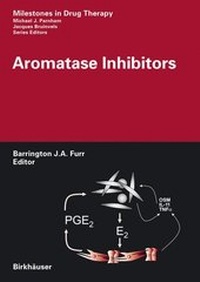
Aromatase Inhibitors
1st Edition
Published on 9. December 2005
Book
Hardback
IX, 182 pages
978-3-7643-7199-9 (ISBN)
Description
Many breast tumours are dependent upon oestrogen for their development and continued growth. Over the last 25 years hormone therapy has progressed from the irreversible destruction of endocrine glands to the use of drugs that reversibly suppress oestrogen synthesis or action. The inhibition of oestrogen synthesis is most readily achieved by inhibiting the final step in the pathway of oestrogen biosynthesis, the reaction which transforms androgens into oestrogens by creating an aromatic ring in the steroid molecule (hence the enzyme's trivial name, aromatase).Whereas the first aromatase inhibitors to be used therapeutically could be shown to produce drug-induced inhibition of the enzyme and therapeutic benefits in patients with breast cancer, they were not particularly potent and lacked specificity. However, second-generation drugs were developed and most recently third-generation inhibitors have evolved which possess remarkable specificity and potency. Initial results from clinical trials suggest that these agents will become the cornerstones of future endocrine therapy.
More details
Series
Edition
1., Ed.
Language
English
Place of publication
Basel
Switzerland
Target group
Professional and scholarly
Scientific libraries, pharmaceutical industry, researchers and clinicians, postgraduate students
Illustrations
5
25 s/w Zeichnungen, 30 s/w Abbildungen, 24 s/w Tabellen, 5 s/w Photographien bzw. Rasterbilder
30 illus.
Dimensions
Height: 23.5 cm
Width: 16.5 cm
ISBN-13
978-3-7643-7199-9 (9783764371999)
DOI
10.1007/3-7643-7418-7
Schweitzer Classification
Other editions
New editions
Book
12/2007
2nd Edition
Birkhäuser
€106.99
Shipment within 10-15 days
Additional editions
Persons
Content
Background and development of aromatase inhibitors.- Aromatase inhibitors and models for breast cancer.- Clinical pharmacology of aromatase inhibitors.- Clinical studies with exemestane.- Clinical studies with letrozole.- Clinical studies with anastrozole.- The third-generation aromatase inhibitors: a clinical overview.- Lessons from the ArKO mouse.- Possible additional therapeutic uses of aromatase inhibitors