

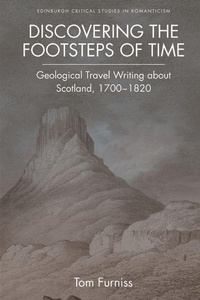
Discovering the Footsteps of Time
Geological Travel Writing about Scotland, 1700-1820
Published on 15. January 2018
Book
Hardback
305 pages
978-1-4744-1001-4 (ISBN)
Description
Traces the history of geological travel writing about Scotland across the historical periods of the Scottish Enlightenment and British Romanticism
Discovering the Footsteps of Time probes the development of a distinctively Scottish tradition of geological travel writing from the seventeenth to early nineteenth century. The tradition tracks a fertile interaction of scientific and aesthetic themes, mediated through literary techniques, which highlights the emergence of 'Romanticism' as such; a distinctive, recognisable cultural movement of taste and style. Making an important new contribution to our understanding of the 'discovery' and representation of Scotland in the long eighteenth century, the book explores why Scotland's topography has been decisive in the history of geology to such a great extent. Written by a literary academic rather than a geologist, the book is as much concerned with textual strategies and the aesthetic experience of geological discovery as with geology itself.
Key Features
Adds to our understanding of the 'discovery of Scotland' in the 18th and early 19th century, developing a new account of the literary, aesthetic and geological meanings of 'the land of mountain and flood' in the period Offers new insights about James Hutton's geological theory by attending to his geological travel writing about Scotland, and also locates Hutton's work within wider geological debates in and about ScotlandBuilds on previous work on the literariness of scientific writing in the 'second scientific revolution'Contributes to research on 'Romantic Scotland' and on the transition from Enlightenment to Romantic scientific travel writing
Discovering the Footsteps of Time probes the development of a distinctively Scottish tradition of geological travel writing from the seventeenth to early nineteenth century. The tradition tracks a fertile interaction of scientific and aesthetic themes, mediated through literary techniques, which highlights the emergence of 'Romanticism' as such; a distinctive, recognisable cultural movement of taste and style. Making an important new contribution to our understanding of the 'discovery' and representation of Scotland in the long eighteenth century, the book explores why Scotland's topography has been decisive in the history of geology to such a great extent. Written by a literary academic rather than a geologist, the book is as much concerned with textual strategies and the aesthetic experience of geological discovery as with geology itself.
Key Features
Adds to our understanding of the 'discovery of Scotland' in the 18th and early 19th century, developing a new account of the literary, aesthetic and geological meanings of 'the land of mountain and flood' in the period Offers new insights about James Hutton's geological theory by attending to his geological travel writing about Scotland, and also locates Hutton's work within wider geological debates in and about ScotlandBuilds on previous work on the literariness of scientific writing in the 'second scientific revolution'Contributes to research on 'Romantic Scotland' and on the transition from Enlightenment to Romantic scientific travel writing
Reviews / Votes
Focusing on eighteenth and early nineteenth-century travellers in Scotland, Tom Furniss finds new and striking things to say about the literary inflections of pre-scientific geological writing. Combining extensive research with personal experience of the Highlands, for anyone wishing to explore Scottish intersections of geology, literature, and aesthetics this is the go-to book. * Nicholas Roe, University of St Andrews *More details
Series
Language
English
Place of publication
Edinburgh
United Kingdom
Target group
Professional and scholarly
Product notice
sewn/stitched
Cloth over boards
Illustrations
20 black and white illustrations
Dimensions
Height: 236 mm
Width: 152 mm
Thickness: 23 mm
Weight
567 gr
ISBN-13
978-1-4744-1001-4 (9781474410014)
Copyright in bibliographic data and cover images is held by Nielsen Book Services Limited or by the publishers or by their respective licensors: all rights reserved.
Schweitzer Classification
Other editions
Additional editions
E-Book
12/2017
1st Edition
Edinburgh University Press
€29.49
Available for download
Person
Tom Furniss is Senior Lecturer in the Department of English at the University of Strathclyde. He has published widely on literature, philosophy, travel writing and geology of the eighteenth century and Romantic periods. He is the author of Edmund Burke's Aesthetic Ideology: Language, Gender and Political Economy in Revolution (CUP, 1993).
Content
1. Introduction; 2. Natural History, Travel, and Early Explorations of Scotland's Natural History; 3. John Walker's 'Report on the Hebrides' (1764-1771); 4. A Country Torn and Convulsed: Pioneering Geological Observations in Thomas Pennant's Tours of Scotland (1769, 1772); 5. Astonishing Productions of Volcanic Combustion: Barthelemy Faujas de Saint-Fond's Travels in England, Scotland, and the Hebrides (1784, 1799); 6. James Hutton's Geological Tours of Scotland (1764-1788); 7. Natural History Among the Mountains of a Wild Country: Robert Jameson on Arran, 1797 and 1799; 8. The End of Romantic Geology in Scotland? John MacCulloch's A Description of the Western Islands of Scotland (1819); References; Index.