

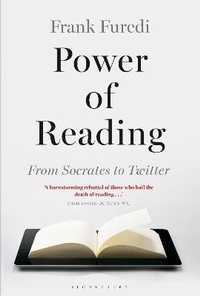
Power of Reading
From Socrates to Twitter
Published on 8. October 2015
Book
Hardback
272 pages
978-1-4729-1477-4 (ISBN)
Description
Power of Reading is a natural companion to Christopher Booker`s bestselling The Seven Basic Plots (Continuum) and John Gross`s seminal study The Rise and Fall of the Man of Letters (Weidenfeld and Nicolson). Eminent cultural and social historian Frank Furedi presents here an eclectic and entirely original history of reading. The very act of reading and the choice of reading material endow individuals with an identity that possesses great symbolic significance. Already in ancient Rome, Cicero was busy drawing up a hierarchy of different types of readers. Since that time people have been divided into a variety of categories - literates and illiterates, intensive and extensive readers, or vulgo and discreet readers. In the 19th Century, accomplished readers were praised as `men of letters` while their moral opposites were described as `unlettered`. Today distinctions are made between cultural and instrumental readers and scorn is communicated towards the infamous `tabloid reader`.
The purpose of this book is to explore the changing meanings attributed to the act of reading. Although it has an historical perspective, the book`s focus is very much on the culture of reading that prevails in the 21st Century. There are numerous texts on the history of literacy (Hoggart), yet there is no publication devoted to the history of readers and their relationship with wider culture and society. It is thus a fascinating insight into understanding the post-Gutenberg debates about literacy in a multimedia environment with such a strong emphasis on the absorption of information. Taking a cue from George Steiner, Furedi argues vigorously for the restoration of the art of reading - every bit as important as the art of writing.
The purpose of this book is to explore the changing meanings attributed to the act of reading. Although it has an historical perspective, the book`s focus is very much on the culture of reading that prevails in the 21st Century. There are numerous texts on the history of literacy (Hoggart), yet there is no publication devoted to the history of readers and their relationship with wider culture and society. It is thus a fascinating insight into understanding the post-Gutenberg debates about literacy in a multimedia environment with such a strong emphasis on the absorption of information. Taking a cue from George Steiner, Furedi argues vigorously for the restoration of the art of reading - every bit as important as the art of writing.
Reviews / Votes
[A] supremely erudite history of reading through the centuries ... Exhaustively researched and punctuated with absorbing anecdotes * Times Literary Supplement * A barnstorming rebuttal of those who hail the death of reading and the author. This formidably erudite history is an elegant celebration of literature and its power to cultivate the mind. * Professor Duncan Wu * This comprehensive and erudite study is a love letter to literacy * Prospect *More details
Language
English
Place of publication
London
United Kingdom
Publishing group
Bloomsbury Publishing PLC
Illustrations
No illustrations
Dimensions
Height: 234 mm
Width: 153 mm
Weight
548 gr
ISBN-13
978-1-4729-1477-4 (9781472914774)
Copyright in bibliographic data and cover images is held by Nielsen Book Services Limited or by the publishers or by their respective licensors: all rights reserved.
Schweitzer Classification
Other editions
Additional editions
E-Book
10/2015
1st Edition
Bloomsbury Continuum
€16.99
Available for download
E-Book
10/2015
1st Edition
Bloomsbury Continuum
€16.99
Available for download
Person
Frank Furedi fled to England in 1956 from Hungary. He was appointed Professor of Social Studies at the University of Kent but celebrated also as a pundit and public intellectual throughout the English speaking world. His most celebrated books include Paranoid Parenting (reissued by Continuum) The Culture of Fear and Where Have All the Intellectuals Gone. His books are widely reviewed and he is on the lecture circuit from Chatham House to Adelaide.