

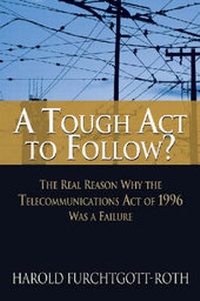
A Tough Act to Follow?
The Real Reason Why the Telecommunications Act of 1996 Was a Failure
Published on 21. December 2005
Book
Paperback/Softback
150 pages
978-0-8447-4235-9 (ISBN)
Description
The telecommunications bubble burst in 2001 was almost certainly the largest financial collapse of any one sector in American history. Many blamed the collapse on the Telecommunications Act of 1996 - which was supposed to allow practically any company to offer communications and other services in a field where regulators had long forbidden competition. But if the law were so bad, why did the telecommunications stock market skyrocket for the first four years after its passage? "In A Tough Act to Follow?", Harold Furchtgott-Roth, who from 1997 to 2001 served on the Federal Communications Commission (the agency with primary responsibility for implementing the act), provides a different explanation: The law itself was never properly implemented. One of the few economists to have served on a federal regulatory commission, he contends that the FCC likely contributed to both the depth of the collapse and the slowness of the recovery of the communications sector.
A forceful critic of the agency's over regulation of communications and broadcasting markets and a frequent dissenter from its decisions while he was a commissioner, Furchtgott-Roth explains that the act preserved the FCC's multiple and conflicting responsibilities, including the writing of rules to implement the act, the enforcement of those rules, and the adjudication of the disputes that arose under them. Furchtgott-Roth presents the act as a case study in how badly government can work by describing the consequences of an agency's failure to operate clearly under a clear rule of law. The example given is the FCC, but the same failure may be observed to varying degrees at other government agencies. The consequences of bad government, and the remedies he offers for it, are likely to be similar.
A forceful critic of the agency's over regulation of communications and broadcasting markets and a frequent dissenter from its decisions while he was a commissioner, Furchtgott-Roth explains that the act preserved the FCC's multiple and conflicting responsibilities, including the writing of rules to implement the act, the enforcement of those rules, and the adjudication of the disputes that arose under them. Furchtgott-Roth presents the act as a case study in how badly government can work by describing the consequences of an agency's failure to operate clearly under a clear rule of law. The example given is the FCC, but the same failure may be observed to varying degrees at other government agencies. The consequences of bad government, and the remedies he offers for it, are likely to be similar.
More details
Language
English
Place of publication
Washington DC
United States
Target group
College/higher education
Professional and scholarly
Product notice
Paperback (trade)
Dimensions
Height: 222 mm
Width: 159 mm
Thickness: 16 mm
Weight
308 gr
ISBN-13
978-0-8447-4235-9 (9780844742359)
Copyright in bibliographic data and cover images is held by Nielsen Book Services Limited or by the publishers or by their respective licensors: all rights reserved.
Schweitzer Classification
Person
Harold Furchtgott-Roth, a former commissioner of the Federal Communications Commission, is president of Furchtgott-Roth Economic Enterprises in Washington, D.C. Before his appointment to the FCC, he was a chief economist for the House Committee on Commerce and a principal staff member behind the Telecommunications Act of 1996. Mr. Furchtgott-Roth has coauthored several books, most recently (with Robert W. Crandall) Cable TV: Regulation or Competition (Brookings Institution Press, 1996).