

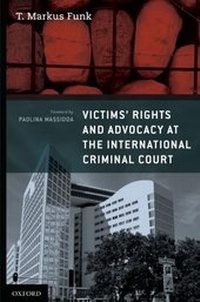
Victims Rights And Advocac
1st Edition
Published on 8. April 2010
Book
Hardback
480 pages
978-0-19-973747-5 (ISBN)
Description
Victims' Rights and Advocacy at the International Criminal Court explores the unique and vital role played by victims in cases before the ICC. Author T. Markus Funk draws on his experience in international criminal law to show how the ICC has developed procedural rights and other rules for the parts of ICC proceedings devoted to victims. To set the stage for that analysis, Funk first provides a background history on the ICC's creation and on the Rome Statute's development. This background detail helps the reader answer a number of key questions: How does the ICC compare to its predecessor ad hoc tribunals? What are the legal, theoretical, and political pillars on which the ICC is built? What are the upsides and downsides for sovereign nations considering participation in the ICC? Funk then moves beyond that legal background to propose reforms that would help the ICC fulfill its mission of redressing past atrocities while preserving victims' rights.
Featuring a foreword by Paolina Massidda, Principal Counsel of the Office of Public Counsel for Victims at the International Criminal Court, Victims' Rights and Advocacy at the International Criminal Court equips lawyers, victim advocates, academics, government officials, and other decision-makers with a thorough understanding of the promises and potential pitfalls of victim advocacy at the ICC. In addition to discussing the foundation of victims' rights under international law, as well as the history and purpose of the ICC, the book examines the ICC's rules of procedure, rules of evidence, and other practical issues impacting daily litigation practice at the Court.
Featuring a foreword by Paolina Massidda, Principal Counsel of the Office of Public Counsel for Victims at the International Criminal Court, Victims' Rights and Advocacy at the International Criminal Court equips lawyers, victim advocates, academics, government officials, and other decision-makers with a thorough understanding of the promises and potential pitfalls of victim advocacy at the ICC. In addition to discussing the foundation of victims' rights under international law, as well as the history and purpose of the ICC, the book examines the ICC's rules of procedure, rules of evidence, and other practical issues impacting daily litigation practice at the Court.
Reviews / Votes
The detailed manner of this book is impressive. The author appears to have analysed virtually all provisions in the Rome statute and the Rules of Procedure and Evidence, which have a bearing on the procedural status of victims. Sergey Sayapin, Journal of International Law of Peace and Armed Conflicts ...clear-eyed but optimistic descriptions of how the International Criminal Court can pursue 'victim-centered' justice by developing processes of legal participation and reparations. Asad Kiyani, The International Journal of Transitional JusticeMore details
Language
English
Place of publication
New York
United States
Target group
College/higher education
Professional and scholarly
Illustrations
Illustrations
Dimensions
Height: 242 mm
Width: 164 mm
Thickness: 37 mm
Weight
828 gr
ISBN-13
978-0-19-973747-5 (9780199737475)
Copyright in bibliographic data and cover images is held by Nielsen Book Services Limited or by the publishers or by their respective licensors: all rights reserved.
Schweitzer Classification
Other editions
Additional editions
E-Book
03/2015
2nd Edition
OUP eBook
€84.99
Available for download
E-Book
03/2015
2nd Edition
OUP eBook
€76.49
Available for download
E-Book
03/2010
1st Edition
Oxford University Press, USA
€139.59
Available for download
Person
collaborate with war crimes prosecutors and tribunals, and provided advice to the Chief of Missions concerning ongoing cases and investigations. In 2008, Funk headed multiple week-long trainings in Pristina, Kosovo, for local and international judges, Supreme Court justices, prosecutors, victims' advocates, and investigators. Funk is currently Co-Chair of the American Bar Association's Special Committee on Human Trafficking, and is a Member of the ABA's Darfur Task Force. He has written dozens of scholarly and popular articles and book chapters on a wide variety of topics in such publications as the Oxford Journal of Legal Studies, the Kosovo Law Journal, the University of Michigan Journal of Law Reform, the Tennessee Law Review, and the Journal of Criminal Law and Criminology. Funk has also been featured in The Atlantic Monthly, the Los Angeles Times, and The Washington Post.
Content
PART I. INTRODUCTION
PART II. A Legacy of Abuse and Suffering Leads to the Birth of the ICC
PART III. TRACING THE DEVELOPMENT OF VICTIMS' RIGHTS UNDER INTERNATIONAL LAW
A. Victim-Centric Justice of the 1400's - Customary Law As Exemplified By the Code of Leke Dukagjini
B. Centralized State Power in the 1700's and 1800's, the Scientification of Criminal Law, And the Decline of Victims' Rights Under Domestic Law
C. Twentieth-Century Resurgence of Victims Rights Under Domestic Law
D. Victims' Rights Recognized as Part of International Law
PART IV. PRIMER ON THE ICC
A. Breaking New Ground for Victims' Rights
B. The ICC's Operation
C. The ICC's Limited Subject-Matter Jurisdiction
D. Territorial and Personal Jurisdiction
E. The ICC's Limited Temporal Jurisdiction
F. The ICC's Due Process Guarantees
G. The
PART II. A Legacy of Abuse and Suffering Leads to the Birth of the ICC
PART III. TRACING THE DEVELOPMENT OF VICTIMS' RIGHTS UNDER INTERNATIONAL LAW
A. Victim-Centric Justice of the 1400's - Customary Law As Exemplified By the Code of Leke Dukagjini
B. Centralized State Power in the 1700's and 1800's, the Scientification of Criminal Law, And the Decline of Victims' Rights Under Domestic Law
C. Twentieth-Century Resurgence of Victims Rights Under Domestic Law
D. Victims' Rights Recognized as Part of International Law
PART IV. PRIMER ON THE ICC
A. Breaking New Ground for Victims' Rights
B. The ICC's Operation
C. The ICC's Limited Subject-Matter Jurisdiction
D. Territorial and Personal Jurisdiction
E. The ICC's Limited Temporal Jurisdiction
F. The ICC's Due Process Guarantees
G. The