

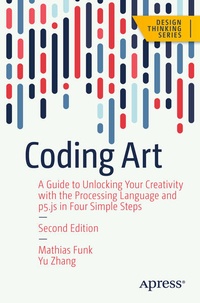
Coding Art
Description
Rather than following a computer science curriculum, this book is aimed at creatives who are working in the intersection of design, art, and education. Following a real-world use case of computation art, you'll see how it relates back to the four key pillars, and addresses potential pitfalls and challenges in the creative process. All code examples are presented in a fully integrated Processing example library, making it easy for readers to get started.
This unique and finely balanced approach between skill acquisition and development makes Coding Art, Second Edition the ideal reference book for both creative programming and the creative process for professors and students alike.
What You'll Learn
-
Review ideas and approaches from creative programming to different professional domains
- Work with computational tools like the Processing language
- Understand the skills needed to move from static elements to animation to interaction
- Use interactivity as input to bring creative concepts closer to refinement and depth
- Simplify and extend the design of aesthetics, rhythms, and smoothness with data structures
- Leverage the diversity of art code on other platforms like the web or mobile applications
- Understand the end-to-end process of computation art through real world use cases
- Study best practices, common pitfalls, and challenges of the creative process
Who This Book Is For
Those looking to see what computation and data can do for their creative expression; learners who want to integrate computation and data into their practices in different perspectives; creative technologists, educators, digital artists and those who already know how to program, seeking creativity and inspiration in the context of computation and data.
Reviews / Votes
"Coding art is a remarkable resource that expertly bridges the gap between artistic imagination and computational skills. . Coding art achieves a delicate balance between skill acquisition and creative process development, making it an invaluable reference for both professors and students engaged in creative programming and computational art." (Mihailescu Marius Iulian, Computing Reviews, January 29, 2024)
"This book is a practicable addition to coding art and will benefit its intended audience." (S. V. Nagaraj, Computing Reviews, April 15, 2024)
More details
Other editions
Additional editions
Previous edition
Persons
Mathias Funk is Associate Professor in the Future Everyday group in the Department of Industrial Design at the Eindhoven University of Technology (TU/e). He has a background in Computer Science and a PhD in Electrical Engineering (from Eindhoven University of Technology). His research interests include complex systems design, remote data collection, systems for musical expression, and design tools such as domain-specific languages and integrated development environments. In the past he has worked in research positions at ATR Japan, RWTH Aachen and he has been Visiting Researcher at Philips Consumer Lifestyle, The Netherlands. He is also the co-founder of UXsuite, a high-tech spin-off from Eindhoven University ofTechnology. He has years of experience in software architecture and design, engineering of distributed systems, and web technologies. Further areas of interest and practice are domain-specific languages and code generation, sound and video processing systems, and data and information visualization approaches. He has been involved extensively in the business side of innovation, the transfer of research to commercial products, and he loves to think about a design's real world impact. As a teacher, he teaches various technology-oriented courses in the Industrial Design curriculum about designing with data and visualization approaches, systems design and technologies for connected products and systems. He is regularly invited to give international workshops on large-scale interactive systems, group music improvisation interfaces and expressive (musical) interaction. He has been an active musician for years, and is very interested in the intersection of music, art, and design in particular. Mathias Funk is a senior member of the ACM.
Content
Chapter 1: Introduction.- Chapter 2: Idea to visuals.- Chapter 3: Composition and structure.- Chapter 4: Refinement and depth.- Chapter 5: Completion and production.- Chapter 6: Taking a larger project through all four steps.- Chapter 7: Flow fields and particle storms with p5.js.- Chapter 8: Making sense of touch and sensors with p5.js.- Chapter 9: Dealing with problems.- Chapter 10: Learning path.- Chapter 11: Creative processes.