

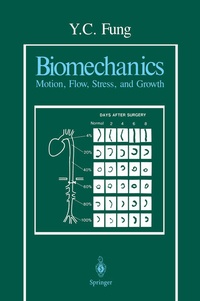
Biomechanics
Motion, Flow, Stress, and Growth
Published on 26. June 1990
Book
Hardback
XVI, 570 pages
978-0-387-97124-7 (ISBN)
Description
Biomechanics aims to explain the mechanics oflife and living. From molecules to organisms, everything must obey the laws of mechanics. Clarification of mechanics clarifies many things. Biomechanics helps us to appreciate life. It sensitizes us to observe nature. It is a tool for design and invention of devices to improve the quality of life. It is a useful tool, a simple tool, a valuable tool, an unavoidable tool. It is a necessary part of biology and engineering. The method of biomechanics is the method of engineering, which consists of observation, experimentation, theorization, validation, and application. To understand any object, we must know its geometry and materials of construc tion, the mechanical properties of the materials involved, the governing natural laws, the mathematical formulation of specific problems and their solutions, and the results of validation. Once understood, one goes on to develop applications. In my plan to present an outline of biomechanics, I followedthe engineering approach and used three volumes. In the first volume, Biomechanics: Mechanical Properties of Living Tissues, the geometrical struc ture and the rheological properties of various materials, tissues, and organs are presented. In the second volume, Biodynamics: Circulation, the physiology of blood circulation is analyzed by the engineering method.
More details
Edition
1st ed. 1990. Corr. 2nd printing 1998
Language
English
Place of publication
New York
United States
Target group
Professional and scholarly
Research
Illustrations
XVI, 570 p.
Dimensions
Height: 241 mm
Width: 160 mm
Thickness: 37 mm
Weight
1042 gr
ISBN-13
978-0-387-97124-7 (9780387971247)
DOI
10.1007/978-1-4419-6856-2
Schweitzer Classification
Other editions
Additional editions
E-Book
03/2013
1st Edition
Springer
€309.23
Available for download
Book
02/2013
Springer
€320.99
Shipment within 15-20 days
Content
1 Motion.- 2 Segmental Movement and Vibrations.- 3 External Flow: Fluid Dynamic Forces Acting on Moving Bodies.- 4 Flying and Swimming.- 5 Blood Flow in Heart, Lung, Arteries, and Veins.- 6 Micro- and Macrocirculation.- 7 Respiratory Gas Flow.- 8 Basic Transport Equations According to Thermodynamics, Molecular Diffusion, Mechanisms in Membranes, and Multiphasic Structure.- 9 Mass Transport in Capillaries, Tissues, Interstitial Space, Lymphatics, Indicator Dilution Method, and Peristalsis.- 10 Description of Internal Deformation and Forces.- 11 Stress, Strain, and Stability of Organs.- 12 Strength, Trauma, and Tolerance.- 13 Biomechanical Aspects of Growth and Tissue Engineering.- Author Index.