

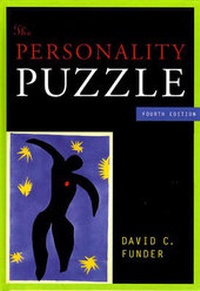
The Personality Puzzle
Published on 1. March 2007
Book
Hardback
798 pages
978-0-393-92858-7 (ISBN)
Description
The Personality Puzzle offers everything students need to gain a
sure understanding of personality psychology -- balanced coverage
of classic and contemporary theories, accessible organization and
pedagogy -- and the lively, often humorous prose of experienced
teacher David Funder. Organized around the field\'s major
domains/paradigms -- trait, biological, psychoanalytic, humanistic
and crosscultural, and cognitive and learning -- the text outlines
the foundations of personality psychology and emphasizes the
significance of contemporary research. A new capstone chapter on
personality disorders synthesizes these domains/paradigms.
The Fourth Edition adds a new chapter on cognition and the self,
new coverage of the "Big Five" personality traits and of
personality in a developmental context, and a new Student Website
to enable effective study and review.
Takes a Contemporary Domains/Paradigm-Based
Approach
By organizing the text around major domains/paradigms -- trait,
biological, psychoanalytic, humanistic and cross-cultural, and
cognitive and learning -- The Personality Puzzle offers a broad
view of the discipline\'s theories and research in an
easy-to-understand format. A new chapter on personality disorders
concludes the book by clarifying how the six paradigms are closely
interrelated.
Expanded Coverage of Contemporary
Research
The Fourth Edition\'s expanded coverage of contemporary research
includes a more detailed treatment of the "Big Five" personality
traits, a new discussion of personality traits across the lifespan,
up-to-date coverage of the biological and cultural aspects of
personality, a new chapter on the self, and updated coverage of
cognition, motivation, and emotion.
Theory in the Context of Everyday Life
To help students understand the theories discussed in the book,
Professor Funder includes, in each chapter, interludes that clarify
concepts by demonstrating their relevance to everyday life. For the
Fourth Edition, Professor Funder has added a question set at the
end of each chapter that challenges students to apply what they
learn in a real-world context.
sure understanding of personality psychology -- balanced coverage
of classic and contemporary theories, accessible organization and
pedagogy -- and the lively, often humorous prose of experienced
teacher David Funder. Organized around the field\'s major
domains/paradigms -- trait, biological, psychoanalytic, humanistic
and crosscultural, and cognitive and learning -- the text outlines
the foundations of personality psychology and emphasizes the
significance of contemporary research. A new capstone chapter on
personality disorders synthesizes these domains/paradigms.
The Fourth Edition adds a new chapter on cognition and the self,
new coverage of the "Big Five" personality traits and of
personality in a developmental context, and a new Student Website
to enable effective study and review.
Takes a Contemporary Domains/Paradigm-Based
Approach
By organizing the text around major domains/paradigms -- trait,
biological, psychoanalytic, humanistic and cross-cultural, and
cognitive and learning -- The Personality Puzzle offers a broad
view of the discipline\'s theories and research in an
easy-to-understand format. A new chapter on personality disorders
concludes the book by clarifying how the six paradigms are closely
interrelated.
Expanded Coverage of Contemporary
Research
The Fourth Edition\'s expanded coverage of contemporary research
includes a more detailed treatment of the "Big Five" personality
traits, a new discussion of personality traits across the lifespan,
up-to-date coverage of the biological and cultural aspects of
personality, a new chapter on the self, and updated coverage of
cognition, motivation, and emotion.
Theory in the Context of Everyday Life
To help students understand the theories discussed in the book,
Professor Funder includes, in each chapter, interludes that clarify
concepts by demonstrating their relevance to everyday life. For the
Fourth Edition, Professor Funder has added a question set at the
end of each chapter that challenges students to apply what they
learn in a real-world context.
More details
Language
English
Place of publication
New York
United States
Target group
Professional and scholarly
Weight
1129 gr
ISBN-13
978-0-393-92858-7 (9780393928587)
Copyright in bibliographic data and cover images is held by Nielsen Book Services Limited or by the publishers or by their respective licensors: all rights reserved.
Schweitzer Classification
Other editions
New editions

David C. Funder
The Personality Puzzle
Book
03/2010
5th Edition
WW Norton & Co
€112.85
Article not available
Previous edition

Book
04/2004
WW Norton & Co
€36.04
Article exhausted; check for reprint
Content
Chapter 1 (Introduction): The Study of the Person
Part I Research Methods
Chapter 2: Clues to Personality: The Basic Sources of Data
Chapter 3: Personality Psychology as Science: Research
Methods
Part II How People Differ: The Trait
Approach
Chapter 4: Personality Traits and Behavior
Chapter 5: Personality Assessment I: Personality Testing and Its
Consequences
Chapter 6: Personality Assessment II: Personality Judgment in Daily
Life
Chapter 7: Using Personality Traits to Understand Behavior (HEAVILY
REVISED)
NEW updated treatment of the "Big Five" and development of
personality over the lifespan
Part III The Mind and the Body: Biological Approaches to
Personality
Chapter 8: The Anatomy and Physiology of Personality
NEW updated treatment of brain imaging and fMRI scans
Chapter 9: The Inheritance of Personality: Behavioral Genetics and
Evolutionary Theory
NEW section on molecular genetics
Part IV The Hidden World of the Mind: The Psychoanalytic
Approach
Chapter 10: Basics of Psychoanalysis
Chapter 11: The Workings of the Unconscious Mind: Defenses and
Slips
Chapter 12: Psychoanalysis after Freud: The Neo-Freudians, Object
Relations, and Empirical Evidence
Part V Experience and Awareness: Humanistic and
Cross-Cultural Psychology
Chapter 13: Experience, Existence, and the Meaning of Life:
Humanistic Psychology
Chapter 14: Cultural Variation in Experience, Behavior, and
Personality
NEW updated treatment of multiculturalism and individual
differences in acculturation
Part VI The Person and the Situation: Learning and
Cognitive Approaches to Personality
Chapter 15: How the World Creates Who You Are: Behaviorism and
Social Learning Theory
Chapter 16: Personality Processes: Perception, Thought, Motivation,
and Emotion
NEW updated treatment of emotion, including a new section on
happiness
Chapter 17: What You Know About You: The Self (NEW CHAPTER)
NEW chapter integrates material previously spread across the
cognitive domain
Chapter 18: Disorders of Personality (NEW CHAPTER)
NEW capstone chapter that acts as a synthesis point for the major
paradigms
Chapter 19: Conclusion: Looking Back and Looking Ahead
Part I Research Methods
Chapter 2: Clues to Personality: The Basic Sources of Data
Chapter 3: Personality Psychology as Science: Research
Methods
Part II How People Differ: The Trait
Approach
Chapter 4: Personality Traits and Behavior
Chapter 5: Personality Assessment I: Personality Testing and Its
Consequences
Chapter 6: Personality Assessment II: Personality Judgment in Daily
Life
Chapter 7: Using Personality Traits to Understand Behavior (HEAVILY
REVISED)
NEW updated treatment of the "Big Five" and development of
personality over the lifespan
Part III The Mind and the Body: Biological Approaches to
Personality
Chapter 8: The Anatomy and Physiology of Personality
NEW updated treatment of brain imaging and fMRI scans
Chapter 9: The Inheritance of Personality: Behavioral Genetics and
Evolutionary Theory
NEW section on molecular genetics
Part IV The Hidden World of the Mind: The Psychoanalytic
Approach
Chapter 10: Basics of Psychoanalysis
Chapter 11: The Workings of the Unconscious Mind: Defenses and
Slips
Chapter 12: Psychoanalysis after Freud: The Neo-Freudians, Object
Relations, and Empirical Evidence
Part V Experience and Awareness: Humanistic and
Cross-Cultural Psychology
Chapter 13: Experience, Existence, and the Meaning of Life:
Humanistic Psychology
Chapter 14: Cultural Variation in Experience, Behavior, and
Personality
NEW updated treatment of multiculturalism and individual
differences in acculturation
Part VI The Person and the Situation: Learning and
Cognitive Approaches to Personality
Chapter 15: How the World Creates Who You Are: Behaviorism and
Social Learning Theory
Chapter 16: Personality Processes: Perception, Thought, Motivation,
and Emotion
NEW updated treatment of emotion, including a new section on
happiness
Chapter 17: What You Know About You: The Self (NEW CHAPTER)
NEW chapter integrates material previously spread across the
cognitive domain
Chapter 18: Disorders of Personality (NEW CHAPTER)
NEW capstone chapter that acts as a synthesis point for the major
paradigms
Chapter 19: Conclusion: Looking Back and Looking Ahead