

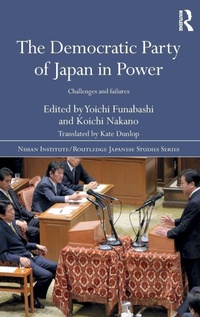
The Democratic Party of Japan in Power
Challenges and Failures
1st Edition
Published on 8. September 2016
Book
Hardback
206 pages
978-1-138-63870-9 (ISBN)
Description
When the Democratic Party of Japan (DPJ) came to power in September 2009, Japanese citizens expected the imminent arrival of a new political era, characterized by a two-party system. However, in addition to the triple disasters of March 2011, the DPJ faced numerous difficulties arising from its controversial policies and massive party defections following the government's consumption tax hike legislation. The DPJ fell from power following a crushing defeat in the 2012 Lower House election, in which its seat total was drastically reduced.
This book examines the September 2009-December 2012 administration of the DPJ from various perspectives, including policies, party governance, management, and legacy. It identifies the significance of the DPJ to Japan's party politics, explains the reasons for its downfall, and derives crucial lessons for the future of party democracy in Japan. The contributors, a team of professional academics and a lawyer, analyse the policies and events of the DPJ administration based on their interviews with key DPJ politicians and related persons at or close to the centre of the administration. Together they elicit insights from the experiences of the DPJ government to inform the expectations of Japan's party democracy.
Explaining how the failure of the DPJ government has long-term importance for understanding Japanese politics, this book will be invaluable for students and scholars of the field.
This book examines the September 2009-December 2012 administration of the DPJ from various perspectives, including policies, party governance, management, and legacy. It identifies the significance of the DPJ to Japan's party politics, explains the reasons for its downfall, and derives crucial lessons for the future of party democracy in Japan. The contributors, a team of professional academics and a lawyer, analyse the policies and events of the DPJ administration based on their interviews with key DPJ politicians and related persons at or close to the centre of the administration. Together they elicit insights from the experiences of the DPJ government to inform the expectations of Japan's party democracy.
Explaining how the failure of the DPJ government has long-term importance for understanding Japanese politics, this book will be invaluable for students and scholars of the field.
More details
Series
Language
English
Place of publication
London
United Kingdom
Publishing group
Taylor & Francis Ltd
Target group
College/higher education
Illustrations
11 s/w Abbildungen, 11 s/w Zeichnungen, 10 s/w Tabellen
10 Tables, black and white; 11 Line drawings, black and white; 11 Illustrations, black and white
Dimensions
Height: 240 mm
Width: 161 mm
Thickness: 17 mm
Weight
502 gr
ISBN-13
978-1-138-63870-9 (9781138638709)
Copyright in bibliographic data and cover images is held by Nielsen Book Services Limited or by the publishers or by their respective licensors: all rights reserved.
Schweitzer Classification
Other editions
Additional editions
Book
01/2019
1st Edition
Routledge
€71.90
Shipment within 15-20 days
E-Book
09/2016
Routledge
€64.49
Available for download
E-Book
09/2016
Routledge
€64.49
Available for download
Persons
Yoichi Funabashi is Chairman of the Rebuild Japan Initiative Foundation and former Editor-in-Chief for the Asahi Shinbun.
Koichi Nakano is Professor of Political Science, Sophia University, Japan.
Koichi Nakano is Professor of Political Science, Sophia University, Japan.
Content
Foreword Preface to the English Edition Introduction: The DPJ's Evolution and Three Years in Power 1. The Manifesto: Why was the DPJ Unable to Keep its Campaign Promises? 2. Political Leadership: The Failure of the DPJ's "Five Measures" 3. The Economy and Public Finance: The Challenges and Setbacks of Reform, Hideaki Tanaka 4. Foreign Policy and Security under the DPJ: From Idealism to Pragmatism 5. The Child Allowance: A Failed Attempt to Put "Children First" 6. The DPJ's Mismanagement of Administration and Party: Was Ozawa Alone to Blame? 7. DPJ Election Strategy: The Dilemma of Landslide Victory, Phillip Y. Lipscy 8. Conclusion Afterword