

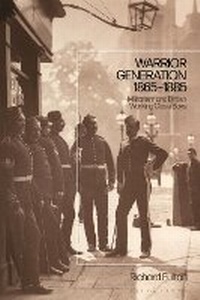
Warrior Generation 1865-1885
Militarism and British Working Class Boys
Published on 24. February 2022
Book
Paperback/Softback
344 pages
978-1-350-19716-9 (ISBN)
Description
Richard Fulton's Warrior Generation 1865-1885 fundamentally rethinks the efficacy of an institutional drive among influential middle-class opinion leaders to militarize lower-class boys in Victorian Britain. He contends that instead of engendering the desired cultural militarism, as has been commonly argued, their push had merely contributed to a fast-developing culture of adventure and masculinity.
Challenging this popular assumption, Fulton carefully reexamines many of the oft cited touchstones of militaristic influence on lower-class boys, deeply assessing their actual effects on the behaviours and cultural practices of this generation. He explores a range of themes from, among others, the propagation of the military's message in school curricula (and its glorification in students' textbooks), to the military's heroic depiction and ubiquitous presence in lower-class boys' entertainment and popular media.
Challenging this popular assumption, Fulton carefully reexamines many of the oft cited touchstones of militaristic influence on lower-class boys, deeply assessing their actual effects on the behaviours and cultural practices of this generation. He explores a range of themes from, among others, the propagation of the military's message in school curricula (and its glorification in students' textbooks), to the military's heroic depiction and ubiquitous presence in lower-class boys' entertainment and popular media.
Reviews / Votes
In this narrowly defined but deeply researched study, Fulton explores the activities that shaped the lives and attitudes of lower-class boys in late Victorian Britain. He shows that pervasive messaging in education, entertainment, and popular media contributed to a growing culture of masculinity and adventure, but generally failed to militarize a generation ... While focusing on a particular period, age group, and issue, Fulton offers a porthole to Victorian culture as a whole. * Washington State University Magazine * Warrior Generation is an excellent example, especially for graduate students, of how to question or challenge traditional academic conceptions. * Journal of British Studies * In Warrior Generation, Richard Fulton pulls apart the argument that the military had become more popular by the end of the nineteenth century due to the indoctrination of boys through schooling, fiction, recreational activities, and national discourses. He adroitly takes the reader through the realities of boy culture, demonstrating that most lads were well aware of the division between fact and fiction. Most took their opinion of the army from personal acquaintance with recruits and local opinions, preferring to take local jobs rather than join up. Fulton looks deeply into the activities that shaped late Victorian lower-class boyhood to show that education, leisure, and even membership in the Boys Brigade seldom led to a higher opinion in the armed services. Geography and history texts, he demonstrates, were often read in the same way as popular adventure magazines: as broadly supportive of Britain's place in the world. However, few lads uncritically accepted them as templates for living. Readers will find that Warrior Generation offers a lively account of boy life accompanied by Fulton's penetrating analysis of the resilience of lads in the face of narratives of imperial and military power. * Kelly Boyd, Senior Research Fellow, Institute of Historical Research, University of London, UK * Fulton's readable, well-documented and thoughtful study addresses how working-class and often poor English young men thought about the Army and their relationships to it. In doing so, the author addresses enduring and central questions about culture, class and militarism. Writing with wit and clarity, Fulton is willing to take on orthodox views about the pre-1914 Tommy and what others said and wrote about him. We learn a lot about what the common young man and his middle- and upper-class contemporaries thought about his putting on a uniform, marching and perhaps going on a great adventure, from which he might not return. The author addresses these and other later-Victorian matters with professionalism, nuance and common sense. * Peter H. Hoffenberg, Associate Professor of History, University of Hawai'i at Manoa, USA * A spirited look at the "warrior generation" in Victorian Britain-working-class boys born and growing up from 1865 to 1885-and their attitudes toward the army and warfare. Fulton eschews large analytic categories like Imperialism and avoids facile generalizations about militarism in favor of a richer, more nuanced account of the culture of boyhood and its influence on changing attitudes toward the military. Buttressed by careful consideration of contemporary periodicals and working-class autobiographies, this work provides a valuable corrective to previous accounts and a window into multiple aspects of late Victorian culture. * Christopher C. Dahl, President Emeritus and Professor of English, State University of New York at Geneseo, USA * This book offers an insistently revisionist interpretation of later Victorian cultures of imperialism and militarism as they were experienced by working class boys and young men born in the twenty-year period denominated in its title. In taking this approach, it also offers a case-study of the potential for generational analysis in Victorian history. * The English Historical Review *More details
Language
English
Place of publication
London
United Kingdom
Publishing group
Bloomsbury Publishing PLC
Target group
College/higher education
Illustrations
12 bw illus
Dimensions
Height: 234 mm
Width: 156 mm
Weight
481 gr
ISBN-13
978-1-350-19716-9 (9781350197169)
Copyright in bibliographic data and cover images is held by Nielsen Book Services Limited or by the publishers or by their respective licensors: all rights reserved.
Schweitzer Classification
Other editions
Additional editions
E-Book
07/2020
1st Edition
Bloomsbury Academic
€35.49
Available for download
E-Book
07/2020
1st Edition
Bloomsbury Academic
€35.49
Available for download
Person
Richard Fulton is Visiting Faculty in English at Washington State University.
Content
List of Figures
Chapter 1. Introduction and the Warrior Generation
Chapter 2. The Military and the Warrior Generation
Chapter 3. Work and Family
Chapter 4. School and Schooling
Chapter 5. Leisure, Play, Entertainment
Chapter 6. Reading, and Some Conclusions
Bibliography
Index
Chapter 1. Introduction and the Warrior Generation
Chapter 2. The Military and the Warrior Generation
Chapter 3. Work and Family
Chapter 4. School and Schooling
Chapter 5. Leisure, Play, Entertainment
Chapter 6. Reading, and Some Conclusions
Bibliography
Index