

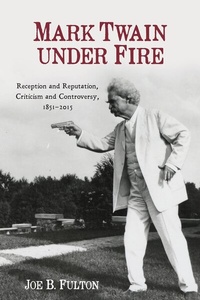
Mark Twain under Fire
Reception and Reputation, Criticism and Controversy, 1851-2015
Published on 15. November 2016
Book
Hardback
306 pages
978-1-57113-553-7 (ISBN)
Description
Threatened by a rival editor brandishing a double-barreled shotgun, young Samuel Clemens had his first taste of literary criticism. Clemens began his long writing career penning satirical articles for his brother's newspaper in Hannibal, Missouri. His humor delighted everyone except his targets, and it would not be the last time his writing provoked threats of "dissection, tomahawking, libel, and getting his head shot off." Clemens adopted the name Mark Twain while living in the Nevada Territory, where his caustic comedy led to angry confrontations, a challenge to a duel, and a subsequent flight. Nursing his wounded ego in California, Twain vowed to develop a reputation that would"stand fire" and in the process became the classic American writer.
Mark Twain under Fire tracks the genesis and evolution of Twain's reputation as a writer: his reception as a humorist, his "return fire" on genteel critics, and the development of academic criticism. As a history of Twain criticism, the book draws on English and foreign-language scholarship. Fulton discusses the forces and ideas that have influenced criticism, revealinghow and why Mark Twain has been "under fire" from the advent of his career to the present day, when his masterpiece Huckleberry Finn remains one of America's most frequently banned books.
Joe B. Fulton is Professor of English at Baylor University in Waco, Texas. He has published four previous books on Mark Twain.
Mark Twain under Fire tracks the genesis and evolution of Twain's reputation as a writer: his reception as a humorist, his "return fire" on genteel critics, and the development of academic criticism. As a history of Twain criticism, the book draws on English and foreign-language scholarship. Fulton discusses the forces and ideas that have influenced criticism, revealinghow and why Mark Twain has been "under fire" from the advent of his career to the present day, when his masterpiece Huckleberry Finn remains one of America's most frequently banned books.
Joe B. Fulton is Professor of English at Baylor University in Waco, Texas. He has published four previous books on Mark Twain.
Reviews / Votes
Fulton gives an excellent account of the difficulties faced by nineteenth-century American scholars . . . who wanted both to establish American literature on strong 'native' ground yet struggled to recognize that ground in Calaveras County, or a Colorado silver mine, or on the banks of the Mississippi. * TLS *More details
Series
Language
English
Place of publication
Columbia, MD
United States
Publishing group
Boydell & Brewer Ltd
Target group
College/higher education
Product notice
Cloth over boards
Illustrations
1 s/w Abbildung
1 b/w.
Dimensions
Height: 229 mm
Width: 152 mm
Weight
612 gr
ISBN-13
978-1-57113-553-7 (9781571135537)
Copyright in bibliographic data and cover images is held by Nielsen Book Services Limited or by the publishers or by their respective licensors: all rights reserved.
Schweitzer Classification
Other editions
Additional editions
Book
07/2018
Camden House Inc
€37.70
Shipment within 15-20 days
Person
Content
Introduction
"A Reputation That Can Stand Fire": Mark Twain's Early Reception through 1910
"All Right, Then, I'll Go to Hell": Mark Twain's Disputed Legacy, 1910-1950
"Only One Right Form for a Story": Mark Twain and Cold War Criticism, 1950-1970
"Everyone Is a Moon, and Has a Dark Side": New Phases of Mark Twain Criticism from the 1970s through the 1980s
"It Is Difference of Opinion That Makes Horse-Races": Mark Twain as a Partisan in the Culture Wars, 1990s to 2015
Conclusion
Notes
Works Cited
Index
"A Reputation That Can Stand Fire": Mark Twain's Early Reception through 1910
"All Right, Then, I'll Go to Hell": Mark Twain's Disputed Legacy, 1910-1950
"Only One Right Form for a Story": Mark Twain and Cold War Criticism, 1950-1970
"Everyone Is a Moon, and Has a Dark Side": New Phases of Mark Twain Criticism from the 1970s through the 1980s
"It Is Difference of Opinion That Makes Horse-Races": Mark Twain as a Partisan in the Culture Wars, 1990s to 2015
Conclusion
Notes
Works Cited
Index