

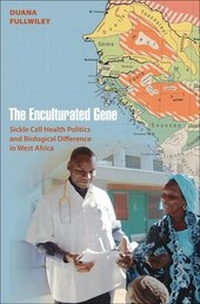
The Enculturated Gene
Sickle Cell Health Politics and Biological Difference in West Africa
Published on 27. November 2011
Book
Hardback
368 pages
978-0-691-12316-5 (ISBN)
Description
In the 1980s, a research team led by Parisian scientists identified several unique DNA sequences, or haplotypes, linked to sickle cell anemia in African populations. After casual observations of how patients managed this painful blood disorder, the researchers in question postulated that the Senegalese type was less severe. "The Enculturated Gene" traces how this genetic discourse has blotted from view the roles that Senegalese patients and doctors have played in making sickle cell "mild" in a social setting where public health priorities and economic austerity programs have forced people to improvise informal strategies of care. Duana Fullwiley shows how geneticists, who were fixated on population differences, never investigated the various modalities of self-care that people developed in this context of biomedical scarcity, and how local doctors, confronted with dire cuts in Senegal's health sector, wittingly accepted the genetic prognosis of better-than-expected health outcomes. Unlike most genetic determinisms that highlight the absoluteness of disease, DNA haplotypes for sickle cell in Senegal did the opposite.
As Fullwiley demonstrates, they allowed the condition to remain officially invisible, never to materialize as a health priority. At the same time, scientists' attribution of a less severe form of Senegalese sickle cell to isolated DNA sequences closed off other explanations of this population's measured biological success. "The Enculturated Gene" reveals how the notion of an advantageous form of sickle cell in this part of West Africa has defined - and obscured - the nature of this illness in Senegal today.
As Fullwiley demonstrates, they allowed the condition to remain officially invisible, never to materialize as a health priority. At the same time, scientists' attribution of a less severe form of Senegalese sickle cell to isolated DNA sequences closed off other explanations of this population's measured biological success. "The Enculturated Gene" reveals how the notion of an advantageous form of sickle cell in this part of West Africa has defined - and obscured - the nature of this illness in Senegal today.
Reviews / Votes
Winner of the 2011 Amaury Talbot Prize for African Anthropology, Royal Anthropological Institute "Duana Fulwilley has produced an extraordinary work that incorporates the insights of anthropology as well as science and technology studies of genetics and race. It is also exceptional in its multi-sited focus on Senegal and France, since many similar studies of genetics have tended to focus on the US and Europe."--Elisha P. Renne, Anthropological Quarterly "The Enculturated Gene is the product of over ten years of research beginning in the late 1990s. The book is stunning in its scope and attention to a full range of issues, from discoveries in the lab to knowledge production in the clinic to global health responses... By elucidating ethnographically the contingencies that have produced the local and global health responses to sickle cell disease, Fullwiley shows us that health policy is as much a product of culture and subjectivity as affective responses to physical and existential pain."--Carolyn Rouse, Medical Anthropology QuarterlyMore details
Language
English
Place of publication
New Jersey
United States
Target group
College/higher education
Professional and scholarly
Product notice
Trade binding
Illustrations
4 Maps
Dimensions
Height: 229 mm
Width: 152 mm
Weight
624 gr
ISBN-13
978-0-691-12316-5 (9780691123165)
Copyright in bibliographic data and cover images is held by Nielsen Book Services Limited or by the publishers or by their respective licensors: all rights reserved.
Schweitzer Classification
Other editions
Additional editions
Duana Fullwiley
The Enculturated Gene
Sickle Cell Health Politics and Biological Difference in West Africa
Book
11/2011
Princeton University Press
€54.00
Article not available at the moment
Person
Duana Fullwiley is associate professor of anthropology at Stanford University.
Content
List of Illustrations viii Preface ix Acknowledgments xxv Chapter One: Introduction: The Powers of Association 1 Chapter Two: Healthy Sicklers with "Mild" Disease: Local Illness Aff ects and Population- Level Eff ects 45 Chapter Three: The Biosocial Politics of Plants and People 77 Chapter Four: Attitudes of Care 119 Chapter Five: Localized Biologies: Mapping Race and Sickle Cell Difference in French West Africa 158 Chapter Six: Ordering Illness: Heterozygous "Trait" Suff ering in the Land of the Mild Disease 197 Chapter Seven: The Work of Patient Advocacy 221 Conclusion: Economic and Health Futures amid Hope and Despair 250 Notes 275 References 307 Index 329