

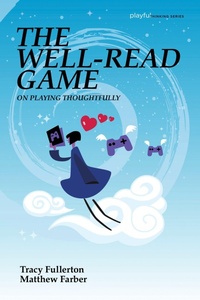
The Well-Read Game
On Playing Thoughtfully
Published on 25. March 2025
Book
Paperback/Softback
240 pages
978-0-262-55223-3 (ISBN)
Description
How players evoke personal and subjective meanings through a new theory of player response.
In The Well-Read Game, Tracy Fullerton and Matthew Farber explore the experiences we have when we play games: not the outcomes of play or the aesthetics of formal game structures but the ephemeral and emotional experiences of being in play. These are the private stories we tell ourselves as we play, the questions we ask, and our reactions to the game’s intent. These experiences are called “readings” because they involve so many of the aspects of engaging with literary, cinematic, and other expressive texts. A game that is experienced in such a way can be called “well-read,” rather than, or as well as, “well-played,” because of the personal, interpretive nature of that experience and the way in which it relates to our reading of texts of all kinds.
The concept of the “well-read game” exists at the convergence of literary, media, and play theories—specifically, the works of Louise Rosenblatt’s reader-response theory, Brian Upton’s situational game theory, Tracy Fullerton’s playcentric design theory, and Bernie DeKoven’s well-played game philosophy. Each of these theories, from their own perspective, challenges notions of a separate, objective, or authorial meaning in a text and underscores the richness that arises from the varied responses of readers, who coauthor the meaning of each text through their active engagement with it. When taken together, these theories point to a richer understanding of what a game is and how we might better value our experiences with games to become more thoughtful readers of their essential meanings.
In The Well-Read Game, Tracy Fullerton and Matthew Farber explore the experiences we have when we play games: not the outcomes of play or the aesthetics of formal game structures but the ephemeral and emotional experiences of being in play. These are the private stories we tell ourselves as we play, the questions we ask, and our reactions to the game’s intent. These experiences are called “readings” because they involve so many of the aspects of engaging with literary, cinematic, and other expressive texts. A game that is experienced in such a way can be called “well-read,” rather than, or as well as, “well-played,” because of the personal, interpretive nature of that experience and the way in which it relates to our reading of texts of all kinds.
The concept of the “well-read game” exists at the convergence of literary, media, and play theories—specifically, the works of Louise Rosenblatt’s reader-response theory, Brian Upton’s situational game theory, Tracy Fullerton’s playcentric design theory, and Bernie DeKoven’s well-played game philosophy. Each of these theories, from their own perspective, challenges notions of a separate, objective, or authorial meaning in a text and underscores the richness that arises from the varied responses of readers, who coauthor the meaning of each text through their active engagement with it. When taken together, these theories point to a richer understanding of what a game is and how we might better value our experiences with games to become more thoughtful readers of their essential meanings.
More details
Language
English
Place of publication
Cambridge (Massachusetts)
United States
Publishing group
MIT Press Ltd
Illustrations
36 BLACK AND WHITE ILLUS.
Dimensions
Height: 227 mm
Width: 149 mm
Thickness: 19 mm
Weight
304 gr
ISBN-13
978-0-262-55223-3 (9780262552233)
Copyright in bibliographic data and cover images is held by Nielsen Book Services Limited or by the publishers or by their respective licensors: all rights reserved.
Schweitzer Classification
Other editions
Additional editions
E-Book
03/2025
MIT Press
€43.99
Available for download
Persons
Tracy Fullerton and Matthew Farber
Content
On Thinking Playfully
Acknowledgments
Introduction
1 Reading Games Aesthetically
2 Learning to Play Closely
3 Reading a Game Deeply
4 Performing a Game
5 Reflecting on Gameplay
6 Playing Against the Game
7 The Pleasures of Reading Games
8 Becoming a Well-Read Player
Conclusion
References
Index
Acknowledgments
Introduction
1 Reading Games Aesthetically
2 Learning to Play Closely
3 Reading a Game Deeply
4 Performing a Game
5 Reflecting on Gameplay
6 Playing Against the Game
7 The Pleasures of Reading Games
8 Becoming a Well-Read Player
Conclusion
References
Index