

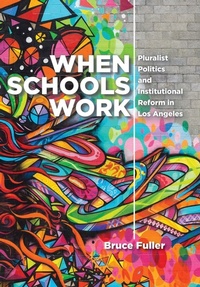
When Schools Work
Pluralist Politics and Institutional Reform in Los Angeles
Published on 26. April 2022
Book
Hardback
232 pages
978-1-4214-4277-8 (ISBN)
Description
How did a young generation of activists come together in 1990s Los Angeles to shake up the education system, creating lasting institutional change and lifting children and families across southern California?
Critics claim that America's public schools remain feckless and hamstrung institutions, unable to improve even when nudged by accountability-minded politicians, market competition, or global pandemic. But if schools are so hopeless, then why did student learning climb in Los Angeles across the initial decades of the twenty-first century?
In When Schools Work, Bruce Fuller details the rise of civic activists in L.A. as they emerged from the ashes of urban riots and failed efforts to desegregate schools. Based on the author's fifteen years of field work in L.A., the book reveals how this network of Latino and Black leaders, civil rights lawyers, ethnic nonprofits, and pedagogical progressives coalesced in the 1990s, staking out a third political ground and gaining distance from corporate neoliberals and staid labor chiefs. Fuller shows how these young activists-whom he terms "new pluralists"-proceeded to better fund central-city schools, win quality teachers, widen access to college prep courses, decriminalize student discipline, and even create a panoply of new school forms, from magnet schools to dual-language campuses, site-run small high schools, and social-justice focused classrooms.
Moving beyond perennial hand-wringing over urban schools, this book offers empirical lessons on what reforms worked to lift achievement-and kids-across this vast and racially divided metropolis. More broadly, this study examines why these new pluralists emerged in this kaleidoscopic city and how they went about jolting an institution once given up for dead. Spotlighting the force of ethnic communities and humanist notions of children's growth, Fuller argues that diversifying forms of schooling also created unforeseen ways of stratifying both children and families. When Schools Work will inform the efforts of educators, activists, policy makers, and anyone else working to reshape public schools and achieve equitable results for all children.
Critics claim that America's public schools remain feckless and hamstrung institutions, unable to improve even when nudged by accountability-minded politicians, market competition, or global pandemic. But if schools are so hopeless, then why did student learning climb in Los Angeles across the initial decades of the twenty-first century?
In When Schools Work, Bruce Fuller details the rise of civic activists in L.A. as they emerged from the ashes of urban riots and failed efforts to desegregate schools. Based on the author's fifteen years of field work in L.A., the book reveals how this network of Latino and Black leaders, civil rights lawyers, ethnic nonprofits, and pedagogical progressives coalesced in the 1990s, staking out a third political ground and gaining distance from corporate neoliberals and staid labor chiefs. Fuller shows how these young activists-whom he terms "new pluralists"-proceeded to better fund central-city schools, win quality teachers, widen access to college prep courses, decriminalize student discipline, and even create a panoply of new school forms, from magnet schools to dual-language campuses, site-run small high schools, and social-justice focused classrooms.
Moving beyond perennial hand-wringing over urban schools, this book offers empirical lessons on what reforms worked to lift achievement-and kids-across this vast and racially divided metropolis. More broadly, this study examines why these new pluralists emerged in this kaleidoscopic city and how they went about jolting an institution once given up for dead. Spotlighting the force of ethnic communities and humanist notions of children's growth, Fuller argues that diversifying forms of schooling also created unforeseen ways of stratifying both children and families. When Schools Work will inform the efforts of educators, activists, policy makers, and anyone else working to reshape public schools and achieve equitable results for all children.
Reviews / Votes
When Schools Work is not a dry tome. It illumines the lives of several remarkable people who made the changes happen-The Washington Post
More details
Language
English
Place of publication
Baltimore, MD
United States
Target group
Professional and scholarly
Product notice
sewn/stitched
Cloth over boards
With dust jacket
Illustrations
11 s/w Abbildungen, 16 s/w Abbildungen
16 Illustrations, black and white; 11 Illustrations, black and white
Dimensions
Height: 232 mm
Width: 152 mm
Thickness: 26 mm
Weight
454 gr
ISBN-13
978-1-4214-4277-8 (9781421442778)
DOI
10.1353/book.100178
Copyright in bibliographic data and cover images is held by Nielsen Book Services Limited or by the publishers or by their respective licensors: all rights reserved.
Schweitzer Classification
Other editions
Additional editions
E-Book
04/2022
Johns Hopkins University Press
€38.99
Available for download
Person
Bruce Fuller is a professor of education and public policy at the University of California, Berkeley. He is the author of Standardized Childhood: The Political and Cultural Struggle over Early Education and Organizing Locally: How the New Decentralists Improve Education, Health Care, and Trade.
Content
Notes on the Vernacular
Prologue. Pluralist Politics Move Institutions
1. Civilizing Los Angeles
with Melissa Ancheta and Sarah Manchanda
2. Palace Revolt
3. Outside Agitators
with Malena Arcidiacono, Caitlin Kearns, and Joon Ho Lee
4. Organizing Pluralist Politics
with Sarah Manchanda
5. Pluralist Politics and Institutional Reform
Acknowledgments
Notes
References
Index
Prologue. Pluralist Politics Move Institutions
1. Civilizing Los Angeles
with Melissa Ancheta and Sarah Manchanda
2. Palace Revolt
3. Outside Agitators
with Malena Arcidiacono, Caitlin Kearns, and Joon Ho Lee
4. Organizing Pluralist Politics
with Sarah Manchanda
5. Pluralist Politics and Institutional Reform
Acknowledgments
Notes
References
Index